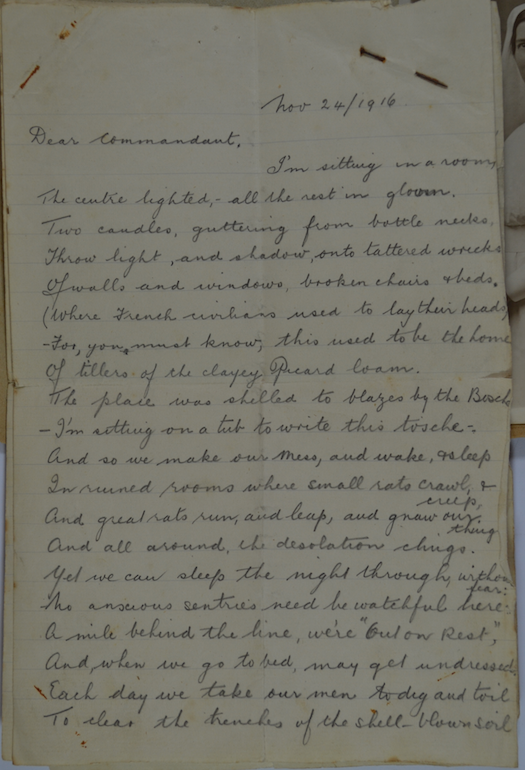
Amongst the archive material from one of our local VAD hospitals, Cornwall Hall, is a carefully preserved three page letter, written entirely in verse and signed Eric F Wilkinson. Wilkinson is also the subject of a newspaper article on the following page of the scrapbook.
He was Captain Eric Fitzwalter Wilkinson who served with A Company of 8th Battalion West Yorkshire Regiment (Leeds Rifles). Wilkinson was born in 1891 and was educated at Dorchester and then Ilkley Grammar School. He took an engineering course at Leeds University and later became a Master at Ilkley Grammar School. Before the war he wrote poetry for the school magazine and he continued to write during his time in the army, which he joined in 1915. Some of his poetry was published and well received during the war.
While serving as a Lieutenant with the Leeds Rifles, he won the Military Cross in July 1915, according to the citation, ‘Near St Julien, he assisted to carry a wounded soldier for a distance of 120 yards into cover under circumstances of great difficulty and danger’; he was also twice mentioned in despatches.
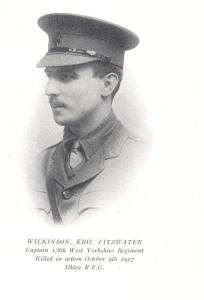 Captain Eric F Wilkinson MC
He was wounded in winter 1915, by a bayonet attack and was also later gassed. He was injured in July 1916 and appears to have spent some time in hospital at Chatham before arriving at Cornwall Hall, VAD 76, in Sevenoaks. Later that year, Wilkinson wrote his letter on 24 November 1916, to Kathleen Mansfield, the Commandant at Cornwall Hall, whom I mentioned, along with nursing Sister, Emma Crump, in an earlier post.
Dear Commandant
I’m sitting in a room,
The candle lighted, – all the rest in gloom.
Two candles, guttering from bottle necks,
Throw light, and shadow, onto tattered wrecks
Of walls and windows, broken chairs and beds,
(Where French civilians used to lay their heads)
– For you, must know, this used to be the home,
Of tillers of the clayey Picard loam.
The place was shelled to blazes by the Bosch,
– I’m sitting on a tub to write this tosche-.
And so we make our mess, and wake, and sleep
In ruined rooms where small rats crawl and creep
And great rats run, and leap, and gnaw anything
And all around, the desolation clings.
Yet we can sleep the night through, without fear:
No conscious sentries need be watchful here:
A mile behind the line, we’re ‘Out on Rest”,
And, when we go to bed, may get undressed,
Each day we take our men to dig and toil
To clear the trenches of the shell-blown soil
That now is heavy mud: each night, again
Return to billets, that keep out the rain,
To sleep; or, if our work is done at night,
– It sometimes is, – Sleep through the hours of light
Our own guns all around us roar and bay,
And Bosche shells, meant for them, come round our way
But, for six days, the front line, and its cares,
Night-watches, bullets, mortars, bombs and flares,
Are off our minds, and we can sit and write
To those we’ve often thought of in the night;
Or in that long slow hour, when laggard dawn
Peers through a drenching mist on fields forlorn,
Full often, in those hours, a vision seemed
To float before my eyes, or else I dreamed:
I saw the little hospital, and those, –
The memory of whose kindness only grows
With lapse of time; and oftentimes I swore
To write and tell the gratitude I bore.
So, Commandant, before I go to bed,
I call down blessings on your kindly head,
Please give the doc my love, and matron too,
And Sister Crump, and Flo, and all I knew.
And when the work seems hard, and old Fort Pitt,
Sends bounders round, whose manners aren’t a bit,
What colonels manners should be, far from it,
Just say ‘Our Patients’ gratitude is ours, –
‘What care we or the manners of the Powers
‘That Be’, and carry on the same old way.
So when I get a ‘blighty’ some great day
I can return to Seven Oaks and be
Once more a lucky patient in ward III
Believe me to remain, – till time is done
Yours gratefully – Eric F Wilkinson.
 First page of Wilkinson’s letter to Kathleen Mansfield
The author of the newspaper article also in the Cornwall Hall archive, identifies themselves as Wilkinson’s uncle and is inspired to write by overhearing a chance remark suggesting that every soldier at the Front would gladly lose a limb, so as to return home with a ‘Blighty’. The author feels moved to detail the true nature of men like his nephew who had, by this time, been killed at Passchendaele in 1917, as an answer to this slur:
He was my sister’s son. When war broke out, he was a master in a Wharfedale grammar-school but a Boy all the same, though twenty-three years old. By virtue of peacetime-training with the O.T.C. he got an immediate commission in the West Yorkshire Regiment (Leeds Rifles) and went to France early in 1915. All through the winter of 1915-16 he was in the nameable trenches in front of Ypres, nothing more serious befalling him than a bayonet wound and a partial asphyxiation by poison-gas.
His part in the great battle of July 1 1916 was the abortive attack on the stronghold of Thiepval. ‘During the night’ he wrote to me ‘I went up to support some men of another division in a trench we had taken and found it had been recaptured. I went in with twelve men and said ‘Hullo!’ to the first person I met, who promptly lobbed a bomb at me. Greatly scandalised, I said ‘English, you thundering fool!’ whereas he and divers unruly other companions did pelt us with bombs. Five of us got away, three wounded’. The horrid wound that fell to his share brought him back to Blighty. Writing from a hospital at Chatham he said ‘So far, we have abstracted one piece of bomb-casing and half a tunic but we suspect the presence of a pair of trousers as I came back the night it happened practically without, and they seem to have gone somewhere’.
Convalescent, he went to Cornwall Hall, in Kent. … it abides in the minds of many men and many mothers of men on a high place and in a strong light of grateful memory. The Boy paid his tribute in a nurse’s album
A little hospital in Kent
As, in a vision I shall see
Where lucky men are sometimes sent,
And kind eyes smile encouragement,
Ad once they smiled on me
And proud and strong my heart shall be
That I am fit to strike a blow
To keep our English women free –
Like those who did so much for me
A little while ago.
Last summer (1917) he was gassed:
‘The Bosche have been trying a new gas on us and I don’t think much of it’. But he was blind for three days and his sight permanently modified.
On Oct 9 last, leading the first wave of attack on some part of the Paschendale Ridge, he fell. His attitude toward death was summed up in some lines he had written:
Mourn not for me too sadly; I have been
For months of an exalted life, a King,
Peer for these months of those whose graves grow green
Where’re the borders of our empire fling
Their mighty arms. And if the crown is death,
Death while I’m fighting for my home and King,
Thank God! The son who drew from you his breath
To death could bring
A not entirely worthless sacrifice,
Because of those brief months when life meant more
Than selfish pleasures. Grudge not then the price
But say, ‘Our country in the storm of war
Has found him fit to fight and die for her.’
And lift your heads in pride for evermore.
but when the leaves the evening breezes stir
Close not the door.
But listen to the wind that hurries by,
To all the Song of Life for tones you knew;
For in the voice of birds, the scent of flowers,
The evening silence and the falling dew,
Through every throbbing pulse of Nature’s powers
I’ll speak to you
And again:
The mother who sent him bowed her head
And wept for the lad she bore;
Yet never she grudged her sacred dead,
For her country’s need was sore
‘He died for his King and the Right,
She said,
‘And no man could do more’
Mutiny at Etaples
I had thought that would be the end of this particular story. However, in researching Captain Wilkinson’s war service, I discovered his participation in one of the war’s significant events, the mutiny at Etaples. Etaples was a training camp for veterans of the frontline, providing refresher training. Criticism was often made of the harsh regime at the infamous ‘Bullring’ and of the staff and officers and their alleged lack of experience at the Front.
During the disturbances at Etaples, Corporal Jesse Robert Short of 24th Battalion Northumberland Fusiliers, was accused of inciting men to lay down their arms and attack one of their officers; this was Eric Wilkinson. According the records of his court martial, on 11th September 1917, Short said ‘That Buggar ought to have a rope tied around his neck with a stone on it and be chucked into the river’. Short had spent two years at the Front, been wounded and later sent to Etaples. He did not challenge Wilkinson’s account of the incident, which was confirmed by his second in command. Wilkinson’s evidence stated:
On the afternoon of the 11th instant, I was in charge of a Picquet of 150 armed and 50 unarmed men on the Bridge over the River Canche leading from Etaples to Paris- Plage. At about 9.15 pm about 80 men marched towards the Bridge from Etaples, some of them armed with sticks and notice boards. The Picquet failed to stop these men from crossing the Bridge. The accused detached himself from this party and while I was addressing my Picquet and remonstrating with them for failing to stand-fast. The accused started haranguing them. Referring to me he said “you want to put a rope round that buggar’s neck tie a stone to it and throw him into the River”, and he told the men that they should not listen to me. Within a few minutes I was able to get the accused arrested.
 Wilkinson’s signed statement to the court martial
Jesse Short was tried and sentenced to death, which was confirmed by Sir Douglas Haig on 30th September, the execution being carried out on 4th October 1917.
Wilkinson’s war record and his poetry shows how far he was from being the caricature of an officer seeking an easy life well behind the lines or an unrelenting disciplinarian and it would be interesting to know what he thought of the incident. He died only four days after Corporal Short’s execution, on 9th October, suggesting that he had been swiftly moved on from Etaples. According to reports ‘Amid the sea of mud he became separated from his men and was last seen making single-handed for the enemy lines’. He is buried at the Tyne Cot cemetery.
I’ll be making a trip to the National Archives to see if Wilkinson’s service papers offer any more information about his army career, including the incident at Etaples and the aftermath. If any readers know anything I’d be very pleased to hear from you.

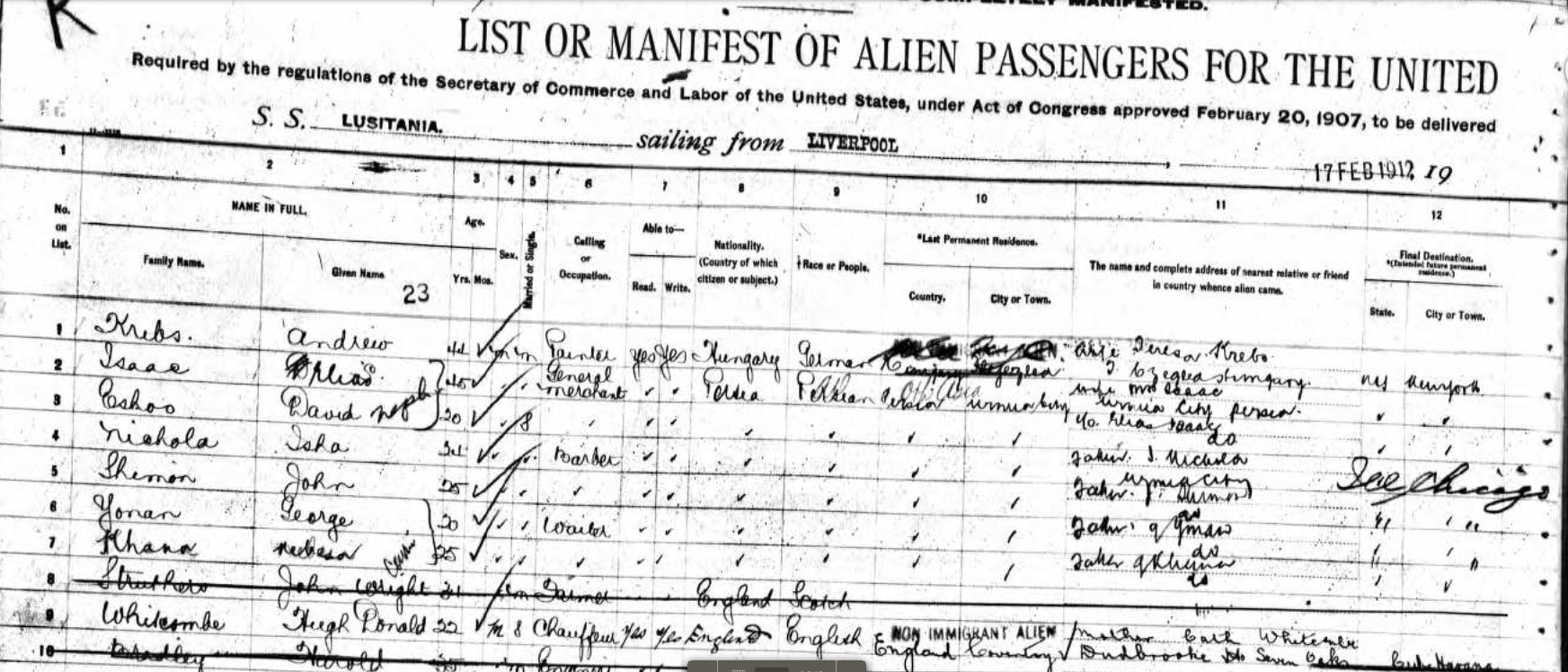 Hugh Whitcombe, listed onboard the Lusitania in 1912
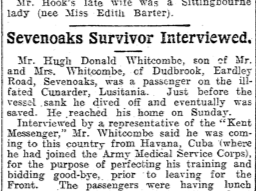 How the Kent Messenger reported Hugh’s story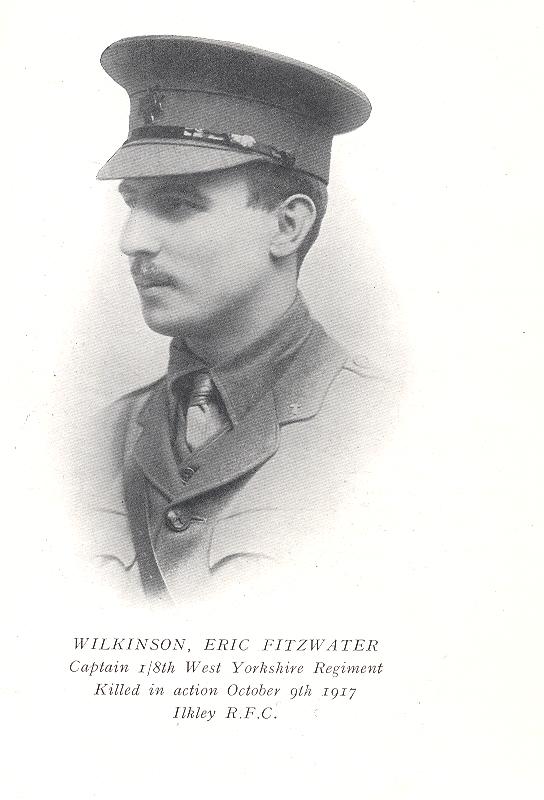


 Sevenoaks WW1