Letters home – ‘The Full Story of the Arethusa by a Sevenoaks Jack Tar’

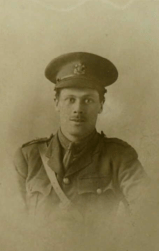
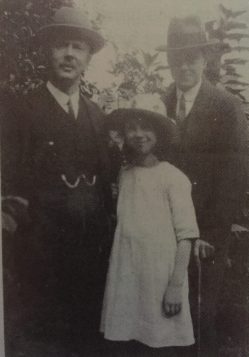
In the early weeks of the war, a number of men from Sevenoaks who were by then in training or already on active service, wrote to the Sevenoaks Chronicle with tales of their exploits. One of the first to do so was Thomas Porter. Thomas was born in Sevenoaks in 1891, the son of Thomas Porter and his wife, Ellen. The 1911 census showed Thomas as aged twenty four, living at 13, Redman Place, High Street, Sevenoaks, with his parents and four of his siblings.

Thomas’s letters are accounts of his time as a Stoker on the Arethusa during the Battle of Heligoland Bight, the first naval battle of the war, which was fought on the 28th August 1914.

Thomas had joined the Royal Navy on 6th August 1909, for the usual period of twelve years. At the time of his joining up he was working as a plumber and his papers show that he was nearly 5’4 tall, with a fresh complexion, brown eyes and hair. Thomas served on a number of ships before joining the Arethusa. From 1909 he was part of the crew of nine ships including the Pembroke, Agamenon, and Blenheim. He was promoted Acting Stoker while still with the Arethusa in January 1915 but left the ship that March and continued to serve with the Navy until October 1919 when, as Leading Stoker, he was invalided out of the service with his character having been ‘Very Good’ throughout.
image

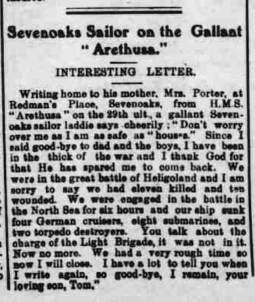
Thomas’s first letter in the Sevenoaks Chronicle

Thomas wrote two letters that were published, the first to his mother, the second to the Sevenoaks Chronicle. He tries to strike a reassuring tone in the letter to his mother

Don’t worry over me as I am as safe as ‘houses’. Since I said goodbye to Dad and the boys, I have been in the thick of the war and thank God for that. He has spared me to come back. We were in the great battle of Heligoland and I am sorry to say we have eleven killed and two wounded. We were engaged in the battle for six hours and our ship sunk four German cruisers, eight submarines and two torpedo destroyers. You talk about the charge of the Light Brigade, it was not in it. Now no more. We had a very rough time so now I will close. I have a lot to tell you when I write again, so goodbye, I remain, your loving son, Tom.

The second letter was published the following week billed as the Full Story of the Arethusa by a Sevenoaks Jack Tar.

This is an account of the great battle of Heligoland. I am just writing as I was an eye witness. It was a sight I shall never forget. We had only been in commission a week. We left on the Thursday from Harwich to try and decoy the skulkers out into the North Sea.

My captain told us the night before we went into action that we were going to have a rub at them sometime next morning. We were steaming all night long without lights, which was a very dangerous job, as there were forty seven destroyers of the British and two 2nd class cruisers about – the Arethusa and HMS Fearless. Well, all went well until about 7 o’clock next morning, and then we were at it.

There was a black fog all around us, but we were not more than three miles off the big forts of Heligoland, and we could see the German destroyers coming to meet us. But we had no idea we were going to meet cruisers. We opened fire on them and of course they retaliated and we had not been in action more than 20 minutes when we sunk one of their destroyers. Yes! Our boats peppered it into them. Then all of a sudden we saw a big cruiser coming towards us, so of course we had to do our best. I had just come off watch, and the fog was still very black, and as I came on deck a terrible sight I saw. Dead and wounded all around me, and the shells of the Germans still bursting over our heads. But we had to stick it. I did my best. I gave a hand with the wounded but I could not see a stretcher, and so I picked up a piece of old canvas, carried two poor chaps to sick bay in it, and back I came.

We came out of action and we had not been out about half an hour when our skipper sighted another two cruisers of the enemy, so of course we had to face the music once more. And this time we all thought it was all up with us, as we were badly damaged. We had our gunners shot away from their guns like nine-pins, and others came up to take their places and then we had four guns out of action, but we had two or three to carry on with, as we meant to fight until the last. Then all of a sudden we sighted the cruisers and battle cruisers of our own Fleet coming to our assistance. It was a Godsend, because we were hit badly below the waterline. We could only steam 20 knots then, as our engines had nearly been put out of action, and afterwards we had to be towed home to Bonny England by the cruiser Hague, and when we got to Sheerness we did get a “chuck-up” by the lads on the battleships.

Mr Churchill came aboard and had a look over our ship to see the damage and to look at our poor lads who had fallen in the battle. After all we went through, it was a marvel to come out of it all. And last of all I must tell you that our captain told us that we had all done our duty and the next time we went in action he hoped we would put our trust in him as we had put our trust in us. We are going to have another out later on to see if we can make some more of them come out and go under.

Apart from a brief reference to Thomas when his brother George was mentioned in the Sevenoaks Chronicle, I haven’t yet been able to find further reference to him, either during the war or after. On 21st September 1917, in its regular ‘Our Boys’ column, George Porter was mentioned as a Sapper in the Royal Engineers home on leave from his current base at Canterbury. According to the brief article, George’s brother Ernest was serving with the Kent Cyclists while Tom was noted as being ‘for some time on board the Arethusa when she did saucy things in the North Sea’.

This short but detailed piece was the first account of any Sevenoaks man who had experienced combat to be published and read by local people.

All of the Porter brothers appear to have survived the war but there was one wartime casualty in the family with the death of their sister, Clarice May Cross nee Porter  (1892-1918). In its report of her burial, the Chronicle reported that Clarice had died of blood poisoning in hospital in Folkestone. Her obituary noted briefly that Clarice had worked in a munitions factory during the war ‘and there contracted the disease of which she died’. Clarice was buried in the cemetery at St Nicholas and left behind her husband, Clarence, and baby daughter, Clarice, who was just a few weeks old.

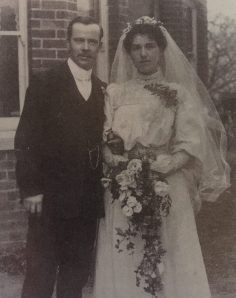
Another of Thomas’s sisters, Elsie Nellie (1886-1975) married Charlie Draper, the soldier whom I wrote about in my post Remember Me 

As ever, I would be very interested to hear from anyone with further information regarding this local family, at least four of whom served either abroad or on the home front.


Searching for the Sevenoaks airmen

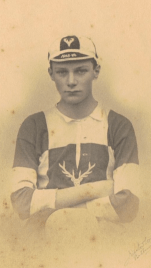
There are five men who served with the Royal Flying Corps named on the Sevenoaks war memorial: Bernard Vernon Gordon, George Walford, Nimrod King, Thomas Sillis and George Walford.

image

Tom Silliss

Bernard Gordon’s brother, Cedric Foskett Gordon went on to serve with the RFC as an observer after losing a leg whilst serving with the North Staffordshire regiment. We know a lot about the Gordon family as their archive, especially Cedric’s letters of that period survive. Just over a week before Bernard’s death, Cedric wrote to his younger brother who was then in training:

9 December, letter to 2nd Lieut BV Gordon at the Aerodrome, Cramlington.

How are you getting on?   I am glad you have got over your Preliminary part.   I hope you still like flying.   What sort of a pilot are you turning out to be?   How long will it probably be before you get your wings?   Life out here in the Winter is pretty dull.   I have only been up twice in the last 3 weeks & there is nothing to do.   They have just started quite a decent officers’ club here.   I am going there for dinner tonight.   We have been having dreadfully dud weather here.   Not much chance of it clearing up ‘till about April.   A Hun who was out on a night bombing raid lost his way & landed about 2 miles from here 3 nights ago.   He only broke his prop. so he did pretty well. There was a great soccer match this afternoon.   There is quite a lot of footer out here;  I wish I could play & the fellows who can play don’t want to!   We have got a very good aerodrome here.   The Hun prisoners have made a good job of it.   There have been one or two very good concert parties down this way lately & there is to be a boxing show on this week.   You ought to try boxing one day, it’s quite good fun & very good exercise.   Let me know if I can do anything for you.   Who have you got as your Sqdn Commander & Flight Commanders?   Nice people I hope.    There are a lot of blighters in the Corps.   Well, very best of luck.   Cheerho.

image

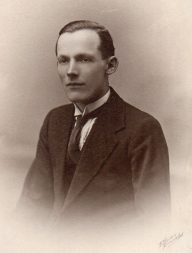
Bernard Vernon Gordon

Bernard was killed, aged 18, in an aircraft crash near Newcastle on 14 December, his 13th Solo sortie.

The exploits of other local RFC men were often reported in the Sevenoaks Chronicle but I am very keen to hear from anyone who might be able to shed more light on our airmen and their stories.

Ernest Horncastle was one such man. A son of Walter Horncastle, a tailor based in the High Street (a family business which still operates today), Ernest was born in Sevenoaks in 1890.  Aged twenty three and at 6’1  and in good health, he enlisted in August 1914 and soon received a temporary commission with the Royal Field Artillery, arriving in France that December. After a few months he was attached to the Royal Flying Corps Balloon Section. In August 1917 the Sevenoaks Chronicle reported that Ernest

…has seen some very stiff work and had some thrilling experiences.

By 1916, Ernest was suffering from shell shock and fever and spent a period of five weeks on leave at home. A Medical Board report concluded that his illness was due to active service and that he ‘is very neurotic and complaining of subjective symptoms’.

Ernest recovered well enough to return to service and continued until early 1918 when he was diagnosed with bronchitis and neurasthenia and was sent to hospital before returning home on leave to England. A Medical Board held in that March noted that his bronchitis had cleared but that he still suffered from muscular pains and other symptoms.

The medical officer’s opinion was that

He has done a good deal of active service. It is highly probable that his nerve for flying is failing or has done so. He is otherwise perfectly well.

In fact, by this time, Ernest had clocked up over 150 hours flying. The board concluded that Ernest should return to some duty, in order for his ‘mind to be distracted from himself’.

(he) leads an ordinary life of pleasure and enjoyment and takes plenty of exercise. He has greatly improved in every way since admission.

Ernest survived the war and lived until 1964.

Another Ernest, a brother of soldier Leonard Brooker who is remembered on the town war memorial, initially served with the Royal Engineers.

image

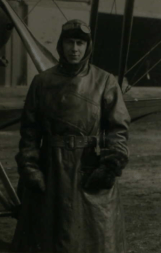
Ernest Brooker

The Sevenoaks Chronicle reported in September 1917 that Ernest

is engaged in wireless telegraphy work. He has been in France eighteen months and finds his work pleasurable.

A chemist before the war, Ernest joined the RFC and survived the war but was tragically killed in a motor accident in 1929.

Horace Owen was born in 1890, he son of local councillor, Richard and his wife, Laura.

Initially joining the Royal Naval Volunteer Reserve,  Horace later transferred to be the Flying Corps, where he served as a Temporary Lieutenant.

image

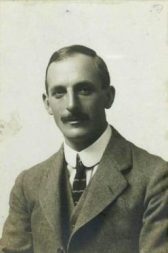
Horace William Owen

The Chronicle reported in early 1917 that Horace had only recently left Sevenoaks to commence his duties in France as a member of the RFC and went missing after his first flight. After weeks of uncertainty, a letter from Horace arrived home informing his parents that he was now a prisoner of war and had been shot down while flying. Horace had been captured on 28th March 1917 and was repatriated on 14th January 1919. He lived on until 1969.

image

Ivan Hart Davies

Ivan Hart Davies (1878-1917), had been  a schoolmaster at the Beacon School in Sevenoaks and counted Siegfried Sassoon amongst his pupils. Himself the son of a vicar, he also taught the sons of the Rector of St Nicholas and  the Rev. Thompson of St Mary, Kippington. Hart Davies had left the school by the time of his death, which was reported in The Times

Lieutenant Ivan Beauclerk Hart-Davies, RFC, who was killed in an aeroplane accident in England was the son of the late Rev John Hart-Davies of Southam Rectory, Warwickshire and was 39 years of age. He was educated at a school at Maidenhead and at King’s School, Canterbury, and began life as a schoolmaster at New Beacon, Sevenoaks. Afterwards, however, he worked up a wide life insurance and motor insurance business in the Midlands. He held the “end-to-end” “record” for motor cycles and light cars, and in 1913, with three other motorcyclists, won the Murren Cup, though none of the four had done any bobsleighing before. He took to flying before the war as an amateur, but last year he obtained a commission in the RFC and was on the eve of going to the front. A brother officer writes ‘A gallant fellow who we all liked immensely, and are deeply grieved that he should have been fatally injured when he so much wished to go to France, where doubtless he would have won honours’.

image

Harry Watson Durtnell

Harry Watson Durtnell was a scion of the Durtnell family of Brasted, builders since the reign of Elizabeth I. Harry was a cousin of Richard Neville Durtnell who was killed in action in 1917. Initially serving with the Welch regiment, Harry later transferred to serve with the RFC. He survived the war, living until 1971.

image

Frederick Whyntie

Fred Whyntie was the brother of Jack Whyntie, whom I recently wrote about. Like his brother, Fred survived the war but died in 1937 aged 48. His grandson, Adrian Whyntie, told me that the family believed his health had suffered by his job of ‘applying aircraft dope to the fabric. This damaged his lungs badly, which resulted in his early death’.

Many other local men served with the RFC at all levels in the new service. John Potter  had worked with his father for five years in the Blacksmiths Forge at Knole and had joined the army in November 1916 aged 19. Putting his training to good use,  the Sevenoaks Chronicle reported that he had been selected for ‘flying machines repair work’ and was employed in the Royal Naval Flying Corps workshops.

Little is known about Howard Reeder Daws (1898-1969) beyond this excellent photo of him and I’d be very pleased to hear from relatives of any of these men and those listed below whose service is mentioned only briefly in local papers.

image

Howard Reeder Daws

Sevenoaks airmen mentioned in the Chronicle
Capt Nevill Hudson
Lieut Halliday
Lieut A Sargent

Air Mechanic Charlie Bassett
Air Mechanic George Dawson
Air Mechanic A Diamond
Air Mechanic Anthony Holmden
Air Mechanic Charlie Martin
Air Mechanic Arthur Terrry
Air Mechanic Frank Thorogood
First Class Air Mechanic B Frank Townsend
Second Air Mechanic Gordon A Waters

Private S Brazier
George Dawson
Private Harrington
Lionel Hicks
Private W Hoadley
Private Charlie Martin
Corporal R Morris
Private Rich
T E Weller

Air Mechanic (First Class) E C House, RNAS
Bernard Sears RNAS
Arthur Smithurst RNAS
F W Weller, RNAS


Mollie’s story, ‘My father was a conscientious objector’

When I wrote about conscientious objectors in Sevenoaks earlier this year, I tried to convey a sense of how the men who objected and their families were viewed and treated in the town but any personal testimony was difficult to find. In the last week, I have been extremely lucky to find exactly what I was looking for in a book of reminiscences from Somerset.

Mollie Wren was born Ivy Florence Tester in 1912 in Sevenoaks to George Tester (1883-1962) and Emma nee Banfield (18881-1960). Known as Mollie, she married Philip Wren and later in life moved to Somerset. In the early 1990’s, Mollie, along with several other elderly women living in the Winsham area, talked about her childhood memories in an initiative run by the South Somerset Reminiscence Project, the results of which were published, with several of Mollie’s family photos included. Mollie died in 1996 and the couple do not appear to have had any children. Fortunately, her memories are clear and evocative of the challenges her family faced as a result of her father’s stance, as the family were abused, ignored and faced financial hardship.

image

George Tester and Emma Banfield on their wedding day

The 1911 census shows Mollie’s parents, George and Emma, living at 13, St Botolph’s Road with their son, George Albert (1906-1994) with George recorded as a builder. The family were active members of the Vine Baptist Church. By 1916 the family had moved to Cedar Villa, Cedar Terrace and, that June, George was mentioned in the Sevenoaks Chronicle in its report on the proceedings of the  local Military Tribunal. The paper noted that George

wanted to save life rather than take it, but did not object to non-combatant service, to which he was referred.

George’s military records show that he was thirty three and a half, five feet tall, and working as a painter when he subsequently  enrolled with the Non Combatant Corps in July 1916. That December, George was working at Newhaven when he was charged with disobeying a lawful command given to him by an officer while on active service. He was tried by court martial and sentenced to be detained at Wormwood Scrubs.

image

The family at Seaford Cliffs

Mollie recalled this these events in a number of interviews that were edited and published in 1995.

Father said no, he wasn’t going to fight. He just simply believed Thou Shalt Not Kill. He was sent with a lot of others to Seaford Cliffs to load food ships for the troops. He continued with that until they wanted him to load firearms. They all refused. So then we was sent to Lewes gaol and court-martialled. He was tried by Lord Salisbury, who was sympathetic to conscientious objectors. Even so, he sent my father to Wandsworth prison for a year in solitary confinement, and then to Dartmoor Prison for two years and seven months.

image

George (third right) in the workshop at Wormwood Scrubs

As a family, we were ostracised. I remember walking hand in hand with mother along St John’s Road. Two men, up ladders, shouted something abusive at my mother. She gripped my hand tightly and hurried me away. Father had said mother must continue to go to the Baptist church, although no-one spoke to her. I remember walking up the aisle to our pew, which was halfway up the church. My mother held my hand tightly.

A couple of teachers at Sevenoaks Council School were horrible to me because my dad had been a conscientious objector. They felt very strongly.

As my father was a conscientious objector, my mother had no government pay, and in the end she was virtually penniless. One night she knelt at the armchair by the cold grate in the kitchen, and prayed to God to help her. Even as she prayed the front door rattled, and she heard something put through the letterbox. She went through the passage and there was an envelope on the mat. No letter in it, but a five pound note, which in those days was a great deal of money. Mother never forgot this, and she always used to quote me afterwards: The barrel of meal shall not waste, neither shall the cruse of oil fail. And it never did. Finally, kind people came to their senses and brought Mother sewing. She was extremely able. People would bring their sewing on the quiet to start with, but at least it came.

Lord Mons (actually Robert Mond of Combe Bank), who lived at Sundridge Place, gave Home Farm over as a convalescent home for wounded officers and their batmen. Mother became the sewing woman here. Her eldest sister, Fanny, became cook-housekeeper, and my uncle became head cowman.

There was no shortage of food there, despite the war. My aunt was a typical cook of that generation: a large lady in a blue-print dress and snow-white apron, with her lovely hair brushed back. I can see her now, standing at the kitchen table with enormous tin plates covered in pastry, and a gallipot of jam clasped to her bosom, ladling jam onto these plates. Then they were cut in six for the wounded soldiers. They loved her pastry.

Not only was  I spoiled by my aunt, but by the soldiers, I walked out with them in the country lanes and into Sundridge village, where they bought me sweets. A lot of them were married and had children of their own.

There was a great bronze gong hanging on a stand and a stick with a leather ball at the top, I loved sloshing this gong. The soldiers tried to teach me how to work up a real crescendo, but I was too little. I just loved banging it! On Sundays we went to Chevening church in a horse brake, which had seats on either side. There was I, in the middle of all these soldiers, going off to church!

There was one ward for the batmen, and the officers were in another. I remember the long rows of beds and red blankets. One particular officer was very fond of me, and when he was he dying asked to see me. Mother carried me upstairs and told me to be good. We went in with the Matron. I remember being sat on the bed. He held my hand, and his hand was very hot. I remember that clearly but no more. 

image

Mollie and her ‘particular officer’ at Combe Bank

In 1916, my mother took in a lodger, a Miss Bunting. This lady was a brilliant dressmaker. She’d been very adventurous and gone off to Russia and become one of the Tsarina’s court dressmakers. When the Revolution was boiling up, she fled home quickly. One night she tapped at the bedroom door and said, ‘Mrs Tester, you must come quickly! You must see this!’. My mother picked me up out of the cot, wrapped a shawl round me and carried me into her bedroom, which had a wonderful view over the North Downs. And there was this airship going along, a German airship. It had caught fire: it was blazing as it went along. I remember my mother murmuring over my head, ‘Poor souls, poor souls!’.

Father wasn’t released from Dartmoor until 1919. I was seven. Mother couldn’t go to the station to meet him after that separation, so my brother and I went. I remember running round the garden picking a bunch of flowers. It was perfectly ridiculous: I was going to meet this unknown ‘Dad’. I remember getting to the station, and a cloud of steam; and out of it came this man whom my brother rushed to, because he remembered him. Then I remember being crushed, flowers and all, against this man. When we got to the garden gate, Mother, who had been standing watching in the sitting-room window, came to the front door. Father went in, and I was going to prance in after, but my brother hung on to the back of my frock and took me round the garden. He was more sensitive that for just a little while they wanted to be alone.

image

George senior, George and Mollie after the war

George Tester lived on until 1962, surviving his wife, Emma, by two years. His own mother, Martha Tester nee Letchford (1845-1946) lived to see her 101st birthday. Interestingly, she had been born at Chatham Barracks where her own father, Frederick Letchford (1806-1887) was Colour Sergeant with (according to the Sevenoaks Chronicle) ‘the old 50th regiment, known as the Blind Half Hundred’. He had been born in Sevenoaks in the house which eventually became a pub, The Halfway House, and at one point, home to Charlie Draper the subject of a recent post.

Mollie and Philip do not appear to have had children but I would be very interested to hear from anyone who remembers her or any family members who may be able to share more of her and her father’s story. Thanks to Mollie and the oral history team in Somerset, we have this insight into the life of a conscientious objector and his family in Sevenoaks during the war.