Cedric Gordon, An Undaunted Hero

Of the five Gordon brothers who fought in the First World War, two are remembered on the Sevenoaks War memorial. Donald Jervis Gordon was the first to be killed, dying on the third day of the battle of the Somme in 1916. Donald was a Lieutenant in the Border Regiment.

Captain Donald Jervis GordonDonald Jervis Gordon

His younger brother, Bernard Vernon, was killed later that year in December 1916, in a flying accident in Northumberland whilst serving with the Royal Flying Corps.

Second Lieutenant Bernard Vernon GordonBernard Vernon Gordon

The remaining brothers who fought were Thomas Milford – a Second Lieutenant in the Royal Engineers, Edward Basil and Cedric Foskett Gordon. During the course of my research for the book, a family friend of Cedric, David Lambourne, contacted me with information about him, including Cedric’s obituary and recently one of Cedric’s nephews, Martin Gordon, wrote to me from Australia, having been pleased to find the photograph of his uncle that David had sent me and which is now displayed on my ancestry page for Sevenoaks as well as in the War Memorial Gallery on this site.

Cedric lived to the ripe old age of  89, dying in Sevenoaks in 1979. Like his brothers Donald and Edward he was educated at Lancing College, were he excelled in sports. In 1910, he was commissioned into the North Staffordshire Regiment. He was sent to France on the outbreak of war and was wounded twice. In 1915 he was awarded the Military Cross for leading an attack on a village.

imageCedric Gordon (on right)

His second injury was the most serious and resulted in his losing a leg. You might be forgiven for thinking that this would be the end of his war service but Cedric joined the Royal Flying Corps and continued his wartime service as an observer and air gunner on the Western Front. He was subsequently awarded the Croix de Guerre in 1917, was mentioned in dispatches four times and awarded the military class of the OBE in 1919.

According to another nephew,  quoted in his obituary, Cedric was shot at during one flight with the bullet shattering his wooden leg. On landing, he was said to have found the stray bullet in his pocket and was confined to bed until the camp carpenter had made him a new leg.

imageCedric, on left, having lost his right leg

After the war, and having gained his pilot’s licence despite his wooden leg, Cedric was sent to Russia with British forces to aid the White Russians in the Crimea in their fight against the Bolsheviks. He was awarded the Distinguished Flying Cross and received the Order of St Ann and the Order of St Stanislas from the Russians. After leaving Russia, he flew in Palestine, where during one flight for reconnaissance work, he was forced to land in the desert and was, according to his obituary ‘picked up by a band of friendly Arabs’.

Cedric later worked for British intelligence in mainland China, before returning to England and taking command of the RAF Bloom Centre. During the Second World War, he was eventually put in charge of the South East Air Training Corps and was also a member of the Home Guard.

On his retirement, he returned to Lancing College, where his brother Edward was a Master, to become Bursar. Later in life he became well known in Sevenoaks for his involvement in the local scouting movement.

imageCedric Foskett Gordon

Cedric’s nephew, Martin Gordon, wrote to me with his memories of his uncle:

He lived in a big house with grounds in Sevenoaks. He had big vegetable gardens, a large pig, called Mr Pig, and even a little wood on a hill. He had a little MG which he used to drive my sister and I into town with – we stood up in the boot. He never married and lived with his sister Kathleen. She affectionately called him “Beast” and he had a similarly uncomplimentary name for her, which I can no longer remember. He was a wonderful man- we lived near London, but we drove over to visit about once a year when I was a child, and it was always one of my favourite days of the year.

To my shame, I never quizzed him about his life. All I can remember is that he was a pilot in World War I and he lost a leg. He still had the trench coat he was wearing when he was wounded, with a hole burned in it – he showed it to me. He said he also fought in Russia after the war for the RAF. One of the things he told me was that when he was in Russia, he was shot down and had to walk through the snow back to base. I have recently been able to check the facts, and this is what actually happened:

On 23 December 1919 the plane he was in was hit and they had to make a forced landing behind enemy lines. He and the pilot burned the plane and set off walking through the winter snow. You can imagine how cold it was, Christmas time in Russia! And they didn’t get back to base until the next day. I can’t imagine how he did that with one leg.

Martin Gordon is investigating his uncle’s service in Russia and I am continuing to research the service of all of the brothers who fought during the war and who gave so much to their country.
The Warde Family at War

Last year I was very pleased to have been asked to join the summer Celebration at Squerryes .

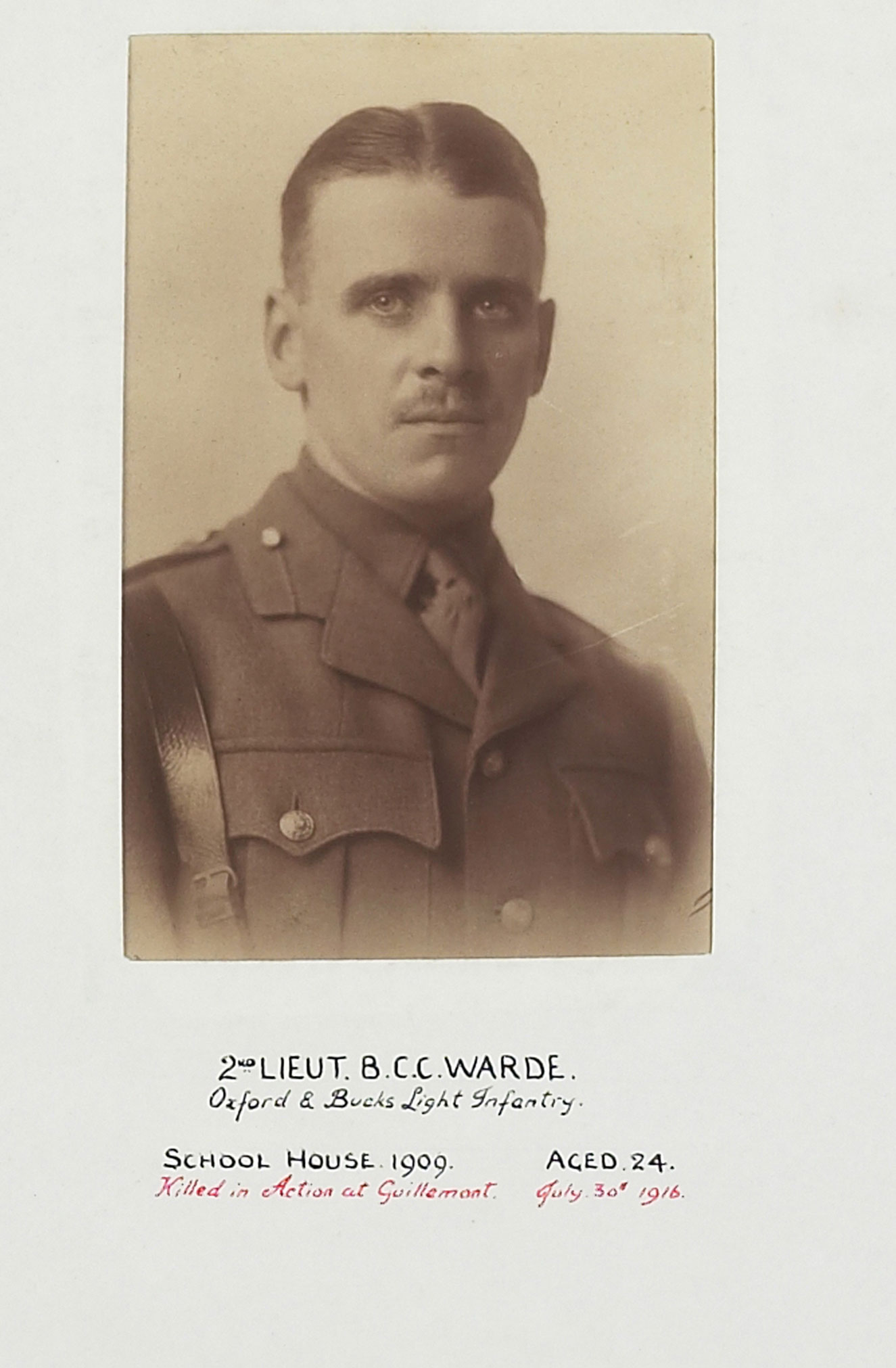
Current owner, Henry Warde, Is a cousin of Basil Charles Conroy Warde, who was killed during the war and is remembered on the Sevenoaks War Memorial. Basil was born in 1892 and had served in Canada with the Royal Canadian Mounted Police or ‘Mounties’ before returning home to England and serving with the Oxfordshire and Buckinghamshire Light Infantry.

A Family Memoir

I hadn’t been able to find out very much about Basil, beyond a photograph and a brief mention in the Sevenoaks Chronicle. However, looking again for more information in advance of this weekend, I found an article written by his Great Great Niece, which had been posted on a Canadian website dedicated to remembering members of the Royal Canadian Mounted Police. The article was published in November last year, after my book was published but I’m delighted that the author, Thomasina Godwin, has allowed me to reproduce it here:

As 2014 marks the 100th anniversary of the start of WWI, I thought it would be the best time to share some photos and information on my great-great uncle Reg.#4989, Basil Charles Conroy Warde.

Basil was born on February 28th, 1892 in Sevenoaks, Kent, England. He was the fifth of six children, and the youngest son. His family were relatives of the Warde’s of Squerryes Court and he received his education at Tonbridge School. Tonbridge is a boarding school for boys located in Tonbridge, Kent, England. It was founded in 1553.Basil and his older brother, Richard, had a thirst to explore other frontiers and work hard for a living. Richard travelled to South America, where for some time he was involved in cattle ranching. And Basil, as you can tell, came to Canada.

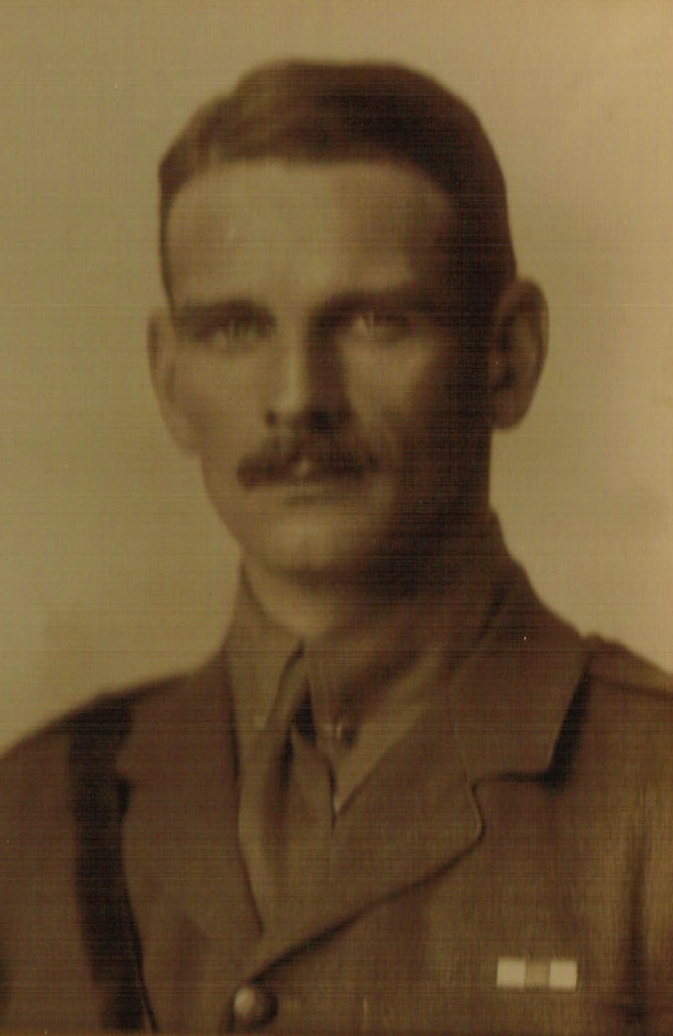
Filename.ashxSecond Lieutenant Basil C C Warde 1892 – 1916

Basil wasn’t the first in his family to travel to Canada. His great uncle, Major Henry John Warde, came to Canada with the Royal Regiment and he was killed in a duel on May 22, 1838 in Montreal, QC. Basil arrived in Saint John, New Brunswick on January 8th, 1910 aboard the Empress of Britain. He was not yet 18 years of age. The passenger list stated that Basil’s intended occupation in Canada was farming, yet a few days later, on January 14th he had engaged with the Royal North-West Mounted Police (RNWMP).

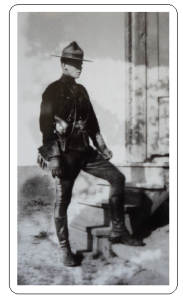
Not much is known about Basil’s experience with the RNWMP, as many of the service records from that period have been destroyed. Nevertheless, I have a photo of Basil in Gravelbourg, Saskatchewan (photo was dated 1910). At that time, Gravelbourg was a small, budding town with settlers arriving from across Canada, from the United States, and from many European countries.

4989Warde7.jpgBasil Warde in the uniform of the Royal North West Mounted Police
On October 25th, 1914, Basil arrived back in England as the country was engaged in World War I. He attended the wedding of his sister, Francesca; to Edward Norman Fortescue Hitchins on July 12th, 1915 (these are my great grandparents). My family has some photos of the wedding where Basil can be seen in his military uniform.

On February 28th, 1916 Basil entered France with the 2nd Battalion, Oxford and Bucks Light Infantry. At this point his Battalion were probably in Béthune or the Festubert trenches — it is hard to imagine what frightful conditions Basil would have encountered in the trenches upon his arrival.

Meanwhile, back home in England, my grandmother Enriquetta Mary Hitchins, was born. It was May 23, 1916. Basil would have received the news of Enriquetta’s birth shortly afterwards. On June 19th, 1916 Basil wrote a letter to his new little niece providing her with some insightful life advice. 

July 1st, 1916 saw the start of the Battle of the Somme. Basil’s Battalion was involved in operations around Delville Wood and Guillemont. Early in the morning of July 30th, the 2nd Oxford and Bucks Light Infantry and the 24th Royal Fusiliers, supported by 5 Brigade’s Machine Gun Company, attacked from Waterlot Farm towards Guillemont Station, but the attack was unsuccessful and the Units were forced to withdraw. There were heavy casualties that day and Basil was listed as missing and presumed dead. Eventually, his body was located. He now rests in Delville Wood Cemetery, France not far from where he fell.

Basil Warde was only 24 years of age when he died and it was a tough loss for a close-knit family. Some of his personal belongings have been passed down over the years and his memory has not been forgotten. In fact, my sister, a Constable with the RCMP, now holds his RNWMP belt and pin.

‘A Great Grief to All’

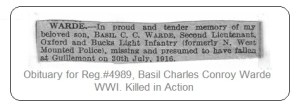
Further research has revealed that Basil became Assistant Riding Master and Roughrider with the Royal North West Mounted Police His superior officer wrote of him as the grittiest youngster he had ever known “No matter how many times a horse threw him he was never beaten.” On the outbreak of war he came home and enlisted in the 16th Lancers, but realising that he was less likely to get to France at an early date in the cavalry, he applied for an infantry commission and was gazetted to the Oxford and Bucks. Light Infantry, on June 26th, 1915. He went out the following winter, and was slightly wounded on the first day of the Somme but insisted on carrying on and remained with his Regiment.

On the night of July 30th he was leading his platoon in an attack on an enemy trench when he was seen to fall. He was for long reported missing, but it is now known that he was killed, shot through the head, that night. Letters received from the Regiment testify to his utter fearlessness and his value as an officer, and his CO., writing at the time said that his being “missing” was a ” really great grief to all” and that he “could ill be spared by the Regiment.”

4989WardeObit

From Nursing to Spying, the Warde Family at War

Basil’s niece wrote to me this week with more information on the war service of Basil’s brother and sister:

Richard Edward Warde, known as Dick (1884 – 1932) attended Tonbridge School with his brother and also served in WW1. I believe he served with the Scots Guards and was wounded in the Battle of Loos. During his convalescence he met and fell in love with Muriel Wilson, who Winston Churchill had once proposed to. They married in 1917. Dick has been described as “an uncomplicated extrovert, very much an outdoor man, with the look of a buccaneer”. There is a story that during the war he had the terrible duty of commanding a firing squad for the execution at the Tower of London, of a spy, who being a soldier, avoided hanging. It is said that Dick sat up all night drinking with the condemned man, until the German passed out and never knew that dawn had come.

DickWardeMajor Dick Warde

In fact, according to Tonbridge School, Dick Warde served with the 2nd Battalion, Scots Guards, in France from May to September 1915, and from September 1916, to January 1917. He was slightly wounded in the leg on September 25th, 1915, and was again wounded, this time more seriously in the arm, the following day near the Hohenzollern Redoubt. He was twice Mentioned in Despatches for services in France and was awarded the M.C. in 1916. Dick Warde was subsequently employed on intelligence work in 1918, with the acting rank of Major, which he kept on relinquishing his commission in 1920.

Basil and Dick had an older sister who also served during the war. Enriqueta Rosita Jenny Warde (1883 – 1966) was known as Diddy. Diddy trained as a nurse at Sevenoaks Hospital. During WW1 she joined Queen Alexandra’s Royal Nursing Service and was awarded the Royal Red Cross for bravery during a Zeppelin raid. In 1933 she was asked to open and run a private nursing home in Sevenoaks which proved a success. On the outbreak of war Carrick Grange was turned over to the army and for the next five years Diddy was back in uniform and was awarded another Royal Red Cross.

Another sister, Alice Enderica Warde (1896 – 1984) married Col. Bertram Ede, who became head of MI5 on Malta during the Second World War. The couple had two sons, one of whom, Charles Richard Ede, served with the Royal Tank Regiment during the war and went on to found The Folio Society. When he died in 2002, aged 80, his obituary  was carried in the Daily Telegraph.

My thanks to Thomasina Godwin and Superintendent J..J.  (Joe) Healy (Retired) for their help in the research for this post and kind permission to reproduce material originally posted elsewhere.

“It was a horrible time’ – A survivor of the Lusitania from Sevenoaks

I can often find a link between someone from Sevenoaks and one of the significant anniversaries of the First World War and the sinking of the RMS Lusitania on 7 May 1915 is no different. A local man, Hugh Donald Whitcombe, whose parents lived at Dudbrook on Eardley Road was on board the ship. Fortunately, Hugh survived that terrible event and lived to tell the tale, his story being recorded in both the Sevenoaks Chronicle and the Kent Messenger.

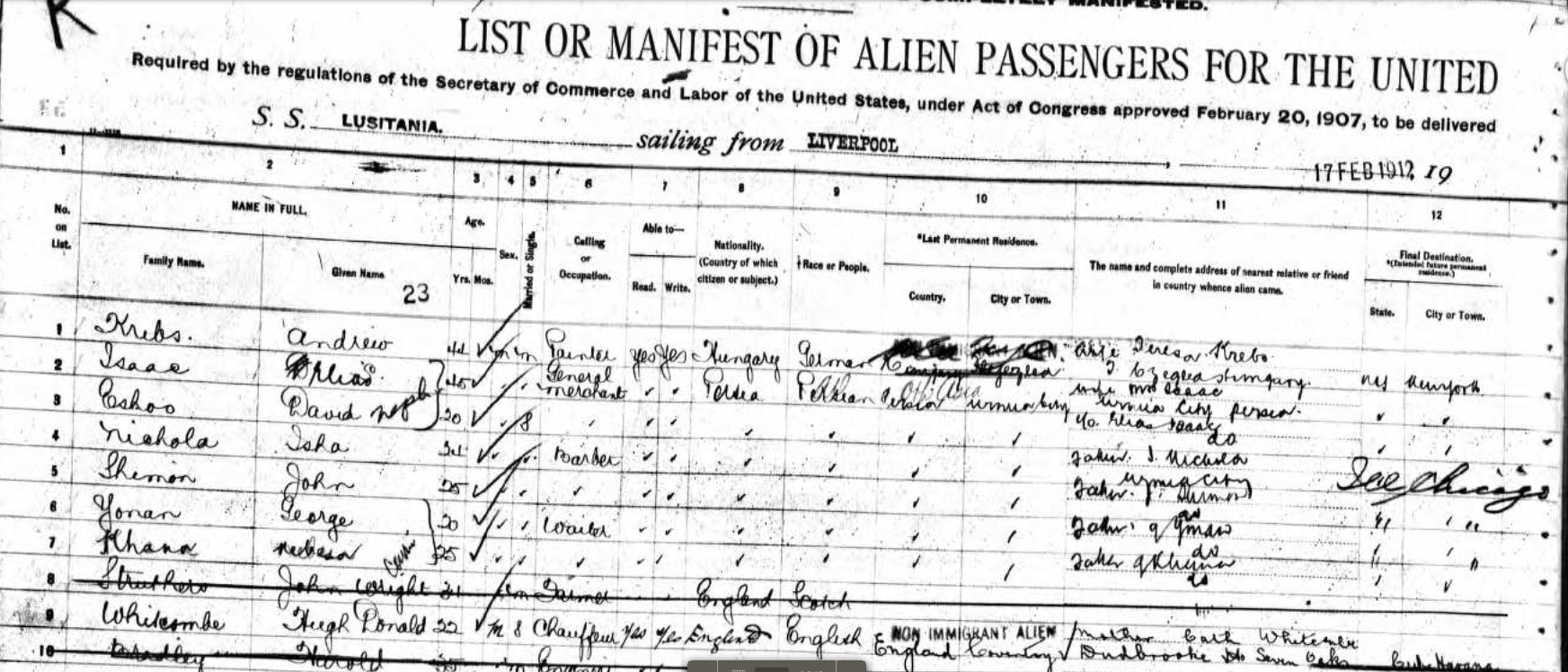
Hugh Martin Donald Gore Whitcombe, was born in 1894 in Suffolk, the son of John Walker Whitcombe and his wife, Katherine Louisa nee Linnall. By 1901, the family are living in Sevenoaks and the 1911 census records Hugh as an engineer at a motor car works in Coventry. He left for the USA and then Cuba in February 1912, sailing on the Lusitania where his occupation was recorded as chauffeur.

Screen Shot 2015-05-07 at 16.12.13Hugh Whitcombe, listed onboard the Lusitania in 1912

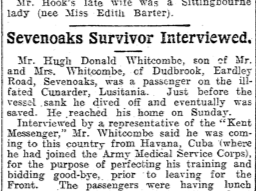
Three years later in 1915, Hugh was sailing from Havana, Cuba, where he had joined the Army Service Medical Corps. According to his interview with the Kent Messenger, the passengers were having lunch in the dining saloon about four flights below deck when he heard a big bang “and the plates and everything on the tables were upset, and fell into their laps”. He stated that everyone knew at once what had happened but took things calmly, the males keeping their seats, until the ladies and children were got up to the boat deck. “Some ladies fainted but the babies, not understanding what happened, remained happy”.

Screen Shot 2015-05-07 at 19.02.55How the Kent Messenger reported Hugh’s story

Hugh then made his way to the boat deck and helped get women and children into the boats. The ship had listed heavily to starboard the moment she was struck and the rescue rafts on the port side could not be used as the vessel had listed, bringing that side high out of the water. According to Hugh’s account, the sinking was so rapid that the other boats were only just away before the ship went down, while many boats “were struck by the funnels and were taken down by the boat itself”, with only twelve of the original nineteen boats getting away.

Hugh had stayed onboard with two of the ship’s engineers and some of the stewards, waiting until the last minute, when they were nearly waist deep in water. Very shortly before she sank, they dived off and he became entangled with some of the wireless telegraph gear, which dragged him underwater. He managed to struggle free and swam for fifteen minutes until he met a raft containing the two engineers he had been stood with and an elderly couple,

“The water was full of struggling men and women. We managed to drag onto our raft a lady whose hand and leg had been badly crushed, and a little later a lady who was holding a dead child. We then manoeuvred our raft to an upturned boat and clambered on to it and remained drifting about until we were picked up by a destroyer, It was a horrible time – terrible! The elderly gentleman became exhausted and died before we were picked up, and we had to take the dead child from its mother, as the poor woman was growing frantic”.

After three hours in the water, they were picked up by the first destroyer from Queenstown and taken to the town.

“It was”, Hugh told the press, “a terrible sight to see wives looking for their husbands, husbands for their wives and children for their parents”.

Hugh had been travelling with five pounds worth of tobacco and cigarettes, sent by Cuban planters for the Indian soldiers – all of this and his own possessions were lost. Arriving safely in Sevenoaks, he said that despite some stiffness and bruises and a cut from a wire across the leg, he was little the worse for his experience.

Hugh went on to serve with the Army Service Corps and later with the Royal Flying Corps, being awarded the Belgian Croix de Guerre. Sadly, he died of sunstroke on 23 July 1920, and was buried in the Mikra British Cemetery in Kalamria, Greece.