An officer and poet – Captain Eric Wilkinson in Sevenoaks

Amongst the archive material from one of our local VAD hospitals, Cornwall Hall, is a carefully preserved three page letter, written entirely in verse and signed Eric F Wilkinson. Wilkinson is also the subject of a newspaper article on the following page of the scrapbook.

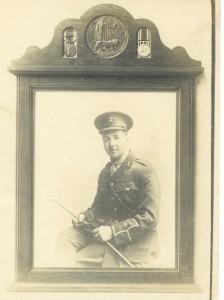
He was Captain Eric Fitzwalter Wilkinson who served with A Company of 8th Battalion West Yorkshire Regiment (Leeds Rifles). Wilkinson was born in 1891 and was educated at Dorchester and then Ilkley Grammar School. He took an engineering course at Leeds University and later became a Master at Ilkley Grammar School. Before the war he wrote poetry for the school magazine and he continued to write during his time in the army, which he joined in 1915. Some of his poetry was published and well received during the war.

While serving as a Lieutenant with the Leeds Rifles, he won the Military Cross in July 1915, according to the citation, ‘Near St Julien, he assisted to carry a wounded soldier for a distance of 120 yards into cover under circumstances of great difficulty and danger’; he was also twice mentioned in despatches.
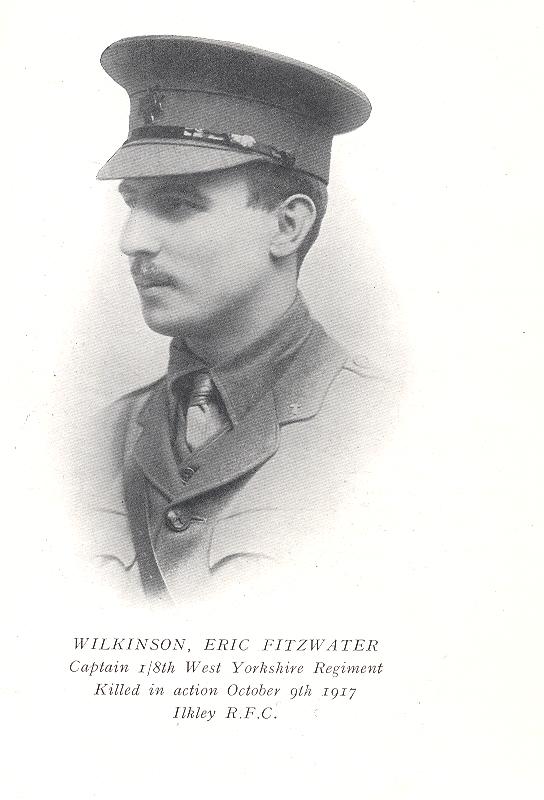
12255539_138171272573Captain Eric F Wilkinson MC

He was wounded in winter 1915, by a bayonet attack and was also later gassed. He was injured in July 1916 and appears to have spent some time in hospital at Chatham before arriving at Cornwall Hall, VAD 76, in Sevenoaks. Later that year, Wilkinson wrote his letter on 24 November 1916, to Kathleen Mansfield, the Commandant at Cornwall Hall, whom I mentioned, along with nursing Sister, Emma Crump, in an earlier post.

Dear Commandant

I’m sitting in a room,
The candle lighted, – all the rest in gloom.
Two candles, guttering from bottle necks,
Throw light, and shadow, onto tattered wrecks
Of walls and windows, broken chairs and beds,
(Where French civilians used to lay their heads)
– For you, must know, this used to be the home,
Of tillers of the clayey Picard loam.
The place was shelled to blazes by the Bosch,
– I’m sitting on a tub to write this tosche-.
And so we make our mess, and wake, and sleep
In ruined rooms where small rats crawl and creep
And great rats run, and leap, and gnaw anything
And all around, the desolation clings.
Yet we can sleep the night through, without fear:
No conscious sentries need be watchful here:
A mile behind the line, we’re ‘Out on Rest”,
And, when we go to bed, may get undressed,
Each day we take our men to dig and toil
To clear the trenches of the shell-blown soil
That now is heavy mud: each night, again
Return to billets, that keep out the rain,
To sleep; or, if our work is done at night,
– It sometimes is, – Sleep through the hours of light
Our own guns all around us roar and bay,
And Bosche shells, meant for them, come round our way
But, for six days, the front line, and its cares,
Night-watches, bullets, mortars, bombs and flares,
Are off our minds, and we can sit and write
To those we’ve often thought of in the night;
Or in that long slow hour, when laggard dawn
Peers through a drenching mist on fields forlorn,
Full often, in those hours, a vision seemed
To float before my eyes, or else I dreamed:
I saw the little hospital, and those, –
The memory of whose kindness only grows
With lapse of time; and oftentimes I swore
To write and tell the gratitude I bore.
So, Commandant, before I go to bed,
I call down blessings on your kindly head,
Please give the doc my love, and matron too,
And Sister Crump, and Flo, and all I knew.
And when the work seems hard, and old Fort Pitt,
Sends bounders round, whose manners aren’t a bit,
What colonels manners should be, far from it,
Just say ‘Our Patients’ gratitude is ours, –
‘What care we or the manners of the Powers
‘That Be’, and carry on the same old way.
So when I get a ‘blighty’ some great day
I can return to Seven Oaks and be
Once more a lucky patient in ward III
Believe me to remain, – till time is done

Yours gratefully – Eric F Wilkinson.
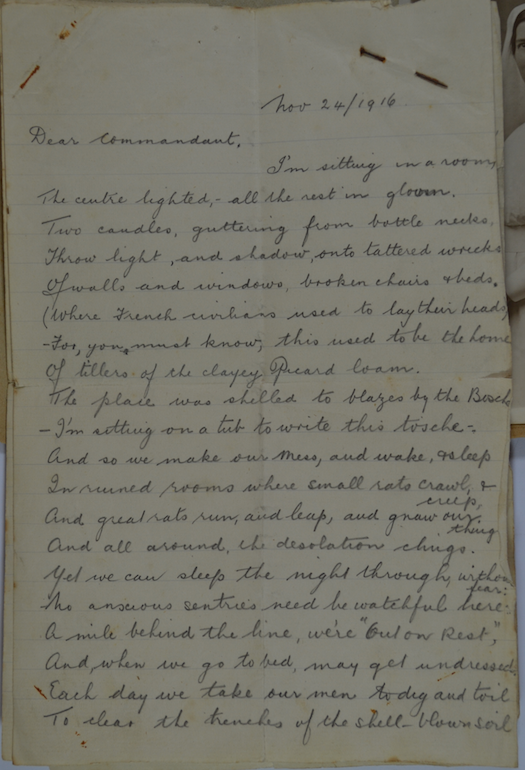
Screen Shot 2015-05-01 at 15.27.33First page of Wilkinson’s letter to Kathleen Mansfield

The author of the newspaper article also in the Cornwall Hall archive, identifies themselves as Wilkinson’s uncle and is inspired to write by overhearing a chance remark suggesting that every soldier at the Front would gladly lose a limb, so as to return home with a ‘Blighty’. The author feels moved to detail the true nature of men like his nephew who had, by this time, been killed at Passchendaele in 1917, as an answer to this slur:

He was my sister’s son. When war broke out, he was a master in a Wharfedale grammar-school but a Boy all the same, though twenty-three years old. By virtue of peacetime-training with the O.T.C. he got an immediate commission in the West Yorkshire Regiment (Leeds Rifles) and went to France early in 1915. All through the winter of 1915-16 he was in the nameable trenches in front of Ypres, nothing more serious befalling him than a bayonet wound and a partial asphyxiation by poison-gas.

His part in the great battle of July 1 1916 was the abortive attack on the stronghold of Thiepval. ‘During the night’ he wrote to me ‘I went up to support some men of another division in a trench we had taken and found it had been recaptured. I went in with twelve men and said ‘Hullo!’ to the first person I met, who promptly lobbed a bomb at me. Greatly scandalised, I said ‘English, you thundering fool!’ whereas he and divers unruly other companions did pelt us with bombs. Five of us got away, three wounded’. The horrid wound that fell to his share brought him back to Blighty. Writing from a hospital at Chatham he said ‘So far, we have abstracted one piece of bomb-casing and half a tunic but we suspect the presence of a pair of trousers as I came back the night it happened practically without, and they seem to have gone somewhere’.

Convalescent, he went to Cornwall Hall, in Kent. … it abides in the minds of many men and many mothers of men on a high place and in a strong light of grateful memory. The Boy paid his tribute in a nurse’s album

A little hospital in Kent
As, in a vision I shall see
Where lucky men are sometimes sent,
And kind eyes smile encouragement,
Ad once they smiled on me
And proud and strong my heart shall be
That I am fit to strike a blow
To keep our English women free –
Like those who did so much for me
A little while ago.

Last summer (1917) he was gassed:

‘The Bosche have been trying a new gas on us and I don’t think much of it’. But he was blind for three days and his sight permanently modified.

On Oct 9 last, leading the first wave of attack on some part of the Paschendale Ridge, he fell. His attitude toward death was summed up in some lines he had written:

Mourn not for me too sadly; I have been
For months of an exalted life, a King,
Peer for these months of those whose graves grow green
Where’re the borders of our empire fling
Their mighty arms. And if the crown is death,
Death while I’m fighting for my home and King,
Thank God! The son who drew from you his breath
To death could bring
A not entirely worthless sacrifice,
Because of those brief months when life meant more
Than selfish pleasures. Grudge not then the price
But say, ‘Our country in the storm of war
Has found him fit to fight and die for her.’
And lift your heads in pride for evermore.
but when the leaves the evening breezes stir
Close not the door.
But listen to the wind that hurries by,
To all the Song of Life for tones you knew;
For in the voice of birds, the scent of flowers,
The evening silence and the falling dew,
Through every throbbing pulse of Nature’s powers
I’ll speak to you

And again:

The mother who sent him bowed her head
And wept for the lad she bore;
Yet never she grudged her sacred dead,
For her country’s need was sore
‘He died for his King and the Right,
She said,
‘And no man could do more’

Mutiny at Etaples

I had thought that would be the end of this particular story. However, in researching Captain Wilkinson’s war service, I discovered his participation in one of the war’s significant events, the mutiny at Etaples. Etaples was a training camp for veterans of the frontline, providing refresher training. Criticism was often made of the harsh regime at the infamous ‘Bullring’ and of the staff and officers and their alleged lack of experience at the Front.

During the disturbances at Etaples, Corporal Jesse Robert Short of 24th Battalion Northumberland Fusiliers, was accused of inciting men to lay down their arms and attack one of their officers; this was Eric Wilkinson. According the records of his court martial, on 11th September 1917, Short said ‘That Buggar ought to have a rope tied around his neck with a stone on it and be chucked into the river’. Short had spent two years at the Front, been wounded and later sent to Etaples. He did not challenge Wilkinson’s account of the incident, which was confirmed by his second in command. Wilkinson’s evidence stated:

On the afternoon of the 11th instant, I was in charge of a Picquet of 150 armed and 50 unarmed men on the Bridge over the River Canche leading from Etaples to Paris- Plage. At about 9.15 pm about 80 men marched towards the Bridge from Etaples, some of them armed with sticks and notice boards. The Picquet failed to stop these men from crossing the Bridge. The accused detached himself from this party and while I was addressing my Picquet and remonstrating with them for failing to stand-fast. The accused started haranguing them. Referring to me he said “you want to put a rope round that buggar’s neck tie a stone to it and throw him into the River”, and he told the men that they should not listen to me. Within a few minutes I was able to get the accused arrested.

short docs 2Wilkinson’s signed statement to the court martial

Jesse Short was tried and sentenced to death, which was confirmed by Sir Douglas Haig on 30th September, the execution being carried out on 4th October 1917.

Wilkinson’s war record and his poetry shows how far he was from being the caricature of an officer seeking an easy life well behind the lines or an unrelenting disciplinarian and it would be interesting to know what he thought of the incident. He died only four days after Corporal Short’s execution, on 9th October, suggesting that he had been swiftly moved on from Etaples. According to reports ‘Amid the sea of mud he became separated from his men and was last seen making single-handed for the enemy lines’. He is buried at the Tyne Cot cemetery.

I’ll be making a trip to the National Archives to see if Wilkinson’s service papers offer any more information about his army career, including the incident at Etaples and the aftermath. If any readers know anything I’d be very pleased to hear from you.

Searching for the Sevenoaks Anzacs

Many men from Sevenoaks and the surrounding area decided, in the early years of the last century, to seek a better life and emigrate, either by themselves or with their families. Some headed to Canada and others to Australia and New Zealand. I have written in my book, Sevenoaks War Memorial, The Men Remembered, about those who were killed while serving with Australian or Canadian forces.

H06329Francis George Carnell

Those who served with the Australian Imperial Force include the oldest man remembered on the war memorial, Francis George Carnell. Francis was born in Sevenoaks in 1859 and had spent time in Africa, serving as a captain in the Cape Mounted Rifles and in peacetime as part of the Cape Mounted Police. He was thirty five when he arrived in Australia and enlisted soon after the outbreak of war on 5 September 1914. Francis was fifty five and serving at Gallipoli when he was shot in the chest in August 1915. He was evacuated to a hospital ship where he died of his wounds three days later.

The other Sevenoaks Anzacs named on the memorial are George Lauder Hutchison Drummond, a Presbyterian who served with 11th Australian Infantry Battalion; friends Arnold Jarvis and George Marshall, who emigrated together in 1912; Frederick Harold Bourne, a sergeant with 13th Australian Infantry Battalion, who was awarded the Military Medal; Frederick Herbert Clouting, a sergeant with 16th Army Service Corps, who was awarded the Distinguished Conduct Medal and George Richter, the last of the Sevenoaks Anzacs to be killed, who was fatally wounded by shellfire in August 1918. As well as the excellent photo of Francis Carnell, I have been able to find newspaper photos of both George Richter and Frederick Bourne and met relatives of Arnold Jarvis and George Marshall. I would very much like to hear from anyone else connected to these men, all of whom have fascinating stories of bravery and sacrifice.

IMG_2038Frederick Bourne

Tracing these men made me curious as to how many others from Sevenoaks made a similar journey and then fought with their adopted country’s forces. Fortunately, the Australian and New Zealand service records have survived in excellent condition, many having been made freely available online and I have been able to compile the list below:

Australia

Thomas James Allen, enlisted 21 February 1917

William Waters Avis, enlisted 26 August 1914

Frank Barton, enlisted September 1915

Henry Blake, from Shoreham, enlisted 1916

Harold Victor Brooker, from Otford, enlisted 22 November 1915

Hildren Berkley Henn, enlisted 25 April 1918

Horace Brooks, enlisted 28 February 1915

John Reginald Carey, enlisted 4 September 1915

Jack Chandler, enlisted 4 September 1914

Eric Duce, enlisted 24 July 1915

William Edgar, enlisted 26 January 1915

Arthur George William Farrants, enlisted 11 January 1915

George Fleet, enlisted 31 May 1916

George Thomas Gorham, enlisted 29 August 1914

William Gorham, enlisted October 1914

Walter Sylvanus Griffin, enlisted 18 March 1916

John Henry Henderson, enlisted 1 April 1916

William John George Kerry, enlisted 1916

George Henry Nevill, enlisted 20 September 1916

Robert Prendergast, enlisted 16 July 1917

Walter James Roots, enlisted 14 July 1915

George Henry Seal, from Chipstead, enlisted 28 January 1916

Horace Simmons, enlisted 29 November 1916

Frederick Walter Standen, enlisted 24 March 1916

John Basil Steane, from Shoreham, enlisted 26 August 1914

John Henry Tester, enlisted 2 March 1916

Cyril Henry Theobald, enlisted 1 March 1916

Charles George Wood, enlisted 26 January 1917

Oscar John Videan, enlisted 7 March 1916

Percy Wallis, enlisted 21 April 1915

Alec Waterhouse, from Brasted, enlisted 1 October 1915

Harry Worship, enlisted 8 September 1914

Together with the only woman I have discovered so far, nurse, Maie St Clair De Lisle.

New Zealand

Henry Bottle

George Holden Clarke, enlisted 1915

Harry Hodgson Cripps, enlisted 1916

Kenrid Horace Davey, enlisted 1915

William James Parsons, enlisted 6 April 1916

No doubt this is not the complete list but it gives an indication of the number of emigrants from Sevenoaks and the surrounding area who fought as Anzacs The youngest, John Henry Tester, was eighteen when he joined up, the eldest were in their forties. Some were invalided, some killed in action and others survived the war. Not all of those killed were commemorated in Sevenoaks or on nearby memorials, perhaps because they had emigrated with their entire families and there was no one left behind to ensure that their names were added. Some interesting stories have already emerged, such as that of Alec Waterhouse, who had a remarkable war. He was wounded in battle in France and taken prisoner. He escaped from PoW camp twice before making it back to the family home in Brasted. He related the whole story of his capture and escapes to a UK parliamentary group after the war and I am researching the full transcripts of his submission and that of a comrade who escaped with him. His brother William (Jack) also served with AIF and was wounded in battle. There are also photos of Alec and others of the men, such as Walter James Roots, a carpenter who was nearly fifty when he enlisted but gave his age as forty four.

500-3Walter James Roots

As we approach Anzac Day on 25 April and the hundredth anniversary of the Gallipoli campaign, I hope to hear from anyone with a connection to these men and women. All of them took the decision to leave Sevenoaks and seek a better or at least a different way of life in Australia and New Zealand. Later, they took the decision to enlist and crossed half way around the world once again to fight in the war. There is no doubting their bravery and I would be thrilled to hear from anyone who has a connection to any of these names.

A family at war

I’ve already written about George Sidney Bassett (1892-1917) in my book on the Sevenoaks war memorial. George was born in Sevenoaks in the house I now live in, in 1879. He was attached to 10th Battalion, Lancashire Fusiliers and had gone to supervise some wiring that his men were undertaking when he was hit in the face by a bullet from an enemy machine gun. He was carried to a first-aid post and died of his wounds. Second Lieutenant Edgar Hurst wrote to George’s parents, Charles (1861-1935) and Adelaide (1860-1956)

Second Lieutenant George Sidney Bassett

George Sidney Bassett

‘I had learnt to like him very much in the few weeks I had known him. He was my favourite of the officers of our company and I have since heard the men say how they liked him. It is one great crying shame that such good lives should be wasted in such an awful war…’

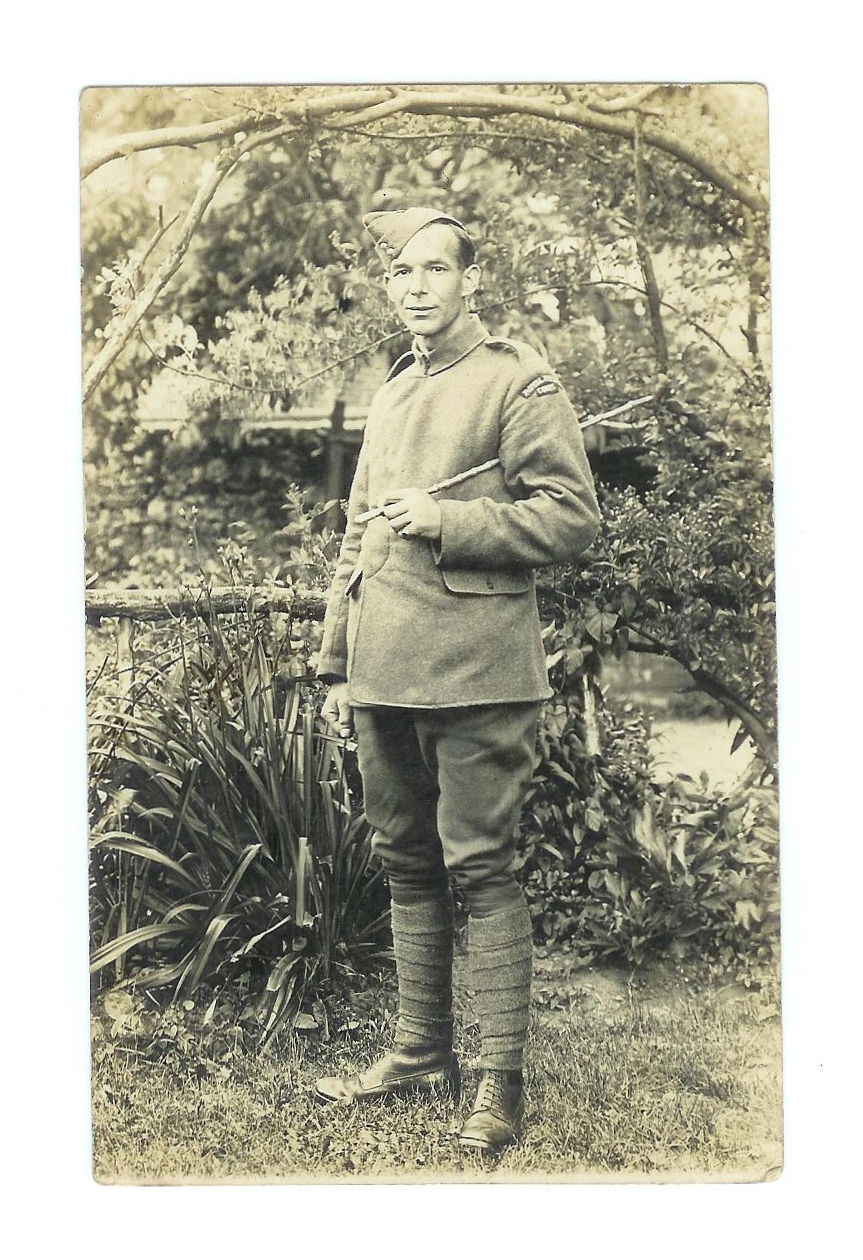
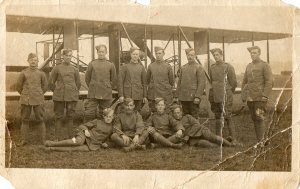
However, George was not the only member of his family to fight during the war, in fact, several of the men and women of the Bassett family served their country in different ways. George’s uncle, Gilbert Bassett (1879-1935), served with the Royal Flying Corps as Gunner/Observer G BASSETT 60561, 62nd Squadron and the family have photographs of Gilbert, as well as his war diary, which records many of his exploits.

During the war he was apparently shot down behind enemy lines and his belongings were returned to his mother as he was reported missing. He then turned up in a hospital in Folkestone but further details on this incident are scarce.

Gilbert Bassett.3Gilbert Bassett

Extracts from Gilbert’s war diary

TRIP NO.2 – JUNE 11th

We started away from Lympne at 2.30 of the afternoon of June 11th and after an uneventful voyage of 35 minutes, with Lt Shaw as pilot, we landed at Marques and made a very good landing indeed.  After stopping there a few minutes to get all particulars we took off again and headed south and finally landed at a place called Verton after a run of 25 minutes.  He over judged the distance across the aerodrome and before he could turn the machine round he had run into a potato field and if the potatoes had been fit for digging the owners would have had them dug up gratis, but with our 700 horse power engines it got out alright.  We were taken down to the mess to tea and a tender was ready for us afterwards to take us to Boulogne, where we arrived safely after having two burst tyres on the road.  Stopped the night in Boulogne at “Peters” and paid 3 francs for a bed and 1 franc 75c for breakfast then proceeded to the boat at 11.30 and after a very nice voyage arrived back in Blighty safe and sound after a very short journey of two days.

TRIP NO.3 – JUNE 13th
When we arrived back from the previous trip we find there is another HP for us so on the 13th June we stand by that one and at 3.30 we make another move and after 40 minutes run we arrive in Marques.  Again with Lt Shaw as pilot.  It was too late then to catch the boat so stop in Marques the night and as usual sleep on the stage.  Next morning we get a tender to take us to Bologne and the boat leaves at 12.15 and arrive back in Blighty all safe as per usual, but nothing doing in the way of excitement on these short trips worse luck and its getting monotonous.

Grandad Bassett front row 2nd from left 1917

Gilbert Bassett, front row, second left

TRIP NO.4 – JUNE 14th

On the next day June 14th I was detailed for another bus but it did not go so stood by again on the 15th and then the weather turned dud, but eventually we make a start on the 16th with Captain Buck as pilot, but he can`t fly an HP and it is too windy for my liking and he can`t keep her on an even keel.  Anyway we got to Marques all safe in 35 minutes after a hell of a bumpy landing in which he almost threw us out of the bus  When we got there we found two more ready to go to Dunkirk and we all started away together and arrived there in 25 minutes with a much better landing too.

We go into the Sergeants` Mess for tea and the pilot comes round, picks us up in the CC`s touring car and we start back again for Marques.  I might mention here that Dunkirk must be a very unhealthy place to live in as the `drome from above looked like a large plum pudding with plenty of plum in as Jerry had been over there on the nights of June 6th and 7th and dropped 240 bombs on it so you may guess it made a mess of things.  In fact the door of the Sergeants` Mess was riddled with shrapnel holes and hangars and machines were blown to pieces.  Now they put all the machines on the sands and just bring them up to the `drome to load up with bombs and things and then go back to the sands again and wait for going out at night.  Nobody sleeps on the `drome either now they all go out and the place is left only for the cats and dogs at night.

We start off to Marques, 50 miles distant and after a somewhat fast run in which the dust flies pretty much we arrive there in 1 hour 20 minutes.  In fact I feel a lot safer a few thousand feet in the air than in that car.  We arrive at Marques covered with dust and the pilot gets another car to take him to Boulogne and he wants me to go as well but I knew very well that we should not be in there until late and it would mean a Rest Billet where you don`t rest, as you have to, as a rule, be catching things all night and it isn`t fishing either, so I get permission to stop at Marques and we have a comfortable bed on the stage again and we go down in the morning and have a few hours in Boulogne and also a `posh` luncheon served up in true French style and we catch the boat at 3 o`clock and land back at Lympne at 6 o`clock all safe and sound and am now waiting for another trip which can come as soon as it likes.

After the war

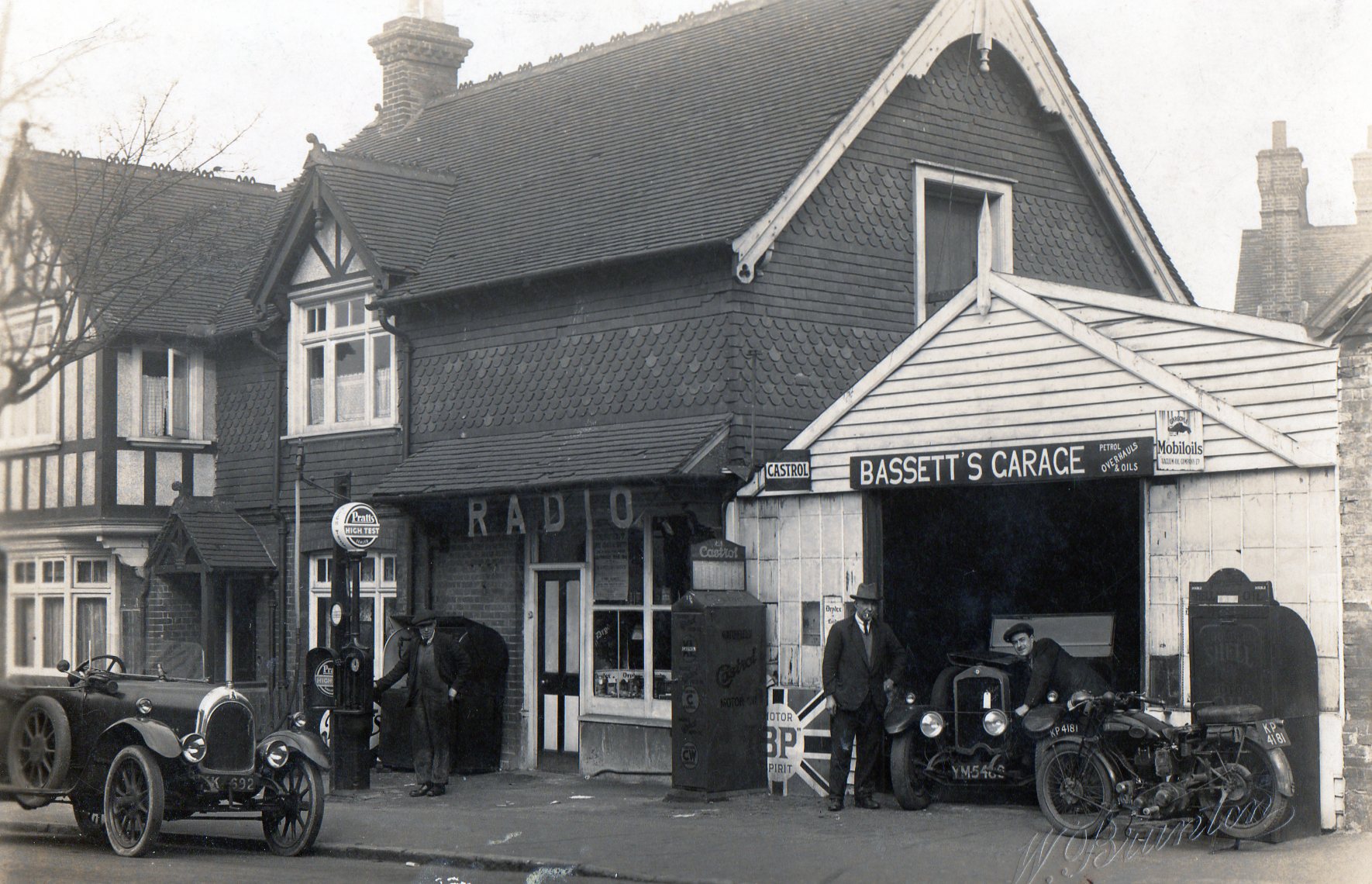
Gilbert had been born in Seal and worked there as a builder before the war. Afterwards, he returned home to Seal where he ran the local garage, builders and coffin makers!

Seal Garage with Grandad, Cecil & Jack Innes

Gilbert Bassett, centre, at his garage in Seal

Gilbert eventually moved to Hastings in the 1930s and died there aged 56.

An early WREN

AMB

Ada Margaret Bassett

Gilbert’s niece and sister of George Sidney, Ada Margaret Bassett, known as Maggie, was born in 1897 and joined the WRENS at its formation in 1917 when she was the fifth to enrol with the new service. Maggie became an official driver, working for Admiral Lord Jellicoe, who was then First Sea Lord. Later she served in the Second World War in the Auxillary Transport Service and was a member of the First Aid Nursing Yeomanry, driving ambulances on the Home Front.

img 513

Aged 92, Maggie was featured in the Daily Telegraph and lived on until 1996, reaching a similar age to her grandmother, Ann.

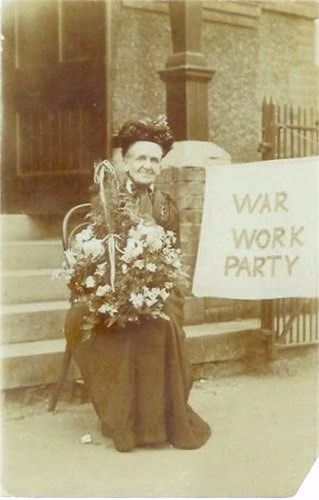
Ann Bassett nee Parsons, the mother of George and Maggie’s father, Charles, was born in 1835 and lived on until 1933. With youngest son Gilbert and grandchildren George and Maggie all serving, Ann became a tireless contributor to the war effort by knitting shirts and other clothing for soldiers at the Front. She was thanked after the war as this photograph shows.

D4lSlIUTjB!uHVL4HJNzA3ql1mnv7aN!X5TltNo!43dA8NC0Nv0nMoa6yad0k__H

Ann Bassett

The story of the Bassett family illustrates the range of of ways that just one family from Sevenoaks contributed to the war effort.

Thank you to all members of the Bassett family who have shared the family stories and photos.