Nursing at Cornwall Hall

A real treasure trove of information on some of the women of Sevenoaks who worked as nurses during the war is the archive of material left by Kathleen Mansfield, Commandant of the Cornwall Hall VAD Hospital. IMG_2286

Kathleen Mansfield

She was born Kathleen Lilian Clark in October 1885 in Portadown. Kathleen attended Sidcot Quaker school and went on to train as a nurse at Almondsbury Memorial Hospital, north of Bristol. In 1910, she married Dr Percy Mansfield, a family doctor in Sevenoaks and they went on to have four children.

The Voluntary Aid Detachment, commonly known as VAD, was founded in 1909 to provide field nursing services both at home and across the Empire. Kathleen Mansfield joined in 1912 and soon held the post of Lady Superintendent. When a VAD hospital was set up at Cornwall Hall near where the couple lived, Kathleen joined  and became the Commandant, joining husband Percy who was already working as the Medical Officer. Other hospitals were established locally at St John’s Hall in Hollybush Lane, at Wildernesse and on the Combe Bank estate. Vita Sackville West of Knole worked at St John’s, together with (Bridget) Aurea Lambarde, of Bradbourne Hall.
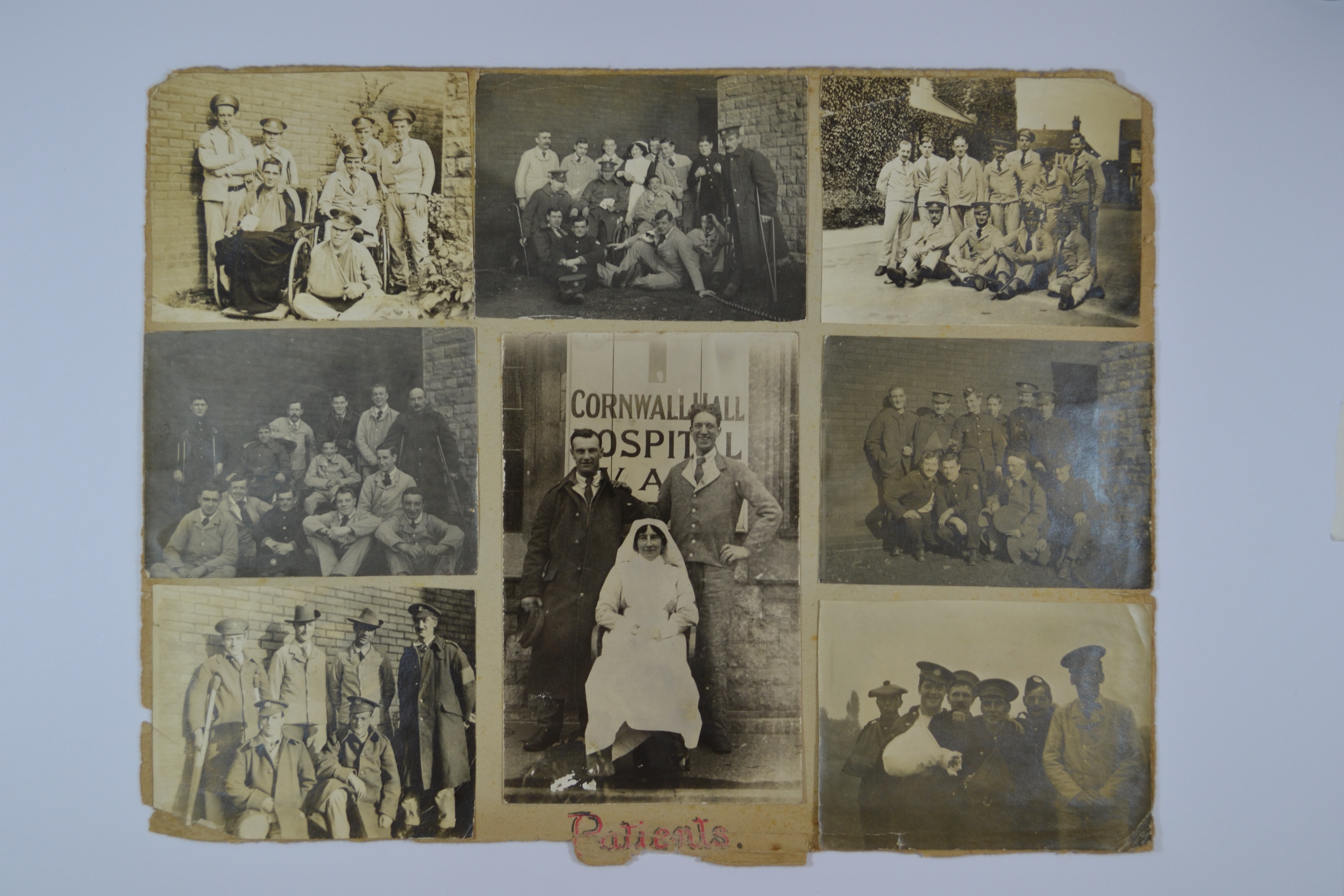
DSC_0183

Staff and patients at Cornwall Hall

Kathleen and her husband served throughout the war, tireless in their work to care for those that arrived at Cornwall Hall, from the Belgian refugees who began to arrive in Sevenoaks in late 1914, to the wounded servicemen who were sent to convalesce throughout the war. Fortunately, Kathleen kept meticulous records, including photographs and letters from the servicemen, with names and service numbers carefully inscribed. The archive also includes some wonderful photos of the nursing staff, who were mainly drawn from the local upper and middle class families of the town, as well as photos of sports days, fancy dress parades, Easter and Christmas celebrations. All of this material, including the glowing testimony of many of their former charges now returned to the Front and recalling the care and comfort that they had received, speaks of the dedication and compassion of the Commandant and her nursing team. Kathleen was awarded the Royal Red Cross in 1917 in recognition of her service. DSC_0253

Staff and patients congratulate the Commandant on her honour

DSC_0321

Telegram from Buckingham Palace regarding her investiture

Kathleen Mansfield died in 1962, surviving her husband by twelve years. Thanks to her family, who have carefully preserved her scrapbooks and given permission for the material to be shared in support of the Nursing Memorial, I will be researching many of those nurses and patients featured within its pages and sharing stories on this website.

One of the nurses featured throughout the archive, is Emma Snow Crump. Emma was born in 1873 in Devon and the 1901 census for Wales shows her working at the Monmouthshire Lunatic Asylum. Ten years later, the 1911 census shows that Emma is as a nurse at Sevenoaks workhouse in Sundridge. Emma Crump joined the staff at Cornwall Hall as a night nurse in October 1914 and stayed there throughout the war, becoming Sister in 1915, Matron in 1918 and Matron in sole charge, 1919. According to her records, she was paid 30/- per week in 1914 and by 1919 this had increased to £2 per week. Emma married in 1926 and lived on until 1952.

IMG_2279

Emma Snow Crump

I’ll be sharing more photos from the Cornwall Hall archive over the coming weeks. As ever, please do let me know if any of your family worked at or had a connection to Cornwall Hall VAD or any of the hospitals in Sevenoaks during the war.

Marjorie’s War

As tomorrow is International Women’s Day and in keeping with my aim of writing more about the women of Sevenoaks and their contribution during the First World War, this weekend’s posts honour some of those local women, from all walks of life, who made a difference. Marjorie Crosbie Hill was one of these. Born in Sutton, Surrey, in 1887, Marjorie was the daughter of William Samuel James Hill and his wife Elizabeth Mary Crosbie. William and Elizabeth had married in Islington in 1871. By 1891 they had moved to Sevenoaks, where William became a prominent resident and JP, and were recorded in that year’s census living at The Red House, once the home of Francis Austen, an uncle of Jane Austen and now the premises of local solicitors, Knocker & Foskett. The  census shows Marjorie at home with five siblings, a governess and three servants. Later the family moved to 50, High Street and by 1911, Marjorie was living with her widowed father at 2, South Park. During the war, Marjorie, who was a Christian Scientist, worked organising and running canteens and clubs for workers at the munitions factories, for the Young Women’s Christian Association. She was awarded the OBE for this war work in early 1918 and this photo was taken around that time. IMG_0931

Marjorie Crosbie Hill

Marjorie’s niece,  Jane Ashmore, recalled:

‘My aunt, at one time, lived next door but one to the old Post Office on return from running two kitchen’s for munitions workers, for which she was decorated. After World War Two, she built herself a house in Burntwood Road, called Tussocks, (her tiny little beech hedge is now huge). Also, she was a well known golfer, belonging to the Knole Club (where she was Lady Captain in 1925 and 1930).’

Marjorie later lived at Stone Street near Sevenoaks and died, aged 80, in 1967. Her elder sister, Barbara, had married Sir James Masterton Smith, who was Private Secretary to successive First Lords of the Admiralty, including Winston Churchill.

Jane Ashmore’s brother and Marjorie’s nephew, Philip Sydney Crosbie Hill, was born in 1917. He was in India, tea-planting in Assam when  the Second World War broke out, and immediately applied for service in the Indian Army. He was an Officer Cadet, undergoing training in the Royal Bombay Sapper and Miners when he was killed in a motor accident in 1941. He is remembered on the Sevenoaks War Memorial.

Jane herself wrote ration books during the Second World War and later joined the First Aid Nursing Yeomanry (Princess Royal’s Volunteer Corps). I was fortunate to be able to speak to Jane last year to talk to her about her memories of her aunt and brother and was saddened to learn that she died in January aged 95.

A munition girl’s bravery

One of the stories that jumped out at me as I first scoured several years worth of the Sevenoaks Chronicle was that of Gladys Chapman, who was honoured for an act of bravery during the war.

According to a news report in the Chronicle on 31st January 1919, Gladys lived at 3, Barrack Corner, St John’s, Sevenoaks and during the war, worked at the Kings Norton Metal Factory at Abbey Wood. About 7000 workers were employed at the factory during the war, most based in temporary huts on the marshes. Cases were made in Birmingham then assembled and loaded at the Abbey Wood Factory, next to Woolwich Arsenal.

   IMG_2258

Gladys Evelyn Chapman

The article explains how Gladys was on duty when a fire broke out in the factory, caused by a spark from a machine igniting some cordite.

The outbreak spread to a stack of aerial bullets, and but for the energies of Miss Chapman might have become much more serious. Miss Chapman first filled pails with water, which were poured on the cases, which were smouldering; then when the foreman threw off the corrugated iron covering to get at the burning wood with hose pipes, she threw the sheets to one side. This done, she secured a small hose and played on the fire, although all through these operations the bullets were exploding and flying in all directions, making the undertaking at once extremely dangerous and alarming.

Gladys was rightly awarded for her bravery and attended a ceremony in Brighton, where she was presented with her medal by Lord Leconfield, Lord Lieutenant of Sussex as a ‘recognition of coolness and courage displayed by her, in face of great danger’.

Although her award was credited as the OBE, it was actually a Medal of the Order of the British Empire, which was awarded to over two thousand people from 1917 until 1922 when it became the Medal of the Order of the British Empire for Meritorious Service (usually referred to as British Empire Medal or BEM).

Gladys gave her full name as Gladys Evelyn Chapman on the reverse of the photo but I have not yet been able to discover anything about her after 1919, so please do get in touch if you know any more about her story or have a similarly heroic relative from Sevenoaks in your family tree.