The Warde Family at War

Last year I was very pleased to have been asked to join the summer Celebration at Squerryes .

Current owner, Henry Warde, Is a cousin of Basil Charles Conroy Warde, who was killed during the war and is remembered on the Sevenoaks War Memorial. Basil was born in 1892 and had served in Canada with the Royal Canadian Mounted Police or ‘Mounties’ before returning home to England and serving with the Oxfordshire and Buckinghamshire Light Infantry.

A Family Memoir

I hadn’t been able to find out very much about Basil, beyond a photograph and a brief mention in the Sevenoaks Chronicle. However, looking again for more information in advance of this weekend, I found an article written by his Great Great Niece, which had been posted on a Canadian website dedicated to remembering members of the Royal Canadian Mounted Police. The article was published in November last year, after my book was published but I’m delighted that the author, Thomasina Godwin, has allowed me to reproduce it here:

As 2014 marks the 100th anniversary of the start of WWI, I thought it would be the best time to share some photos and information on my great-great uncle Reg.#4989, Basil Charles Conroy Warde.

Basil was born on February 28th, 1892 in Sevenoaks, Kent, England. He was the fifth of six children, and the youngest son. His family were relatives of the Warde’s of Squerryes Court and he received his education at Tonbridge School. Tonbridge is a boarding school for boys located in Tonbridge, Kent, England. It was founded in 1553.Basil and his older brother, Richard, had a thirst to explore other frontiers and work hard for a living. Richard travelled to South America, where for some time he was involved in cattle ranching. And Basil, as you can tell, came to Canada.
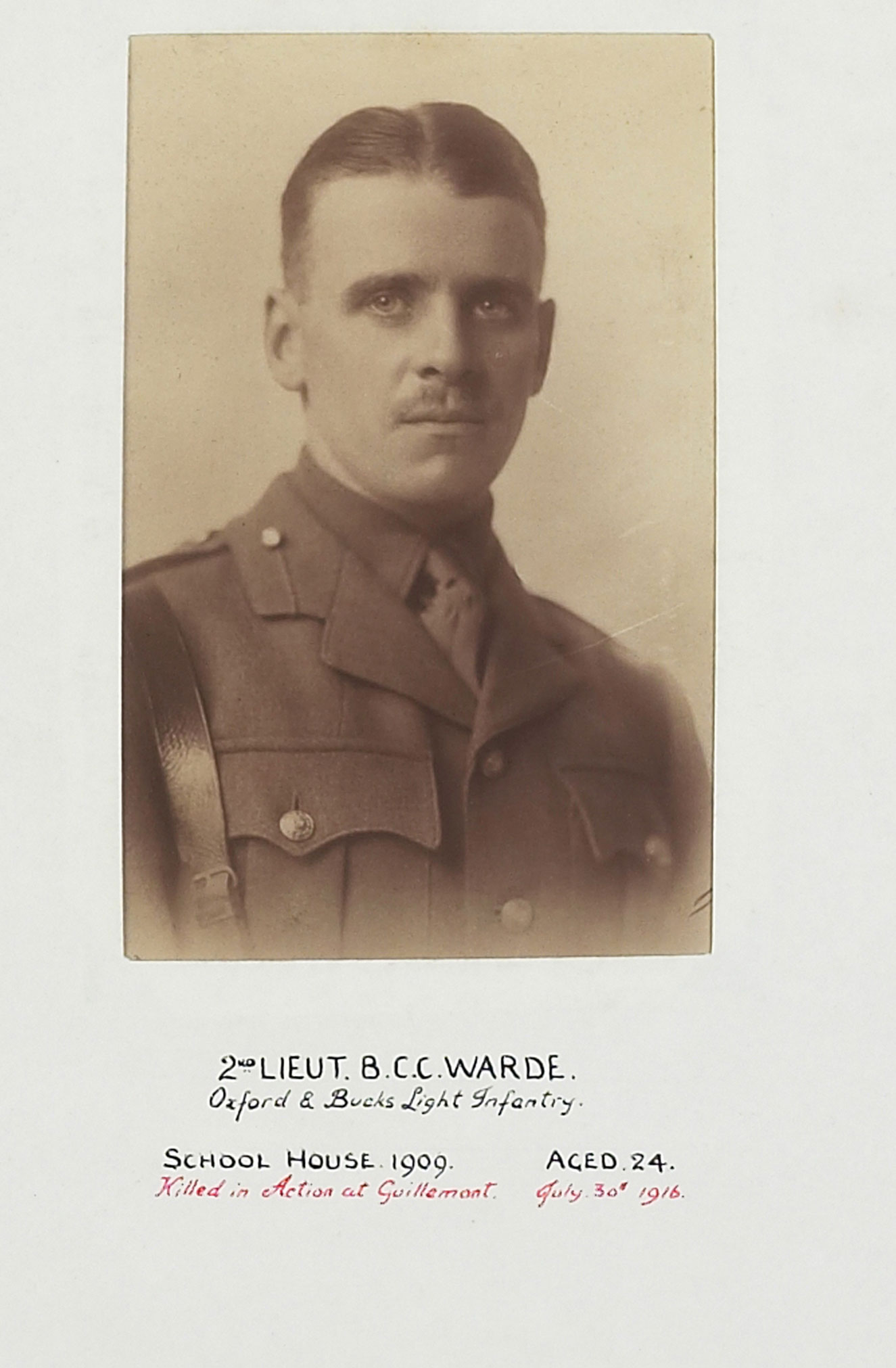
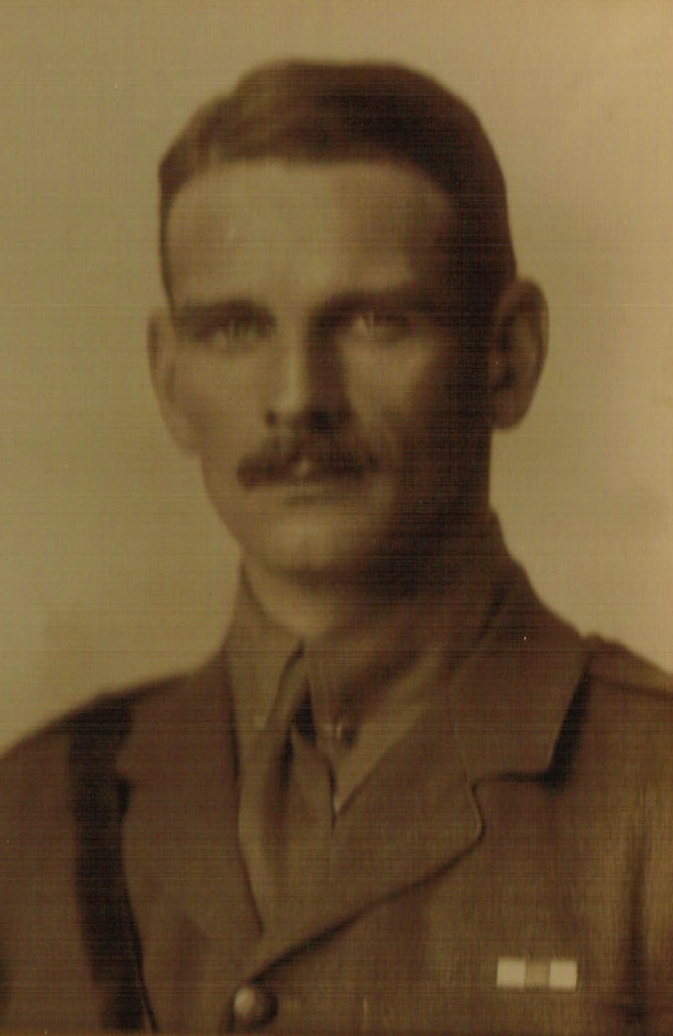
Filename.ashxSecond Lieutenant Basil C C Warde 1892 – 1916

Basil wasn’t the first in his family to travel to Canada. His great uncle, Major Henry John Warde, came to Canada with the Royal Regiment and he was killed in a duel on May 22, 1838 in Montreal, QC. Basil arrived in Saint John, New Brunswick on January 8th, 1910 aboard the Empress of Britain. He was not yet 18 years of age. The passenger list stated that Basil’s intended occupation in Canada was farming, yet a few days later, on January 14th he had engaged with the Royal North-West Mounted Police (RNWMP).

Not much is known about Basil’s experience with the RNWMP, as many of the service records from that period have been destroyed. Nevertheless, I have a photo of Basil in Gravelbourg, Saskatchewan (photo was dated 1910). At that time, Gravelbourg was a small, budding town with settlers arriving from across Canada, from the United States, and from many European countries.
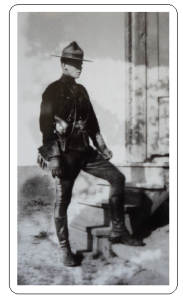
4989Warde7.jpgBasil Warde in the uniform of the Royal North West Mounted Police

On October 25th, 1914, Basil arrived back in England as the country was engaged in World War I. He attended the wedding of his sister, Francesca; to Edward Norman Fortescue Hitchins on July 12th, 1915 (these are my great grandparents). My family has some photos of the wedding where Basil can be seen in his military uniform.

On February 28th, 1916 Basil entered France with the 2nd Battalion, Oxford and Bucks Light Infantry. At this point his Battalion were probably in Béthune or the Festubert trenches — it is hard to imagine what frightful conditions Basil would have encountered in the trenches upon his arrival.

Meanwhile, back home in England, my grandmother Enriquetta Mary Hitchins, was born. It was May 23, 1916. Basil would have received the news of Enriquetta’s birth shortly afterwards. On June 19th, 1916 Basil wrote a letter to his new little niece providing her with some insightful life advice. 

July 1st, 1916 saw the start of the Battle of the Somme. Basil’s Battalion was involved in operations around Delville Wood and Guillemont. Early in the morning of July 30th, the 2nd Oxford and Bucks Light Infantry and the 24th Royal Fusiliers, supported by 5 Brigade’s Machine Gun Company, attacked from Waterlot Farm towards Guillemont Station, but the attack was unsuccessful and the Units were forced to withdraw. There were heavy casualties that day and Basil was listed as missing and presumed dead. Eventually, his body was located. He now rests in Delville Wood Cemetery, France not far from where he fell.

Basil Warde was only 24 years of age when he died and it was a tough loss for a close-knit family. Some of his personal belongings have been passed down over the years and his memory has not been forgotten. In fact, my sister, a Constable with the RCMP, now holds his RNWMP belt and pin.

‘A Great Grief to All’

Further research has revealed that Basil became Assistant Riding Master and Roughrider with the Royal North West Mounted Police His superior officer wrote of him as the grittiest youngster he had ever known “No matter how many times a horse threw him he was never beaten.” On the outbreak of war he came home and enlisted in the 16th Lancers, but realising that he was less likely to get to France at an early date in the cavalry, he applied for an infantry commission and was gazetted to the Oxford and Bucks. Light Infantry, on June 26th, 1915. He went out the following winter, and was slightly wounded on the first day of the Somme but insisted on carrying on and remained with his Regiment.

On the night of July 30th he was leading his platoon in an attack on an enemy trench when he was seen to fall. He was for long reported missing, but it is now known that he was killed, shot through the head, that night. Letters received from the Regiment testify to his utter fearlessness and his value as an officer, and his CO., writing at the time said that his being “missing” was a ” really great grief to all” and that he “could ill be spared by the Regiment.”
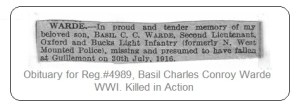
4989WardeObit

From Nursing to Spying, the Warde Family at War

Basil’s niece wrote to me this week with more information on the war service of Basil’s brother and sister:

Richard Edward Warde, known as Dick (1884 – 1932) attended Tonbridge School with his brother and also served in WW1. I believe he served with the Scots Guards and was wounded in the Battle of Loos. During his convalescence he met and fell in love with Muriel Wilson, who Winston Churchill had once proposed to. They married in 1917. Dick has been described as “an uncomplicated extrovert, very much an outdoor man, with the look of a buccaneer”. There is a story that during the war he had the terrible duty of commanding a firing squad for the execution at the Tower of London, of a spy, who being a soldier, avoided hanging. It is said that Dick sat up all night drinking with the condemned man, until the German passed out and never knew that dawn had come.
DickWardeMajor Dick Warde

In fact, according to Tonbridge School, Dick Warde served with the 2nd Battalion, Scots Guards, in France from May to September 1915, and from September 1916, to January 1917. He was slightly wounded in the leg on September 25th, 1915, and was again wounded, this time more seriously in the arm, the following day near the Hohenzollern Redoubt. He was twice Mentioned in Despatches for services in France and was awarded the M.C. in 1916. Dick Warde was subsequently employed on intelligence work in 1918, with the acting rank of Major, which he kept on relinquishing his commission in 1920.

Basil and Dick had an older sister who also served during the war. Enriqueta Rosita Jenny Warde (1883 – 1966) was known as Diddy. Diddy trained as a nurse at Sevenoaks Hospital. During WW1 she joined Queen Alexandra’s Royal Nursing Service and was awarded the Royal Red Cross for bravery during a Zeppelin raid. In 1933 she was asked to open and run a private nursing home in Sevenoaks which proved a success. On the outbreak of war Carrick Grange was turned over to the army and for the next five years Diddy was back in uniform and was awarded another Royal Red Cross.

Another sister, Alice Enderica Warde (1896 – 1984) married Col. Bertram Ede, who became head of MI5 on Malta during the Second World War. The couple had two sons, one of whom, Charles Richard Ede, served with the Royal Tank Regiment during the war and went on to found The Folio Society. When he died in 2002, aged 80, his obituary  was carried in the Daily Telegraph.

My thanks to Thomasina Godwin and Superintendent J..J.  (Joe) Healy (Retired) for their help in the research for this post and kind permission to reproduce material originally posted elsewhere.

Searching for the Sevenoaks Anzacs

Many men from Sevenoaks and the surrounding area decided, in the early years of the last century, to seek a better life and emigrate, either by themselves or with their families. Some headed to Canada and others to Australia and New Zealand. I have written in my book, Sevenoaks War Memorial, The Men Remembered, about those who were killed while serving with Australian or Canadian forces.

H06329Francis George Carnell

Those who served with the Australian Imperial Force include the oldest man remembered on the war memorial, Francis George Carnell. Francis was born in Sevenoaks in 1859 and had spent time in Africa, serving as a captain in the Cape Mounted Rifles and in peacetime as part of the Cape Mounted Police. He was thirty five when he arrived in Australia and enlisted soon after the outbreak of war on 5 September 1914. Francis was fifty five and serving at Gallipoli when he was shot in the chest in August 1915. He was evacuated to a hospital ship where he died of his wounds three days later.

The other Sevenoaks Anzacs named on the memorial are George Lauder Hutchison Drummond, a Presbyterian who served with 11th Australian Infantry Battalion; friends Arnold Jarvis and George Marshall, who emigrated together in 1912; Frederick Harold Bourne, a sergeant with 13th Australian Infantry Battalion, who was awarded the Military Medal; Frederick Herbert Clouting, a sergeant with 16th Army Service Corps, who was awarded the Distinguished Conduct Medal and George Richter, the last of the Sevenoaks Anzacs to be killed, who was fatally wounded by shellfire in August 1918. As well as the excellent photo of Francis Carnell, I have been able to find newspaper photos of both George Richter and Frederick Bourne and met relatives of Arnold Jarvis and George Marshall. I would very much like to hear from anyone else connected to these men, all of whom have fascinating stories of bravery and sacrifice.

IMG_2038Frederick Bourne

Tracing these men made me curious as to how many others from Sevenoaks made a similar journey and then fought with their adopted country’s forces. Fortunately, the Australian and New Zealand service records have survived in excellent condition, many having been made freely available online and I have been able to compile the list below:

Australia

Thomas James Allen, enlisted 21 February 1917

William Waters Avis, enlisted 26 August 1914

Frank Barton, enlisted September 1915

Henry Blake, from Shoreham, enlisted 1916

Harold Victor Brooker, from Otford, enlisted 22 November 1915

Hildren Berkley Henn, enlisted 25 April 1918

Horace Brooks, enlisted 28 February 1915

John Reginald Carey, enlisted 4 September 1915

Jack Chandler, enlisted 4 September 1914

Eric Duce, enlisted 24 July 1915

William Edgar, enlisted 26 January 1915

Arthur George William Farrants, enlisted 11 January 1915

George Fleet, enlisted 31 May 1916

George Thomas Gorham, enlisted 29 August 1914

William Gorham, enlisted October 1914

Walter Sylvanus Griffin, enlisted 18 March 1916

John Henry Henderson, enlisted 1 April 1916

William John George Kerry, enlisted 1916

George Henry Nevill, enlisted 20 September 1916

Robert Prendergast, enlisted 16 July 1917

Walter James Roots, enlisted 14 July 1915

George Henry Seal, from Chipstead, enlisted 28 January 1916

Horace Simmons, enlisted 29 November 1916

Frederick Walter Standen, enlisted 24 March 1916

John Basil Steane, from Shoreham, enlisted 26 August 1914

John Henry Tester, enlisted 2 March 1916

Cyril Henry Theobald, enlisted 1 March 1916

Charles George Wood, enlisted 26 January 1917

Oscar John Videan, enlisted 7 March 1916

Percy Wallis, enlisted 21 April 1915

Alec Waterhouse, from Brasted, enlisted 1 October 1915

Harry Worship, enlisted 8 September 1914

Together with the only woman I have discovered so far, nurse, Maie St Clair De Lisle.

New Zealand

Henry Bottle

George Holden Clarke, enlisted 1915

Harry Hodgson Cripps, enlisted 1916

Kenrid Horace Davey, enlisted 1915

William James Parsons, enlisted 6 April 1916

No doubt this is not the complete list but it gives an indication of the number of emigrants from Sevenoaks and the surrounding area who fought as Anzacs The youngest, John Henry Tester, was eighteen when he joined up, the eldest were in their forties. Some were invalided, some killed in action and others survived the war. Not all of those killed were commemorated in Sevenoaks or on nearby memorials, perhaps because they had emigrated with their entire families and there was no one left behind to ensure that their names were added. Some interesting stories have already emerged, such as that of Alec Waterhouse, who had a remarkable war. He was wounded in battle in France and taken prisoner. He escaped from PoW camp twice before making it back to the family home in Brasted. He related the whole story of his capture and escapes to a UK parliamentary group after the war and I am researching the full transcripts of his submission and that of a comrade who escaped with him. His brother William (Jack) also served with AIF and was wounded in battle. There are also photos of Alec and others of the men, such as Walter James Roots, a carpenter who was nearly fifty when he enlisted but gave his age as forty four.

500-3Walter James Roots

As we approach Anzac Day on 25 April and the hundredth anniversary of the Gallipoli campaign, I hope to hear from anyone with a connection to these men and women. All of them took the decision to leave Sevenoaks and seek a better or at least a different way of life in Australia and New Zealand. Later, they took the decision to enlist and crossed half way around the world once again to fight in the war. There is no doubting their bravery and I would be thrilled to hear from anyone who has a connection to any of these names.

Nursing at Cornwall Hall

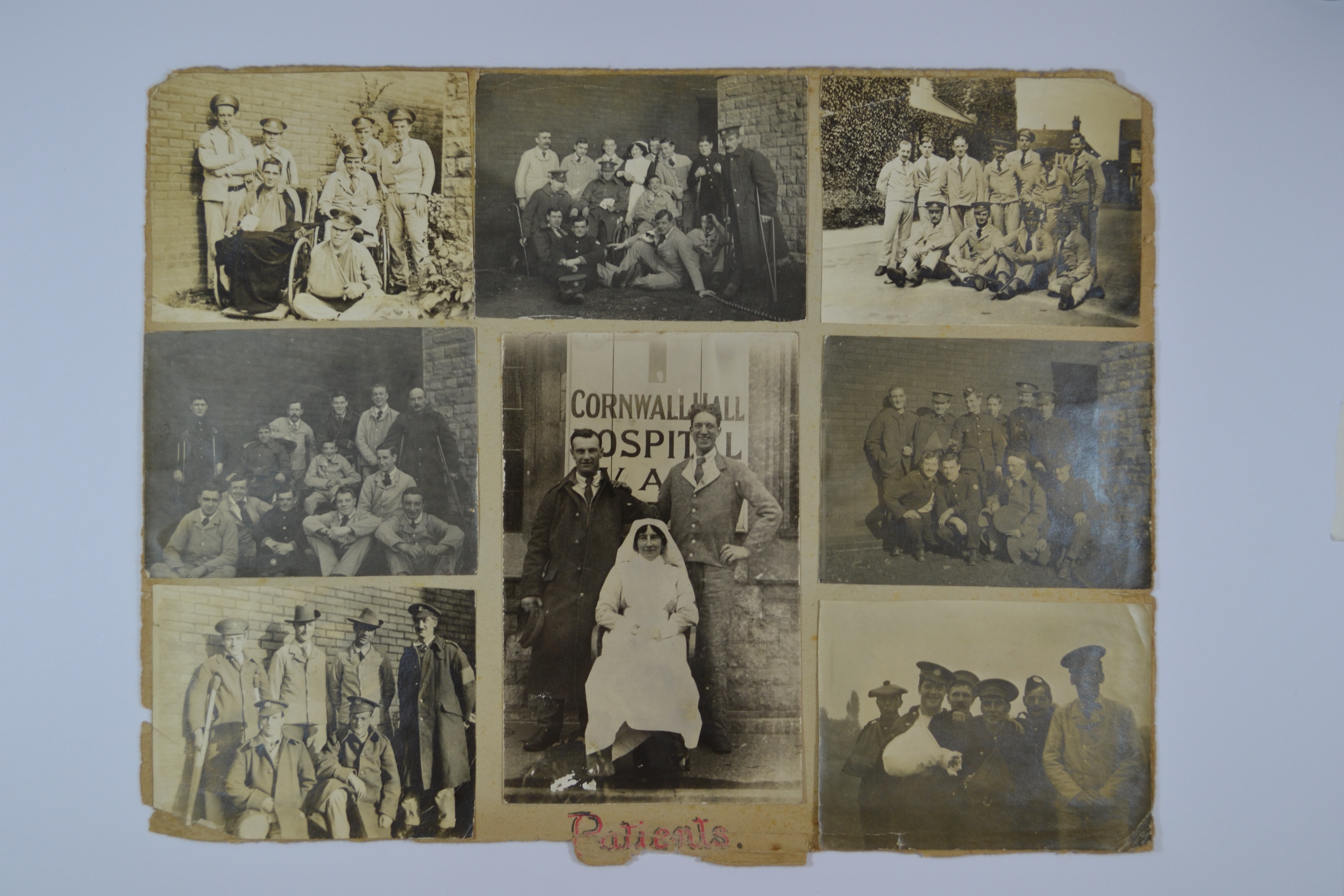
A real treasure trove of information on some of the women of Sevenoaks who worked as nurses during the war is the archive of material left by Kathleen Mansfield, Commandant of the Cornwall Hall VAD Hospital. IMG_2286

Kathleen Mansfield

She was born Kathleen Lilian Clark in October 1885 in Portadown. Kathleen attended Sidcot Quaker school and went on to train as a nurse at Almondsbury Memorial Hospital, north of Bristol. In 1910, she married Dr Percy Mansfield, a family doctor in Sevenoaks and they went on to have four children.

The Voluntary Aid Detachment, commonly known as VAD, was founded in 1909 to provide field nursing services both at home and across the Empire. Kathleen Mansfield joined in 1912 and soon held the post of Lady Superintendent. When a VAD hospital was set up at Cornwall Hall near where the couple lived, Kathleen joined  and became the Commandant, joining husband Percy who was already working as the Medical Officer. Other hospitals were established locally at St John’s Hall in Hollybush Lane, at Wildernesse and on the Combe Bank estate. Vita Sackville West of Knole worked at St John’s, together with (Bridget) Aurea Lambarde, of Bradbourne Hall.

DSC_0183

Staff and patients at Cornwall Hall

Kathleen and her husband served throughout the war, tireless in their work to care for those that arrived at Cornwall Hall, from the Belgian refugees who began to arrive in Sevenoaks in late 1914, to the wounded servicemen who were sent to convalesce throughout the war. Fortunately, Kathleen kept meticulous records, including photographs and letters from the servicemen, with names and service numbers carefully inscribed. The archive also includes some wonderful photos of the nursing staff, who were mainly drawn from the local upper and middle class families of the town, as well as photos of sports days, fancy dress parades, Easter and Christmas celebrations. All of this material, including the glowing testimony of many of their former charges now returned to the Front and recalling the care and comfort that they had received, speaks of the dedication and compassion of the Commandant and her nursing team. Kathleen was awarded the Royal Red Cross in 1917 in recognition of her service. DSC_0253

Staff and patients congratulate the Commandant on her honour

DSC_0321

Telegram from Buckingham Palace regarding her investiture

Kathleen Mansfield died in 1962, surviving her husband by twelve years. Thanks to her family, who have carefully preserved her scrapbooks and given permission for the material to be shared in support of the Nursing Memorial, I will be researching many of those nurses and patients featured within its pages and sharing stories on this website.

One of the nurses featured throughout the archive, is Emma Snow Crump. Emma was born in 1873 in Devon and the 1901 census for Wales shows her working at the Monmouthshire Lunatic Asylum. Ten years later, the 1911 census shows that Emma is as a nurse at Sevenoaks workhouse in Sundridge. Emma Crump joined the staff at Cornwall Hall as a night nurse in October 1914 and stayed there throughout the war, becoming Sister in 1915, Matron in 1918 and Matron in sole charge, 1919. According to her records, she was paid 30/- per week in 1914 and by 1919 this had increased to £2 per week. Emma married in 1926 and lived on until 1952.

IMG_2279

Emma Snow Crump

I’ll be sharing more photos from the Cornwall Hall archive over the coming weeks. As ever, please do let me know if any of your family worked at or had a connection to Cornwall Hall VAD or any of the hospitals in Sevenoaks during the war.