Knole at war – stories of the estate workers

Knole, the imposing Sevenoaks seat of the Sackville  family, has long played a role in the life of the town and did so during the First World War. Lord Sackville served with the Army, seeing action in Gallipoli, Palestine, Egypt and France, while his wife was an ardent fundraiser for wartime charities, and daughter Vita worked with the local VAD. The estate also played a role as a military camp and training ground from 1914-1918. The house has always been an employer of local people and I wanted to investigate what impact the war had on the staff and the running of a great estate.

In 1916, the Kent Messenger reported that before the war there had been 71 employees on the estate, now reduced to 52. The paper noted that when the Derby Scheme had been introduced, Lady Sackville ‘did her best to get all the employees to attest, and all within age did so’. However, this reported attitude contrasts with Lady Sackville’s later letter to Lord Kitchener, which bemoaned the loss of so many staff from the estate. She wrote

“I think perhaps you do not realise Lord K, that we employ five carpenters and four painters and two blacksmiths and two footmen and you are taking them all from us.”
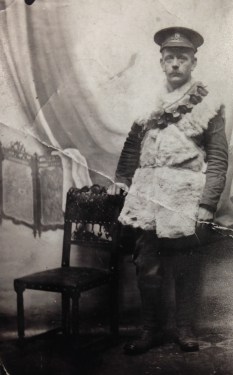
IMG_7308Bombardier William Robert Copper

Three of the men on the Sevenoaks War Memorial were employed at Knole before they enlisted. According to his obituary, William Robert Copper (1883-1917), a bombardier with 24th Siege Battery, Royal Garrison Artillery, had worked at Knole for six years before joining the army. He was a keen cricketer and played regularly for nearby Godden Green, where many of the workers from the estate lived and where he is also remembered on the village war memorial.

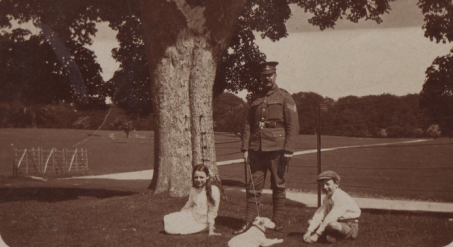
Thomas Edmund Pattenden (1877-1918), a sergeant with 1/5th Battalion Royal West Kents, worked as a wicket porter at Knole, living on site with his wife, Florence, and their two children Doris and John.
image
Sergeant Thomas Edmund Pattenden

Thomas spent most of the war in India, where he died and was buried in Jubbulpore Cantonment Cemetery in 1918. His widow continued in his role as wicket porter at Knole until the 1930s. Thomas’s grandson, Ian, has spoken about his grandfather for the Knole Stories project.

Oliver Older (1878-1916) was born in Sevenoaks and, after working in London for some years, had returned home and was working as a groom at Knole before serving with the 6th Battalion, Royal West Kents. Oliver died of his wounds in October 1916 and is buried at Heilly Station Cemetery, Mericourt-L´Abbe, France.

A fourth man on the memorial, William Goss Hicks (1882-1917), was headmaster at the Lady Boswell School, and son of the butler at Knole, William Hicks senior.

On 1 July 1916, in an article entitled The National Importance of Knole, the Kent Messenger reported the case of Adin Clifton Jeffery (1878-1940), works foreman at Knole, before the West Kent Appeal Tribunal, which heard the cases of men who were appealing against the decisions of their local tribunal. George Saer represented the Knole Estate for Lord Sackville with Mr Knocker, of well-known Sevenoaks solicitors, Knocker & Foskett.

imageHow the Sevenoaks Chronicle reported the story

According to the report, Jeffery had been in post for five years and his father had held it for thirty years before him. The Tribunal heard that he had tried to attest under the Derby Scheme but had been rejected because of an enlarged heart. Jeffery’s solicitor stated that he had attempted to go before a Medical Board but had been unable to get an appointment.

The tribunal heard that Knole contained 365 rooms and its roof covered approximately 7 acres, with, as Jeffery testified, 17 baths and 40 lavatories, as well as several sets of heating apparatus, all of which had to be kept in working order. Further evidence was given of the scale of Knole and the work required to maintain the estate

…some part of the roof of Knole had to receive attention every day, and the antiquated drainage system required constant attention. In addition to the house, there were nine farms on the estate, two being in hand. Fifty tons of firewood per week were being cut for the troops, and about 7000 fir trees had been cut for the Government during the past eighteen months.

The case was made that no replacement would know the workings of the estate like the defendant

It would not be possible for anyone to pick up in a few months the ramifications of the dainage system, of which the only plan was 150 to 200 years old, and that was useless, as there had been additions from time to time.

Mr Knocker emphasised the national importance of Knole and said that the appeal was not in Lady Sackville’s interest, but for the nation.

Colonel Atkinson, military representative at the tribunal, suggested that the medical board were overworked and although he noted that it was only by a small majority that Jeffery had been allowed to appeal his case to this hearing, he was prepared to agree that Jeffery was doing essential work and, in view of his age, would not press for him to serve. Atkinson expressed his opinion that all the employees at Knole had done splendidly.

The court ordered that the case should stand over under regulations until Jeffery was called up when he would have seven days to appeal again.

Adin Jeffery continued to work at Knole until his death, aged 62 in 1940, when he was working as steward. The Sevenoaks Chronicle noted in his obituary that he had been a keen member of the town Choral Society and sang in the choir of the Vine Baptist Church for nearly 40 years. He had died suddenly, collapsing in his chair, while going about his normal duties. According to the paper,

It was fitting to say that he loved the great house of Knole. It was a joy to him that he dwelt under its roof, and he found continual happiness in serving it, and the members of the family residing there, whom he honoured. Often he said that he hoped to end his days at Knole, and it was given unto him to continue his service to the last moment of his life within its walls.

In a mark of the esteem in which he was held, Lord and Lady Sackville, Eddy and Bertram Sackville West all attended his funeral and sent flowers, as did Vita Sackville West.

The case of another Knole employee, Edwin Thomas Harding, aged 45, of Upper Park Lodge, Knole, who had been employed  for two years, came before the Sevenoaks Tribunal in 1918. Again appealed for by Lady Sackville, on behalf of her husband, he appealed on the grounds of the risk to the house from fire breaking out. It was pointed out that

with the exception of the butler, who was 68 years of age, he was the only man about the house during the day who understood the fire appliances.

This case divided the tribunal panel. The Chairman and one other felt that they had taken other men from Knole and that considering the treasures that were in the house they ought to give consideration to the appeal. However, another panel member, Mr White, took the view that it would be a public scandal if they exempted him, because there were plenty of men engaged outside the house if they were wanted in case of fire and the local fire brigade could attend within five minutes.

Harding himself testified that he did everything that was necessary in the house when a man’s work was required and spent his whole time in the house, being the only one who understood the fire appliances and able to attend to them if he should be required.

A query as to whether there had been any attempt to replace him was met with the reply that there were now no men in the garden excepting very old men and boys. The gardeners now, in common with other head gardeners, had to dig instead of supervising.

It was proposed that two months exemption be given but an amendment was moved by Mr White and a fellow panel member that no exemption be given but that he should not be called for 56 days. This was carried by three votes to two, leaving Mr White to remark that

…he recognised that Knole was a sort of national treasure-house, but it was the larger national interests they had to study and that was the Army.

The risk of fire in the house was a real one, as demonstrated in December 1918 when Lord Sackville’s son-in-law, Harold Nicholson, was awakened by smoke and managed to raise the alarm and put out the blaze with the help of the night watchmen and tradesmen. The paper reported that the fire was thought to have been caused by an overheated hearth and

There is no doubt that Lord Sackville as well as his son-in-law had narrow escapes, the beam (that had caught fire) being the main support of his Lordship’s bedroom floor.

imagePrivate Leonard Edwin Harding

Harding’s son, Leonard Edwin (1899-1991), had served with the Royal Fusiliers from March 1917. The Chronicle reported in May 1918 that he had been missing since 24 April. However, Leonard Harding survived the war and long after, living to be ninety-one.

The Kent Messenger carried news in March 1917 of how one former Knole gardener had been injured on service at home. Driver William Smith of the Royal West Kents, son of Mrs Smith of Godden Green, had been badly injured by a kick in the face from a mule at Kennington, near Ashford. According to the paper, his teeth were knocked out and his face so badly cut that it had to be sewn up.

Later that year, in September 1917, it was reported in the ‘Our Boys’ column of the Sevenoaks Chronicle that Private John W Potter had made a surprise visit to his parents. Potter had worked with his father for five years in the Blacksmiths Forge at Knole and had joined the army in November 1916 aged 19. Putting his training to good use, he had been selected for ‘flying machines repair work’ and was employed in the Royal Naval Flying Corps workshops.

Charles Tye of Godden Green was another member of the Knole staff, who had been employed as a tradesman before joining the Royal West Kents. According to the Kent Messenger in August 1918, Private Tye had been in France for about fifteen months and his wife had just received word that he had sustained serious injuries to his shoulders, thigh and one of his legs, and was being treated in hospital.

Men from all parts of the Knole estate served during the war, some paying the ultimate price. The tribunal records also offer a fascinating glimpse of how Knole, its owners and their  remaining staff were perceived. They, like others in the town and across the country, were required to make sacrifices.

Though the War Office had taken many of the men from Knole, it was overreaching itself when William Reynolds of Back Lane, Godden Green, received his enlistment papers. Reynolds had been in the army in his younger days and had seen service in India. However, aged 67, the Chronicle reported that ‘He treats the matter quite as a joke’.

Fundraising and friendship – Belgian refugees in Sevenoaks

How we respond to a refugee crisis is one of the biggest questions of our own time and so I have been curious as to how Sevenoaks responded the last time the country saw a significant influx of refugees – how did the town cope, what did the refugees do, how was life altered?

The presence of significant numbers of Belgian refugees from 1914 onwards is a lesser known fact of the war in the public consciousness but there is plenty of evidence available to help answer these questions.

In 1914, the Sevenoaks Chronicle reported, in its Friday 16 October edition that

Since the fall on Antwerp, the Belgian refugee has really begun to make himself felt as part and parcel of London’s population; we may fairly add, of Sevenoaks population too.

Over the next few weeks and months, the paper highlighted how local people were  engaged in raising money and collecting clothes for the refugees already in their midst. On 23 October, the Chronicle reported a whist drive being held in the Weald for the destitute Belgians Fund, while Mr Frank Robinson let it be known that the cinema was admitting Belgian refugees and soldiers in to the mid-week and Saturday matinee for free, to see such films as A Sporting Chance and the patriotic Your County Needs You.

The same edition of the paper carried names of some of the first refugees to arrive as well as those Sevenoaks residents who had opened up their homes to receive them. Madame de Chauvaux-Marlier, together with her four children and two other adults were staying at Bulimba, the grand residence of the Hemmant family, Mdme Chainage-Rooms of Liege was staying at Ashgrove with her children, and Mrs Hawkes, an English refugee from Insterburg, was staying at 10, Eardley Road, her husband being interned at Spandau fortress.

image

List of refugees published 23 October 1914

J S Richardson, Secretary of the Working Committee of the Sevenoaks War Relief Fund (who was later to be killed on active service and is remembered on the town war memorial) wrote to the paper asking for those hosting or otherwise responsible for any refugees in the town, to register them by completing a form to aid in the compilation of a national register.

A letter also appeared in the paper from Mr Swanzy, Chairman of the Urban District Council.He appealed for more means to deal with the “present and future needs of the Belgian Refugees in Sevenoaks”. Swanzy noted that

Were it not for the brave resistance of the countrymen of these exiles France would probably now be completely over-run by the common enemy and the prospects of the Allies very different to what they are to-day. Try to imagine what we would feel, if, like these people, we were fugitives with no means of livelihood for the future. In most cases they have the terrible certainty that their homes are wrecked and they stand stripped of practically everything.

We cannot exploit the sorrows of our guests. They are here in our midst, representative of every class, members of the aristocracy, tradesmen, artisans and country people. All alike in having lost everything.

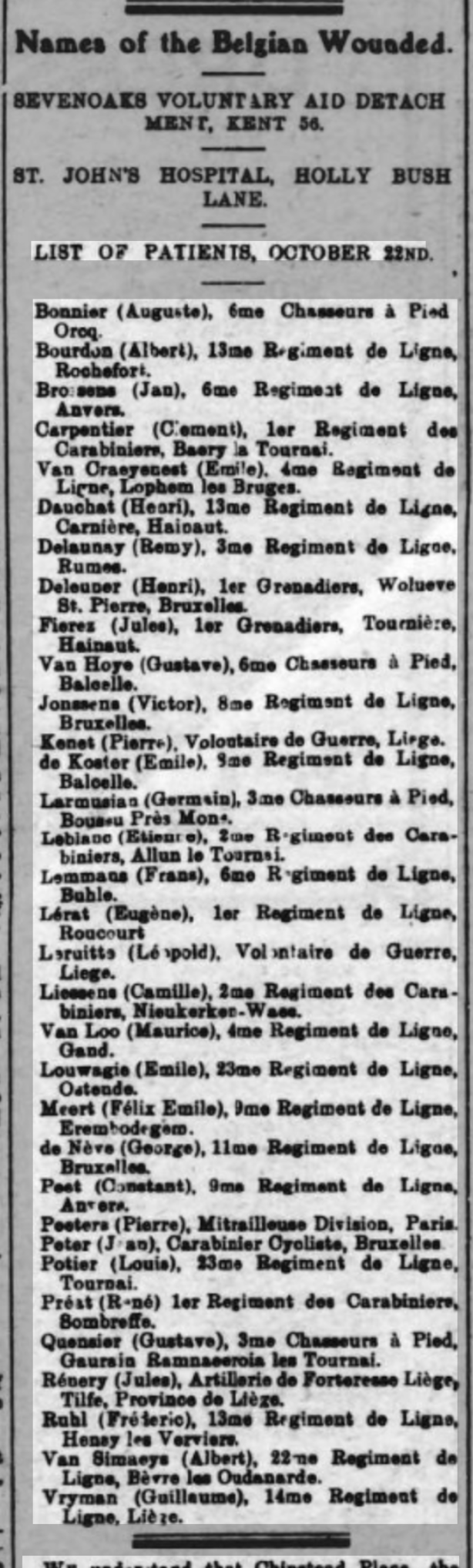
The paper also recorded the number of wounded Belgian servicemen who had arrived in Sevenoaks and the surrounding district, noting that “some of them are really in an awful state of depression, through the loss of the greater part of their families and homes”.

Belgian soldiers were accommodated at the local VAD hospitals, including Cornwall Hall and St John’s and the names of many were listed.Thanks to the Cornwall Hall archive, we know what some of these men looked like, however, although a handful were named in the albums, no surname was given.


image

List of wounded Belgian soldiers in St John’s VAD hospital, published 23 October 1914

According to the Chronicle

At the Cornwall Hall, one soldier was of a regiment which went out 1,400 strong and got cut up by the Germans, only 300 managing to get back to the Belgian lines. He was one of the 300, and he tells how he went over the German trenches in which it was estimated there lay between nine and ten thousand dead Germans. Another tells of how he fell into German hands but managed to escape. He had a terrible wound in his hip and a broken arm.

DSC_0201


DSC_0130

DSC_0194

Photos from the Cornwall Hall archive

At St John’s Hall, there were 33 Belgian patients under the Commandant, Miss Lambarde

The Chronicle again

The patients at this excellent hospital are all Belgians and, in spite of their great troubles, they can be heard happily singing to the tune of a gramophone. Some of them are playing cards, while others eagerly scan the contents of a French journal. The nurses…are doing excellent work, and are very grateful for all the gifts that have been sent, but we understand that all types of dried grocery and perhaps meat would be most acceptable. At this hospital it has been necessary for three operations to be performed, but the patients are progressing favourably.

The paper also carried the story of how one young Belgian soldier had not seen his brother since the start of the war and had thought him missing or injured, but discovered that he was also in Sevenoaks and was able to be reunited with him.

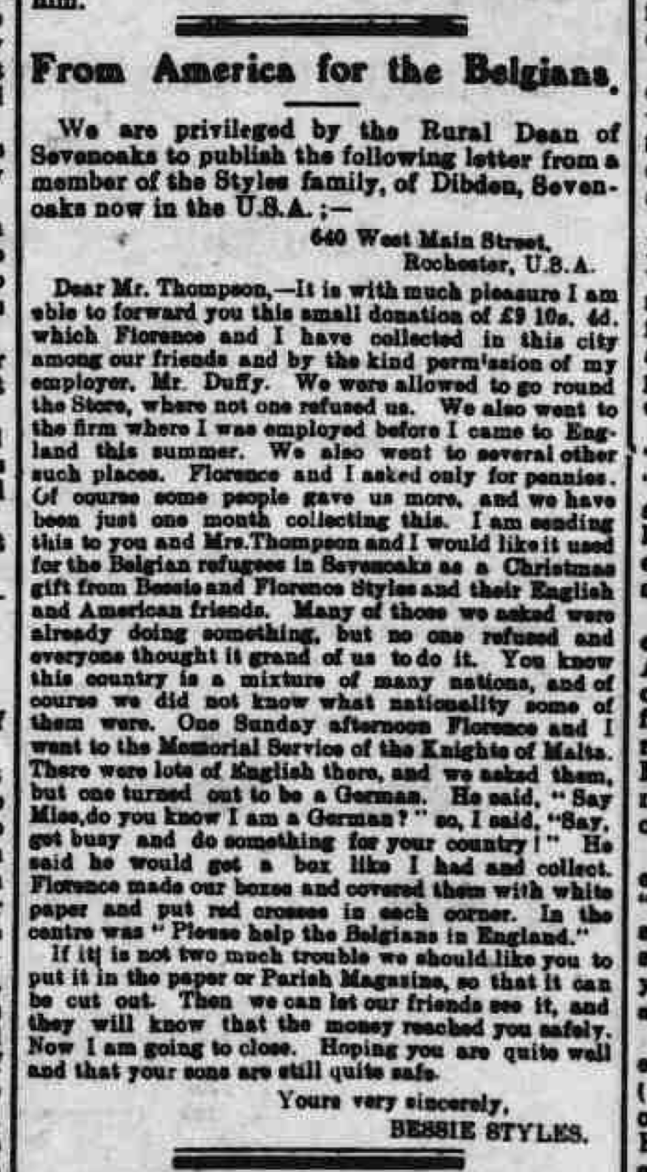
The generosity of the people of Sevenoaks even came from abroad. Bessie Styles, a young woman, formerly of Seal near Sevenoaks, who had emigrated to America, wrote to the vicar of St Mary, Kippington, asking for him to publicise the fact that together with her sister, Florence, she had collected £9 10s 4d from American donors, including one German who undertook to aid her collection. She asked that the generosity of her donors be publicised locally to reassure them that funds raised had reached the intended recipients and so the Rev Thompson had her letter published in the Chronicle in December 1914.

image

Bessie Styles wrote home about the fundraising for Belgian refugees amongst her American friends

A few weeks earlier the Chronicle sent an undercover reporter to chat informally to some of the wounded soldiers and refugees, who, he noted had begun to have “picked up quite a serviceable smattering of English and are now able to make themselves understood”.

Taking into account the many fundraising events, appeals for food and clothing, all of which were well responded to by local people, the paper concluded

Neither in the hospitals nor in the circles of private families throughout the land do we believe that the brave Belgians are being better treated than here in our own town.

This certainly seemed to echo the sentiments of many of the new Belgian residents. On Christmas Day 1914 at the Cornwall Hall hospital, Dr Mansfield was presented with a framed drawing by the Belgian soldiers, which had been drawn by one of the patients, George Dubois. Mrs Mansfield received a small silver stamp box and Mr Fred Keisen addressed the assembled, first in French, then English

For the first time in our lives and in consequence of the grave events which are taking place at the present moment in our beloved country, we are on this holy day which commemorates the birth of our Saviour, far from our homes and families. Although this festival has not in Belgium the significance which characterises it in England, it is for us a day of great joy, for we are always at this season of the year in the bosom of our family. Our grief is great but great is your kindness, for it is in these cruel moments that you have done for us all that was humanly possible to soften our exile, and we thank you very sincerely.

Belgian refugees remained in the town for the duration of the war. They were found homes, supported with food and clothing, helped, where possible, into employment and the people of Sevenoaks maintained the generosity of spirit and fundraising that had welcomed the very first arrivals.

In July 1916 the Sevenoaks Belgian Refugees’ Fund (which had been set up to coordinate relief) published its regular report. The report stated that since its foundation the Fund had “entirely supported or partially assisted over 80 persons” – and individuals had been assisted in a variety of ways, including one disabled soldier, crippled with rheumatism for whom electrical baths had been prescribed. The man had been sent, together with his young family, to Tunbridge Wells to receive this treatment for two months, in the hope that he would be able to work as a chauffeur.

There were some discordant notes. The same report noted King Albert’s request that his countrymen should be found employment rather than forced onto charity and the Fund recorded that

…we have attempted to comply with His Majesty’s request. In this, to our great regret, we have found ourselves hampered by the refusal of several Sevenoaks workmen to permit a Belgian among them.

Though in general, the evidence points to the respect and welcome that Belgian refugees received in Sevenoaks. As ever, news was anxiously awaited of local men serving with the forces and one report from a local soldier highlighted the reciprocal nature of care between the two nations. The Chronicle reported that Percy Ellman, nephew of local resident, Alfred Ellman, had written home to say

My battery was gassed and we lost temporarily a 47 gun. I got lost after the ‘scrap’ for two days but I found a real good Belgian Samaritan, who gave me rest and food and told me he was only returning the kindness shown to Belgian refugees in England.

Support for the refugees in the town continued unabated until the Armistice. The Chronicle reported that many Belgians joined with townspeople in services at the Catholic church to mark the end of the warThere is little evidence to suggest how and when the refugees and wounded servicemen left the town after the end of hostilities. Possibly some kept in touch with their host families and friends they had made. The arrival of so many refugees in the town in the early days of the war was perhaps a stark reminder of the reality of war and how communities are easily displaced, forced to flee with what they could carry. The people of Sevenoaks rose to the occasion, welcoming those who had fled their country and supporting them throughout their stay.


William Guy Cronk – a recent medal sale

Last week someone was kind enough to leave a comment on this site about William Guy Cronk, one of the early casualties of the war from Sevenoaks. William’s medals, along with his memorial plaque and a letter addressed to him, had just been sold at an auction in Hampshire. Listed in the catalogue with a guide price of a couple of hundred pounds, the plaque and trio eventually sold for £1650 after some determined telephone bidding. Initially I was annoyed that I hadn’t seen the medals were up for sale but was consoled by the fact that they were sold for a price way above my medal purchasing budget.

As William is listed on the Sevenoaks War Memorial he is mentioned in my book. He was born on 26th April 1893 and was the only child of William Henry Cronk (1848-1921), a land agent, and his wife Winifred Ruth nee Kidd (1872-1956). The 1901 census shows the family living on Sevenoaks High Street but by 1911 they have moved to Northamptonshire, living with five servants, from parlour maid to coachman and groom. In his obituary the family home is given as Suffolk Place, Sevenoaks.

11987971_1406430124
Second Lieutenant William Guy Cronk

William was educated privately in Westgate on Sea, before going to Eton and then to the Royal Military Academy, Woolwich. According to the Bond of Sacrifice, he enjoyed hunting, polo, cricket and tennis. After graduation he choose to enlist with the East Kent Regiment, The Buffs, and was attached to the King’s Royal Rifles. He was commissioned as Second Lieutenant in March 1914 and left immediately for the Front after completing his training on the last day of that September.

William was killed in action 2 miles east of Zonnebeke near Ypres, on 26 October 1914 whilst leading his platoon in an attack on the German trenches. He was on attachment to 1 Battalion King’s Royal Rifle Corps at the time.

According to the War Diary

“2/Lt Cronk (Buff S.R Attached) was killed on the right. – apparently he was under the impression that the Germans were retiring out of their trenches and rushed forward with part of his platoon. The Germans allowed them to get well out onto the open and then opened a very heavy fire. Almost all of this party were either killed or wounded.”

The battalion suffered 13 killed and 34 wounded – most from D Company (Cronk was D Coy). He was the only officer killed. Two others were wounded.

William was the first fatality to be featured in detail by the Sevenoaks Chronicle, with a photo included in the obituary. The paper recorded that his friend, the Rev. Herbert Fleming, whom he had first met at the Military Academy where Fleming was then Chaplain, wrote to his parents:

“He has died leading his men like the gallant lad he was, without fear and pain”.

He wrote that he had quickly gained the trust and affection of his men, being always thoughtful of them and the best young officer they had.

“This was said before they knew I was his friend. I cannot grieve for him, as no one could desire a greater death or a better epitaph, but for you I do grieve and pray to God to comfort you. I expect to march again tomorrow, and may not be able to kneel by his grave, as he is in another brigade, but I will do if I can”.

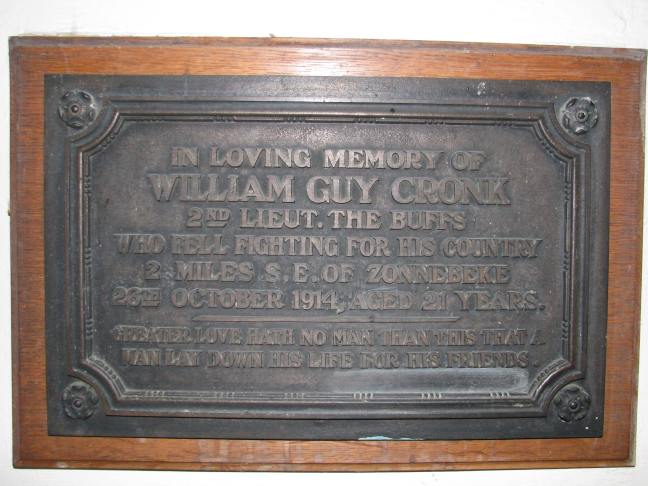
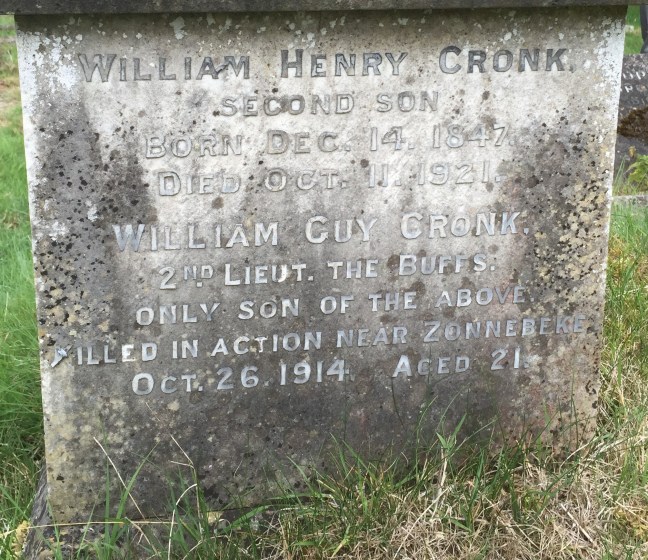
William Cronk is remembered on the Menin Gate and in his former parish church of St Nicholas,  with a memorial plaque. When his father died in 1921, he was buried in the churchyard at St Nicholas and William was also remembered on the gravestone.

IMG_2485

image

Memorials to William Cronk inside St Nicholas as well on the family grave in the churchyard


I would be very pleased to hear from any family members – the Cronks had a long history in Seal and Sevenoaks and other family members are also buried at St Nicholas – and from the person who bought the medals!

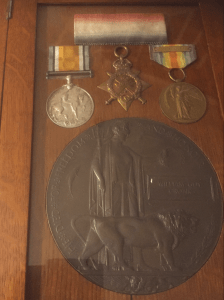
UPDATE: Paul, the bidder who bought the medals successfully has got in touch and kindly shared a photograph of them.

image