Last year I was very pleased to have been asked to join the summer Celebration at Squerryes .
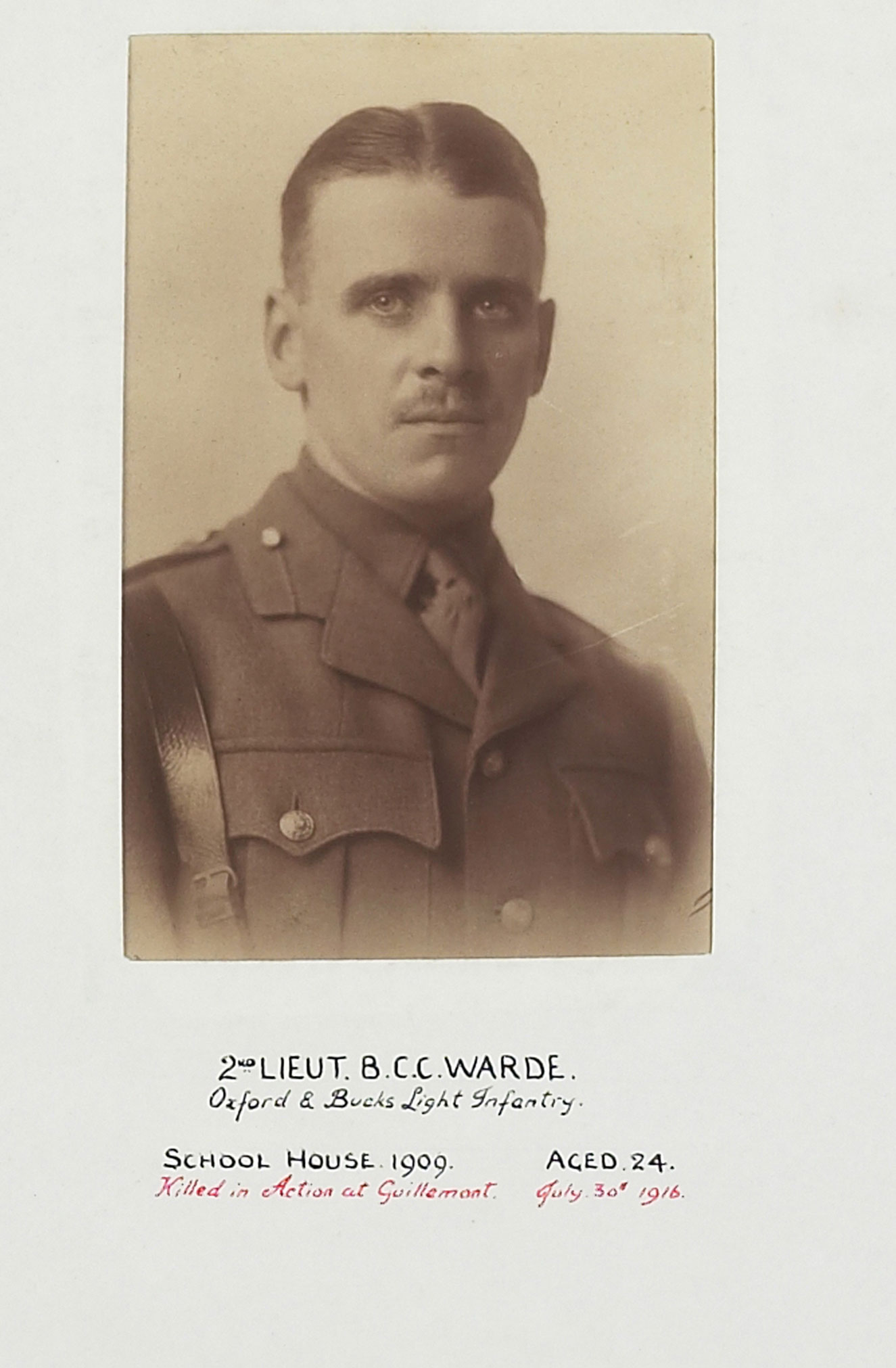
Current owner, Henry Warde, Is a cousin of Basil Charles Conroy Warde, who was killed during the war and is remembered on the Sevenoaks War Memorial. Basil was born in 1892 and had served in Canada with the Royal Canadian Mounted Police or ‘Mounties’ before returning home to England and serving with the Oxfordshire and Buckinghamshire Light Infantry.
A Family Memoir
I hadn’t been able to find out very much about Basil, beyond a photograph and a brief mention in the Sevenoaks Chronicle. However, looking again for more information in advance of this weekend, I found an article written by his Great Great Niece, which had been posted on a Canadian website dedicated to remembering members of the Royal Canadian Mounted Police. The article was published in November last year, after my book was published but I’m delighted that the author, Thomasina Godwin, has allowed me to reproduce it here:
As 2014 marks the 100th anniversary of the start of WWI, I thought it would be the best time to share some photos and information on my great-great uncle Reg.#4989, Basil Charles Conroy Warde.
Basil was born on February 28th, 1892 in Sevenoaks, Kent, England. He was the fifth of six children, and the youngest son. His family were relatives of the Warde’s of Squerryes Court and he received his education at Tonbridge School. Tonbridge is a boarding school for boys located in Tonbridge, Kent, England. It was founded in 1553.Basil and his older brother, Richard, had a thirst to explore other frontiers and work hard for a living. Richard travelled to South America, where for some time he was involved in cattle ranching. And Basil, as you can tell, came to Canada.
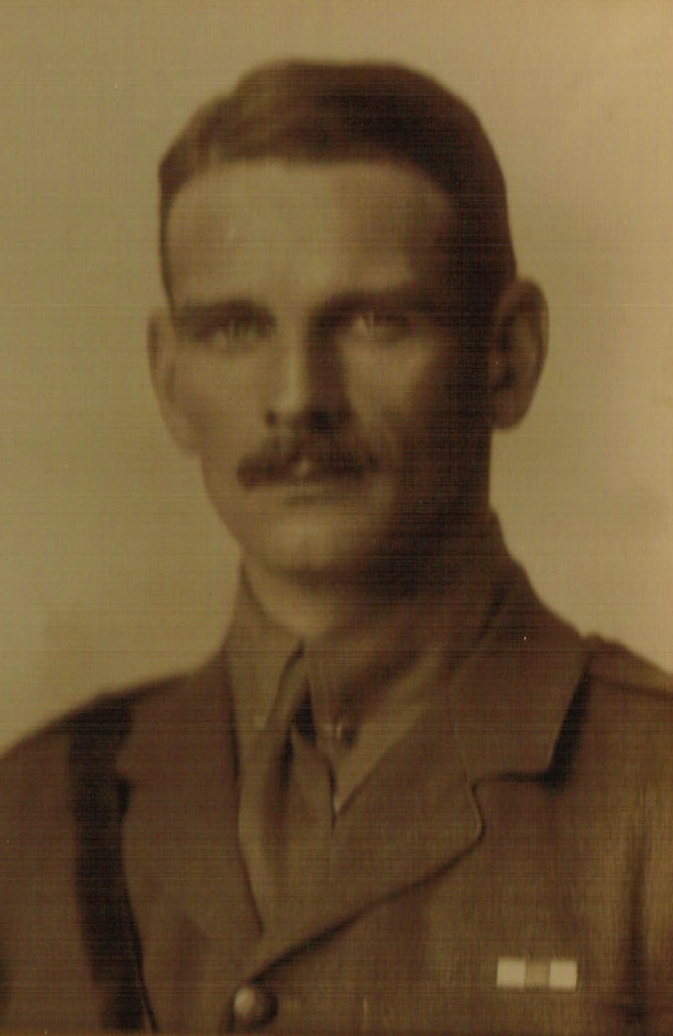
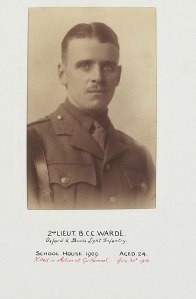 Second Lieutenant Basil C C Warde 1892 – 1916
Basil wasn’t the first in his family to travel to Canada. His great uncle, Major Henry John Warde, came to Canada with the Royal Regiment and he was killed in a duel on May 22, 1838 in Montreal, QC. Basil arrived in Saint John, New Brunswick on January 8th, 1910 aboard the Empress of Britain. He was not yet 18 years of age. The passenger list stated that Basil’s intended occupation in Canada was farming, yet a few days later, on January 14th he had engaged with the Royal North-West Mounted Police (RNWMP).
Not much is known about Basil’s experience with the RNWMP, as many of the service records from that period have been destroyed. Nevertheless, I have a photo of Basil in Gravelbourg, Saskatchewan (photo was dated 1910). At that time, Gravelbourg was a small, budding town with settlers arriving from across Canada, from the United States, and from many European countries.
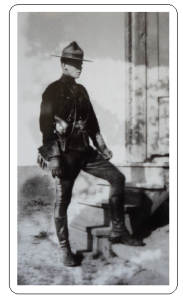 Basil Warde in the uniform of the Royal North West Mounted Police
On October 25th, 1914, Basil arrived back in England as the country was engaged in World War I. He attended the wedding of his sister, Francesca; to Edward Norman Fortescue Hitchins on July 12th, 1915 (these are my great grandparents). My family has some photos of the wedding where Basil can be seen in his military uniform.
On February 28th, 1916 Basil entered France with the 2nd Battalion, Oxford and Bucks Light Infantry. At this point his Battalion were probably in Béthune or the Festubert trenches — it is hard to imagine what frightful conditions Basil would have encountered in the trenches upon his arrival.
Meanwhile, back home in England, my grandmother Enriquetta Mary Hitchins, was born. It was May 23, 1916. Basil would have received the news of Enriquetta’s birth shortly afterwards. On June 19th, 1916 Basil wrote a letter to his new little niece providing her with some insightful life advice.
July 1st, 1916 saw the start of the Battle of the Somme. Basil’s Battalion was involved in operations around Delville Wood and Guillemont. Early in the morning of July 30th, the 2nd Oxford and Bucks Light Infantry and the 24th Royal Fusiliers, supported by 5 Brigade’s Machine Gun Company, attacked from Waterlot Farm towards Guillemont Station, but the attack was unsuccessful and the Units were forced to withdraw. There were heavy casualties that day and Basil was listed as missing and presumed dead. Eventually, his body was located. He now rests in Delville Wood Cemetery, France not far from where he fell.
Basil Warde was only 24 years of age when he died and it was a tough loss for a close-knit family. Some of his personal belongings have been passed down over the years and his memory has not been forgotten. In fact, my sister, a Constable with the RCMP, now holds his RNWMP belt and pin.
‘A Great Grief to All’
Further research has revealed that Basil became Assistant Riding Master and Roughrider with the Royal North West Mounted Police His superior officer wrote of him as the grittiest youngster he had ever known “No matter how many times a horse threw him he was never beaten.” On the outbreak of war he came home and enlisted in the 16th Lancers, but realising that he was less likely to get to France at an early date in the cavalry, he applied for an infantry commission and was gazetted to the Oxford and Bucks. Light Infantry, on June 26th, 1915. He went out the following winter, and was slightly wounded on the first day of the Somme but insisted on carrying on and remained with his Regiment.
On the night of July 30th he was leading his platoon in an attack on an enemy trench when he was seen to fall. He was for long reported missing, but it is now known that he was killed, shot through the head, that night. Letters received from the Regiment testify to his utter fearlessness and his value as an officer, and his CO., writing at the time said that his being “missing” was a ” really great grief to all” and that he “could ill be spared by the Regiment.”
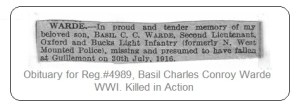
From Nursing to Spying, the Warde Family at War
Basil’s niece wrote to me this week with more information on the war service of Basil’s brother and sister:
Richard Edward Warde, known as Dick (1884 – 1932) attended Tonbridge School with his brother and also served in WW1. I believe he served with the Scots Guards and was wounded in the Battle of Loos. During his convalescence he met and fell in love with Muriel Wilson, who Winston Churchill had once proposed to. They married in 1917. Dick has been described as “an uncomplicated extrovert, very much an outdoor man, with the look of a buccaneer”. There is a story that during the war he had the terrible duty of commanding a firing squad for the execution at the Tower of London, of a spy, who being a soldier, avoided hanging. It is said that Dick sat up all night drinking with the condemned man, until the German passed out and never knew that dawn had come.
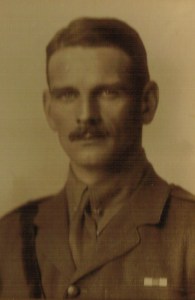 Major Dick Warde
In fact, according to Tonbridge School, Dick Warde served with the 2nd Battalion, Scots Guards, in France from May to September 1915, and from September 1916, to January 1917. He was slightly wounded in the leg on September 25th, 1915, and was again wounded, this time more seriously in the arm, the following day near the Hohenzollern Redoubt. He was twice Mentioned in Despatches for services in France and was awarded the M.C. in 1916. Dick Warde was subsequently employed on intelligence work in 1918, with the acting rank of Major, which he kept on relinquishing his commission in 1920.
Basil and Dick had an older sister who also served during the war. Enriqueta Rosita Jenny Warde (1883 – 1966) was known as Diddy. Diddy trained as a nurse at Sevenoaks Hospital. During WW1 she joined Queen Alexandra’s Royal Nursing Service and was awarded the Royal Red Cross for bravery during a Zeppelin raid. In 1933 she was asked to open and run a private nursing home in Sevenoaks which proved a success. On the outbreak of war Carrick Grange was turned over to the army and for the next five years Diddy was back in uniform and was awarded another Royal Red Cross.
Another sister, Alice Enderica Warde (1896 – 1984) married Col. Bertram Ede, who became head of MI5 on Malta during the Second World War. The couple had two sons, one of whom, Charles Richard Ede, served with the Royal Tank Regiment during the war and went on to found The Folio Society. When he died in 2002, aged 80, his obituary was carried in the Daily Telegraph.
My thanks to Thomasina Godwin and Superintendent J..J. (Joe) Healy (Retired) for their help in the research for this post and kind permission to reproduce material originally posted elsewhere.

 Herbert with wife, Mary and eldest son Arthur, who was also given the name of Mons
 Herbert in hospital in 1917
 Donald Jervis Gordon
 Bernard Vernon Gordon


 Sevenoaks WW1