Searching for the Sevenoaks Anzacs

Many men from Sevenoaks and the surrounding area decided, in the early years of the last century, to seek a better life and emigrate, either by themselves or with their families. Some headed to Canada and others to Australia and New Zealand. I have written in my book, Sevenoaks War Memorial, The Men Remembered, about those who were killed while serving with Australian or Canadian forces.

H06329Francis George Carnell

Those who served with the Australian Imperial Force include the oldest man remembered on the war memorial, Francis George Carnell. Francis was born in Sevenoaks in 1859 and had spent time in Africa, serving as a captain in the Cape Mounted Rifles and in peacetime as part of the Cape Mounted Police. He was thirty five when he arrived in Australia and enlisted soon after the outbreak of war on 5 September 1914. Francis was fifty five and serving at Gallipoli when he was shot in the chest in August 1915. He was evacuated to a hospital ship where he died of his wounds three days later.

The other Sevenoaks Anzacs named on the memorial are George Lauder Hutchison Drummond, a Presbyterian who served with 11th Australian Infantry Battalion; friends Arnold Jarvis and George Marshall, who emigrated together in 1912; Frederick Harold Bourne, a sergeant with 13th Australian Infantry Battalion, who was awarded the Military Medal; Frederick Herbert Clouting, a sergeant with 16th Army Service Corps, who was awarded the Distinguished Conduct Medal and George Richter, the last of the Sevenoaks Anzacs to be killed, who was fatally wounded by shellfire in August 1918. As well as the excellent photo of Francis Carnell, I have been able to find newspaper photos of both George Richter and Frederick Bourne and met relatives of Arnold Jarvis and George Marshall. I would very much like to hear from anyone else connected to these men, all of whom have fascinating stories of bravery and sacrifice.

IMG_2038Frederick Bourne

Tracing these men made me curious as to how many others from Sevenoaks made a similar journey and then fought with their adopted country’s forces. Fortunately, the Australian and New Zealand service records have survived in excellent condition, many having been made freely available online and I have been able to compile the list below:

Australia

Thomas James Allen, enlisted 21 February 1917

William Waters Avis, enlisted 26 August 1914

Frank Barton, enlisted September 1915

Henry Blake, from Shoreham, enlisted 1916

Harold Victor Brooker, from Otford, enlisted 22 November 1915

Hildren Berkley Henn, enlisted 25 April 1918

Horace Brooks, enlisted 28 February 1915

John Reginald Carey, enlisted 4 September 1915

Jack Chandler, enlisted 4 September 1914

Eric Duce, enlisted 24 July 1915

William Edgar, enlisted 26 January 1915

Arthur George William Farrants, enlisted 11 January 1915

George Fleet, enlisted 31 May 1916

George Thomas Gorham, enlisted 29 August 1914

William Gorham, enlisted October 1914

Walter Sylvanus Griffin, enlisted 18 March 1916

John Henry Henderson, enlisted 1 April 1916

William John George Kerry, enlisted 1916

George Henry Nevill, enlisted 20 September 1916

Robert Prendergast, enlisted 16 July 1917

Walter James Roots, enlisted 14 July 1915

George Henry Seal, from Chipstead, enlisted 28 January 1916

Horace Simmons, enlisted 29 November 1916

Frederick Walter Standen, enlisted 24 March 1916

John Basil Steane, from Shoreham, enlisted 26 August 1914

John Henry Tester, enlisted 2 March 1916

Cyril Henry Theobald, enlisted 1 March 1916

Charles George Wood, enlisted 26 January 1917

Oscar John Videan, enlisted 7 March 1916

Percy Wallis, enlisted 21 April 1915

Alec Waterhouse, from Brasted, enlisted 1 October 1915

Harry Worship, enlisted 8 September 1914

Together with the only woman I have discovered so far, nurse, Maie St Clair De Lisle.

New Zealand

Henry Bottle

George Holden Clarke, enlisted 1915

Harry Hodgson Cripps, enlisted 1916

Kenrid Horace Davey, enlisted 1915

William James Parsons, enlisted 6 April 1916

No doubt this is not the complete list but it gives an indication of the number of emigrants from Sevenoaks and the surrounding area who fought as Anzacs The youngest, John Henry Tester, was eighteen when he joined up, the eldest were in their forties. Some were invalided, some killed in action and others survived the war. Not all of those killed were commemorated in Sevenoaks or on nearby memorials, perhaps because they had emigrated with their entire families and there was no one left behind to ensure that their names were added. Some interesting stories have already emerged, such as that of Alec Waterhouse, who had a remarkable war. He was wounded in battle in France and taken prisoner. He escaped from PoW camp twice before making it back to the family home in Brasted. He related the whole story of his capture and escapes to a UK parliamentary group after the war and I am researching the full transcripts of his submission and that of a comrade who escaped with him. His brother William (Jack) also served with AIF and was wounded in battle. There are also photos of Alec and others of the men, such as Walter James Roots, a carpenter who was nearly fifty when he enlisted but gave his age as forty four.

500-3Walter James Roots

As we approach Anzac Day on 25 April and the hundredth anniversary of the Gallipoli campaign, I hope to hear from anyone with a connection to these men and women. All of them took the decision to leave Sevenoaks and seek a better or at least a different way of life in Australia and New Zealand. Later, they took the decision to enlist and crossed half way around the world once again to fight in the war. There is no doubting their bravery and I would be thrilled to hear from anyone who has a connection to any of these names.

Nursing at Cornwall Hall

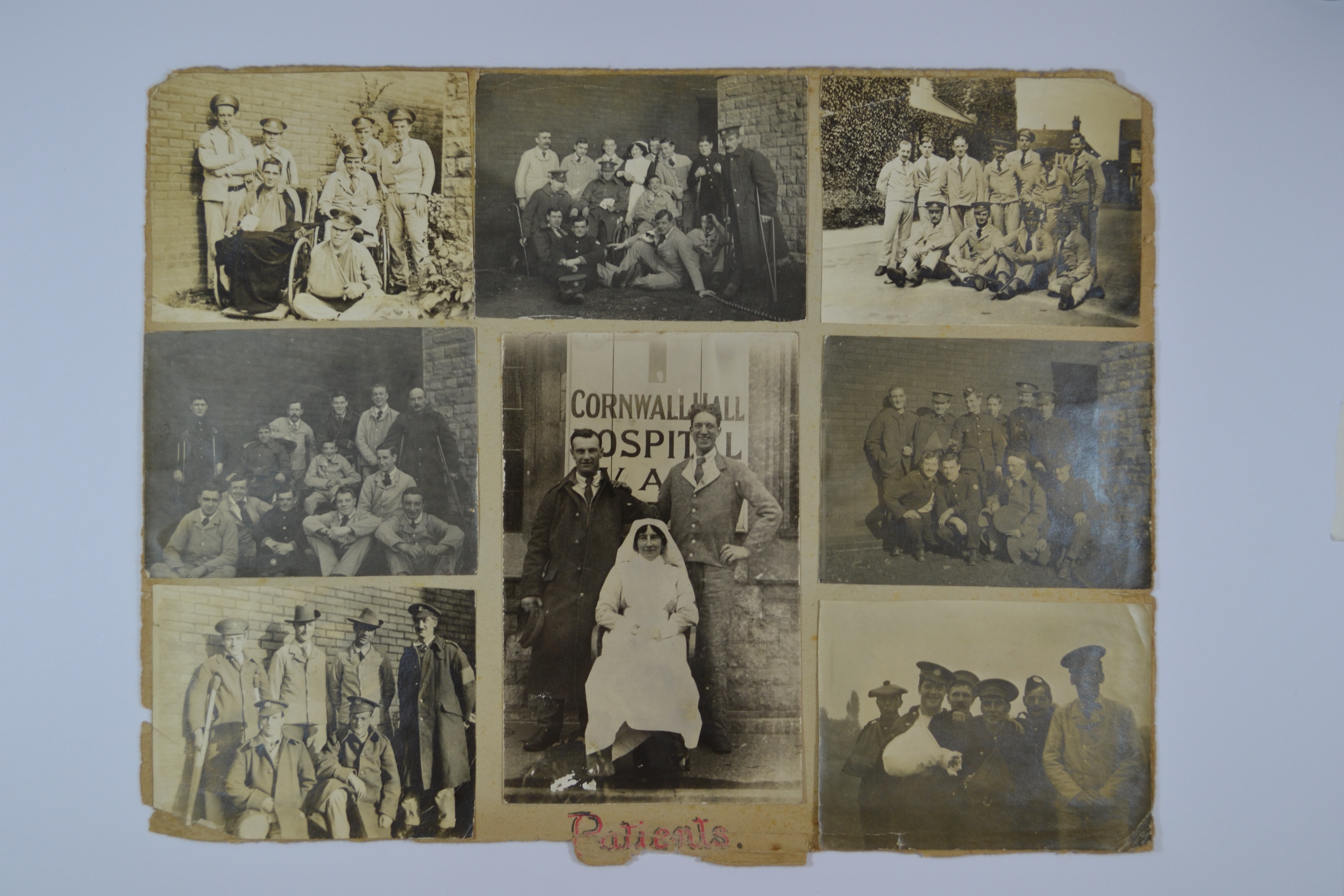
A real treasure trove of information on some of the women of Sevenoaks who worked as nurses during the war is the archive of material left by Kathleen Mansfield, Commandant of the Cornwall Hall VAD Hospital. IMG_2286

Kathleen Mansfield

She was born Kathleen Lilian Clark in October 1885 in Portadown. Kathleen attended Sidcot Quaker school and went on to train as a nurse at Almondsbury Memorial Hospital, north of Bristol. In 1910, she married Dr Percy Mansfield, a family doctor in Sevenoaks and they went on to have four children.

The Voluntary Aid Detachment, commonly known as VAD, was founded in 1909 to provide field nursing services both at home and across the Empire. Kathleen Mansfield joined in 1912 and soon held the post of Lady Superintendent. When a VAD hospital was set up at Cornwall Hall near where the couple lived, Kathleen joined  and became the Commandant, joining husband Percy who was already working as the Medical Officer. Other hospitals were established locally at St John’s Hall in Hollybush Lane, at Wildernesse and on the Combe Bank estate. Vita Sackville West of Knole worked at St John’s, together with (Bridget) Aurea Lambarde, of Bradbourne Hall.

DSC_0183

Staff and patients at Cornwall Hall

Kathleen and her husband served throughout the war, tireless in their work to care for those that arrived at Cornwall Hall, from the Belgian refugees who began to arrive in Sevenoaks in late 1914, to the wounded servicemen who were sent to convalesce throughout the war. Fortunately, Kathleen kept meticulous records, including photographs and letters from the servicemen, with names and service numbers carefully inscribed. The archive also includes some wonderful photos of the nursing staff, who were mainly drawn from the local upper and middle class families of the town, as well as photos of sports days, fancy dress parades, Easter and Christmas celebrations. All of this material, including the glowing testimony of many of their former charges now returned to the Front and recalling the care and comfort that they had received, speaks of the dedication and compassion of the Commandant and her nursing team. Kathleen was awarded the Royal Red Cross in 1917 in recognition of her service. DSC_0253

Staff and patients congratulate the Commandant on her honour

DSC_0321

Telegram from Buckingham Palace regarding her investiture

Kathleen Mansfield died in 1962, surviving her husband by twelve years. Thanks to her family, who have carefully preserved her scrapbooks and given permission for the material to be shared in support of the Nursing Memorial, I will be researching many of those nurses and patients featured within its pages and sharing stories on this website.

One of the nurses featured throughout the archive, is Emma Snow Crump. Emma was born in 1873 in Devon and the 1901 census for Wales shows her working at the Monmouthshire Lunatic Asylum. Ten years later, the 1911 census shows that Emma is as a nurse at Sevenoaks workhouse in Sundridge. Emma Crump joined the staff at Cornwall Hall as a night nurse in October 1914 and stayed there throughout the war, becoming Sister in 1915, Matron in 1918 and Matron in sole charge, 1919. According to her records, she was paid 30/- per week in 1914 and by 1919 this had increased to £2 per week. Emma married in 1926 and lived on until 1952.

IMG_2279

Emma Snow Crump

I’ll be sharing more photos from the Cornwall Hall archive over the coming weeks. As ever, please do let me know if any of your family worked at or had a connection to Cornwall Hall VAD or any of the hospitals in Sevenoaks during the war.

Marjorie’s War

As tomorrow is International Women’s Day and in keeping with my aim of writing more about the women of Sevenoaks and their contribution during the First World War, this weekend’s posts honour some of those local women, from all walks of life, who made a difference. Marjorie Crosbie Hill was one of these. Born in Sutton, Surrey, in 1887, Marjorie was the daughter of William Samuel James Hill and his wife Elizabeth Mary Crosbie. William and Elizabeth had married in Islington in 1871. By 1891 they had moved to Sevenoaks, where William became a prominent resident and JP, and were recorded in that year’s census living at The Red House, once the home of Francis Austen, an uncle of Jane Austen and now the premises of local solicitors, Knocker & Foskett. The  census shows Marjorie at home with five siblings, a governess and three servants. Later the family moved to 50, High Street and by 1911, Marjorie was living with her widowed father at 2, South Park. During the war, Marjorie, who was a Christian Scientist, worked organising and running canteens and clubs for workers at the munitions factories, for the Young Women’s Christian Association. She was awarded the OBE for this war work in early 1918 and this photo was taken around that time. IMG_0931

Marjorie Crosbie Hill

Marjorie’s niece,  Jane Ashmore, recalled:

‘My aunt, at one time, lived next door but one to the old Post Office on return from running two kitchen’s for munitions workers, for which she was decorated. After World War Two, she built herself a house in Burntwood Road, called Tussocks, (her tiny little beech hedge is now huge). Also, she was a well known golfer, belonging to the Knole Club (where she was Lady Captain in 1925 and 1930).’

Marjorie later lived at Stone Street near Sevenoaks and died, aged 80, in 1967. Her elder sister, Barbara, had married Sir James Masterton Smith, who was Private Secretary to successive First Lords of the Admiralty, including Winston Churchill.

Jane Ashmore’s brother and Marjorie’s nephew, Philip Sydney Crosbie Hill, was born in 1917. He was in India, tea-planting in Assam when  the Second World War broke out, and immediately applied for service in the Indian Army. He was an Officer Cadet, undergoing training in the Royal Bombay Sapper and Miners when he was killed in a motor accident in 1941. He is remembered on the Sevenoaks War Memorial.

Jane herself wrote ration books during the Second World War and later joined the First Aid Nursing Yeomanry (Princess Royal’s Volunteer Corps). I was fortunate to be able to speak to Jane last year to talk to her about her memories of her aunt and brother and was saddened to learn that she died in January aged 95.