Mollie’s story, ‘My father was a conscientious objector’

When I wrote about conscientious objectors in Sevenoaks earlier this year, I tried to convey a sense of how the men who objected and their families were viewed and treated in the town but any personal testimony was difficult to find. In the last week, I have been extremely lucky to find exactly what I was looking for in a book of reminiscences from Somerset.

Mollie Wren was born Ivy Florence Tester in 1912 in Sevenoaks to George Tester (1883-1962) and Emma nee Banfield (18881-1960). Known as Mollie, she married Philip Wren and later in life moved to Somerset. In the early 1990’s, Mollie, along with several other elderly women living in the Winsham area, talked about her childhood memories in an initiative run by the South Somerset Reminiscence Project, the results of which were published, with several of Mollie’s family photos included. Mollie died in 1996 and the couple do not appear to have had any children. Fortunately, her memories are clear and evocative of the challenges her family faced as a result of her father’s stance, as the family were abused, ignored and faced financial hardship.
image

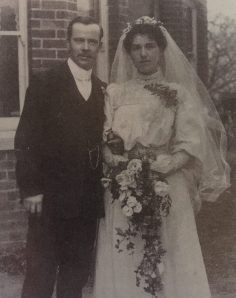
George Tester and Emma Banfield on their wedding day

The 1911 census shows Mollie’s parents, George and Emma, living at 13, St Botolph’s Road with their son, George Albert (1906-1994) with George recorded as a builder. The family were active members of the Vine Baptist Church. By 1916 the family had moved to Cedar Villa, Cedar Terrace and, that June, George was mentioned in the Sevenoaks Chronicle in its report on the proceedings of the  local Military Tribunal. The paper noted that George

wanted to save life rather than take it, but did not object to non-combatant service, to which he was referred.

George’s military records show that he was thirty three and a half, five feet tall, and working as a painter when he subsequently  enrolled with the Non Combatant Corps in July 1916. That December, George was working at Newhaven when he was charged with disobeying a lawful command given to him by an officer while on active service. He was tried by court martial and sentenced to be detained at Wormwood Scrubs.

image

The family at Seaford Cliffs

Mollie recalled this these events in a number of interviews that were edited and published in 1995.

Father said no, he wasn’t going to fight. He just simply believed Thou Shalt Not Kill. He was sent with a lot of others to Seaford Cliffs to load food ships for the troops. He continued with that until they wanted him to load firearms. They all refused. So then we was sent to Lewes gaol and court-martialled. He was tried by Lord Salisbury, who was sympathetic to conscientious objectors. Even so, he sent my father to Wandsworth prison for a year in solitary confinement, and then to Dartmoor Prison for two years and seven months.

image

George (third right) in the workshop at Wormwood Scrubs

As a family, we were ostracised. I remember walking hand in hand with mother along St John’s Road. Two men, up ladders, shouted something abusive at my mother. She gripped my hand tightly and hurried me away. Father had said mother must continue to go to the Baptist church, although no-one spoke to her. I remember walking up the aisle to our pew, which was halfway up the church. My mother held my hand tightly.

A couple of teachers at Sevenoaks Council School were horrible to me because my dad had been a conscientious objector. They felt very strongly.

As my father was a conscientious objector, my mother had no government pay, and in the end she was virtually penniless. One night she knelt at the armchair by the cold grate in the kitchen, and prayed to God to help her. Even as she prayed the front door rattled, and she heard something put through the letterbox. She went through the passage and there was an envelope on the mat. No letter in it, but a five pound note, which in those days was a great deal of money. Mother never forgot this, and she always used to quote me afterwards: The barrel of meal shall not waste, neither shall the cruse of oil fail. And it never did. Finally, kind people came to their senses and brought Mother sewing. She was extremely able. People would bring their sewing on the quiet to start with, but at least it came.

Lord Mons (actually Robert Mond of Combe Bank), who lived at Sundridge Place, gave Home Farm over as a convalescent home for wounded officers and their batmen. Mother became the sewing woman here. Her eldest sister, Fanny, became cook-housekeeper, and my uncle became head cowman.

There was no shortage of food there, despite the war. My aunt was a typical cook of that generation: a large lady in a blue-print dress and snow-white apron, with her lovely hair brushed back. I can see her now, standing at the kitchen table with enormous tin plates covered in pastry, and a gallipot of jam clasped to her bosom, ladling jam onto these plates. Then they were cut in six for the wounded soldiers. They loved her pastry.

Not only was  I spoiled by my aunt, but by the soldiers, I walked out with them in the country lanes and into Sundridge village, where they bought me sweets. A lot of them were married and had children of their own.

There was a great bronze gong hanging on a stand and a stick with a leather ball at the top, I loved sloshing this gong. The soldiers tried to teach me how to work up a real crescendo, but I was too little. I just loved banging it! On Sundays we went to Chevening church in a horse brake, which had seats on either side. There was I, in the middle of all these soldiers, going off to church!

There was one ward for the batmen, and the officers were in another. I remember the long rows of beds and red blankets. One particular officer was very fond of me, and when he was he dying asked to see me. Mother carried me upstairs and told me to be good. We went in with the Matron. I remember being sat on the bed. He held my hand, and his hand was very hot. I remember that clearly but no more. 

image

Mollie and her ‘particular officer’ at Combe Bank

In 1916, my mother took in a lodger, a Miss Bunting. This lady was a brilliant dressmaker. She’d been very adventurous and gone off to Russia and become one of the Tsarina’s court dressmakers. When the Revolution was boiling up, she fled home quickly. One night she tapped at the bedroom door and said, ‘Mrs Tester, you must come quickly! You must see this!’. My mother picked me up out of the cot, wrapped a shawl round me and carried me into her bedroom, which had a wonderful view over the North Downs. And there was this airship going along, a German airship. It had caught fire: it was blazing as it went along. I remember my mother murmuring over my head, ‘Poor souls, poor souls!’.

Father wasn’t released from Dartmoor until 1919. I was seven. Mother couldn’t go to the station to meet him after that separation, so my brother and I went. I remember running round the garden picking a bunch of flowers. It was perfectly ridiculous: I was going to meet this unknown ‘Dad’. I remember getting to the station, and a cloud of steam; and out of it came this man whom my brother rushed to, because he remembered him. Then I remember being crushed, flowers and all, against this man. When we got to the garden gate, Mother, who had been standing watching in the sitting-room window, came to the front door. Father went in, and I was going to prance in after, but my brother hung on to the back of my frock and took me round the garden. He was more sensitive that for just a little while they wanted to be alone.
image

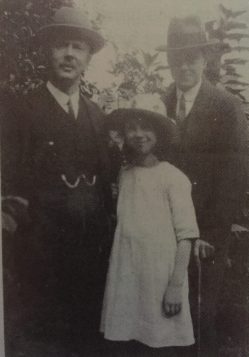
George senior, George and Mollie after the war

George Tester lived on until 1962, surviving his wife, Emma, by two years. His own mother, Martha Tester nee Letchford (1845-1946) lived to see her 101st birthday. Interestingly, she had been born at Chatham Barracks where her own father, Frederick Letchford (1806-1887) was Colour Sergeant with (according to the Sevenoaks Chronicle) ‘the old 50th regiment, known as the Blind Half Hundred’. He had been born in Sevenoaks in the house which eventually became a pub, The Halfway House, and at one point, home to Charlie Draper the subject of a recent post.

Mollie and Philip do not appear to have had children but I would be very interested to hear from anyone who remembers her or any family members who may be able to share more of her and her father’s story. Thanks to Mollie and the oral history team in Somerset, we have this insight into the life of a conscientious objector and his family in Sevenoaks during the war.
 

Remembering Private Hope

Today, on the hundredth anniversary of his death, we are remembering Private Alfred Hope G/11209, 10th Battalion, The Queen’s Own Royal West Kent Regiment.

This morning, together with fellow local historian and author, Ian Walker, I went to the church of St Lawrence, Seal Chart just outside of Sevenoaks where Alfred is buried, to pay our respects.

image

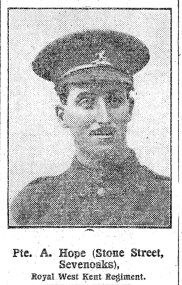
Private Alfred Hope

Alfred Hope was born in 1890, in Sissinghurst, to Mark, a farm bailiff and his wife, Alice, at Lower Fawke farm, where Alfred later worked as a gardener. He grew up with his siblings, Charles Mark, Harry Benjamin, Emily Louisa and Mary.

By the time of his enlistment on 17th November 1915, Alfred and family were living at Stone Street Farm. He served with the Royal West Kents and records show that he was 5’9 and weighed 142lbs.

Alfred joined his regiment, the 10th battalion Royal West Kents, in France in May 1916 and suffered a severe gunshot wound to his leg early that June. He was transferred to England on the SS Brighton to Graylingwell War Hospital, Chichester, where he later died of blood poisoning, surrounded by his family. His body was bought back to Stone Street and buried on the west side of the churchyard at St Lawrence.

The Kent Messenger carried a report of his funeral, recording that he had worked as a gardener. He was also a successful exhibitor at the Sevenoaks Horticultural Society’s Show and a member of the local Gardeners’ Society, and of the St Lawrence Cricket Club. Alfred was also a bell ringer at the church.

During the course of research for my book on the Sevenoaks War Memorial,  I was able to purchase Alfred’s British War and Victory medals, as well as the memorial plaque awarded posthumously. I had already visited his grave two years ago and this morning was a chance to visit again and remember him on the centenary of his death.

image

The church of St Lawrence at Seal Chart

We were met by the Reverend Carol Kitchener and Gretel Wakeham, Lay Reader at the church, who showed us the fine carved memorial to Alfred and the rest of the fallen of the parish (including William Miles, also named on the Sevenoaks War Memorial) inside the church.

image

The parish memorial inside the church

image

Alfred’s grave at St Lawrence

The four of us then went to Alfred’s grave, where Gretel read Psalm 106 and Reverend Kitchener led prayers for Alfred, his family and all those affected by the conflict. We then stood, in that peaceful churchyard in the Kent countryside, on a fine summer’s morning, in silent remembrance.

image

Alfred’s entry in the burial register

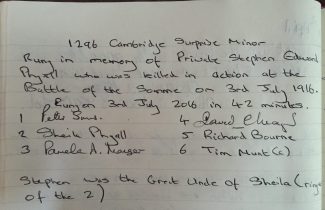
Afterwards, Gretel was able to show us the entry for Alfred in the burial register and we discovered that we were not the only ones to visit the church recently to remember one of the war dead of the parish. The family of Stephen Phyall MM, Private G/386 6th Battalion of the Royal West Kents , who is remembered on the church memorial visited in July to mark the anniversary of his death and rang the 1296 Cambridge Surprise Minor, letting the church bells that he would have been so familiar with, ring out in his memory.

image

Stephen Phyall’s family recorded their tribute to him in the visitors’ book

According to the CWGC, there are two other first world war burials at St Lawrence’s. Hugh Herbert Hodder, died 16th January 1918 and F A Wickham who died of his wounds on 28th September 1915.

My thanks to the Reverend Kitchener and Gretel Wakeham for welcoming us to the church this morning and remembering Alfred with us.


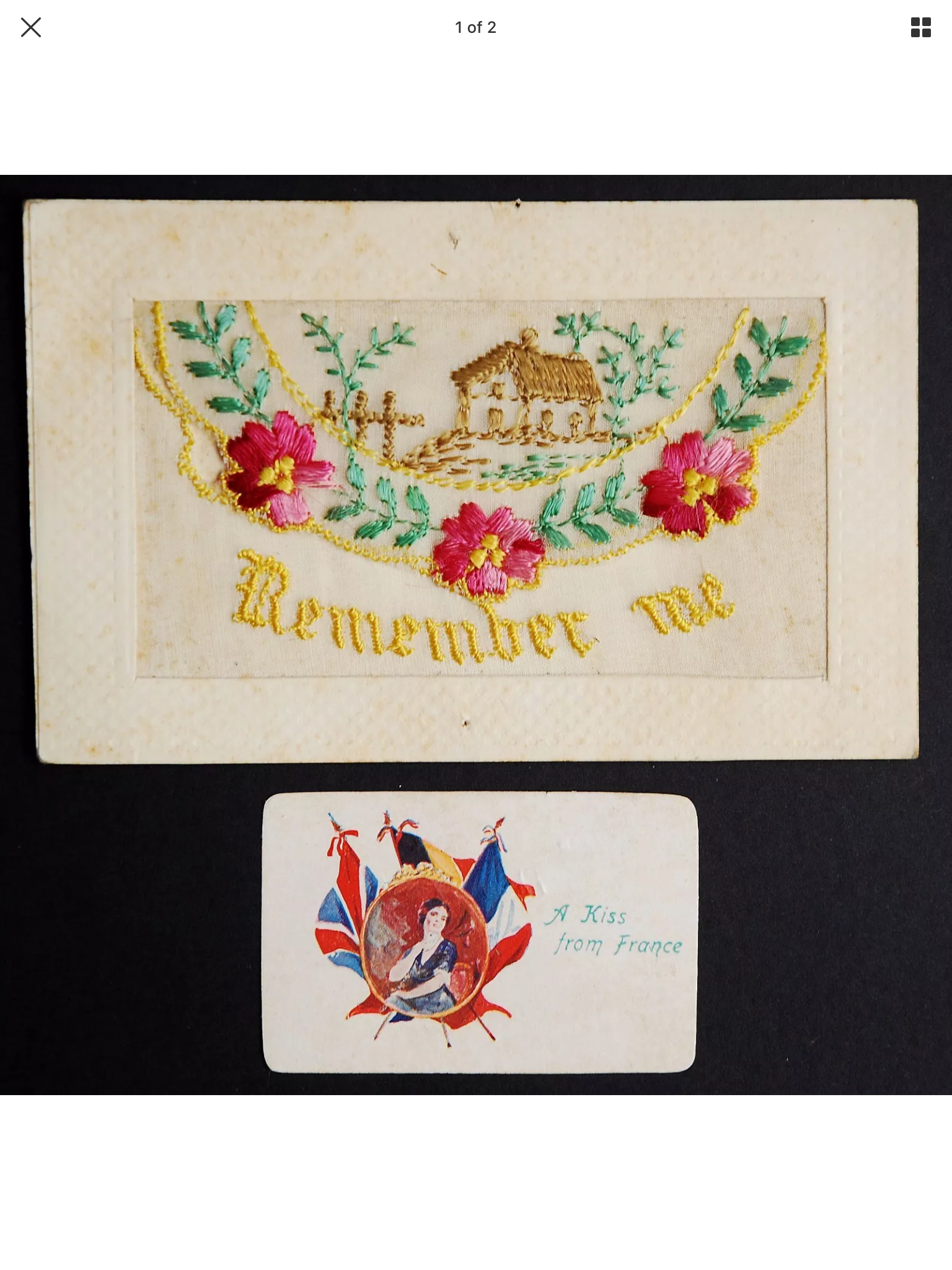
Remember Me – a postcard home

Just this weekend I purchased an embroidered silk postcard from the First World War, in good condition and with the soldier’s name and number written clearly, as well as the name of the recipient.

I try and collect postcards and other ephemera related to Sevenoaks during the First World War, many of which are on display in our postcard gallery to give some idea of what the town would have looked like during this period. This postcard was unusual as the details of sender and addresses meant that it was possible to try and discover more about them.

There is no postmarked envelope to give a date so all I had to go on was the detail given. It was sent by Sapper 24682 C Draper of WR 334 Road Construction Company of the Royal Engineers.

image

image

A quick search on the ancestry website revealed that this was Charlie Draper of Sevenoaks and, fortunately, his service records survive. Charlie’s records show that he was twenty nine and working as an engine driver when he was called up in March 1917, having enlisted the previous March. On enlistment he had expressed a desire to join the Royal Engineers Road Construction Company.

According to his records, Charlie was living at 3, Morants Cottages, Cramptons Road, Sevenoaks with his wife, Elsie Nellie Draper nee Porter, (whom he had married on Boxing Day 1911 in Kippington, Sevenoaks) and his daughter, Elsie Doris, born 1912.

It seems likely that Charlie was employed by the Kent County Council as a letter from the County Surveyor is preserved in his file, which shows that the Council had supported his request to work for the road units in France.

Charlie was sent overseas on 1st March 1917 when he embarked at Southampton bound for Le Havre. In October 1917 he passed a test and was regraded to the skilled rate of engineer pay. The Road Construction Companies performed vital work throughout the war and Charlie’s peacetime skills were no doubt invaluable. It is likely that he was present with 334 Company at Beaumont Hamel in 1917 and I would be interested to hear from anyone who has any more information on this company and its movements during the war. Charlie’s army service continued  until January 1920. He served with 334 Road Construction Company until 24th May 1919, and was then transferred via the base depot to the 5th Transportation Stores Company.

Charlie, as he was christened, was one of seven children born to Charles Draper and his wife, Bertha nee Welfare. Charles Draper senior was well known locally as a cricketer and the landlord of The Halfway House, a pub still open today, not far from Sevenoaks train station on the way to Riverhead.

Through his mother, Bertha, granddaughter of John Wells, Charlie was a second cousin once removed of the writer H . G. Wells. who wrote his novel The Time Machine whilst living at 23, Eardley Road, Sevenoaks.

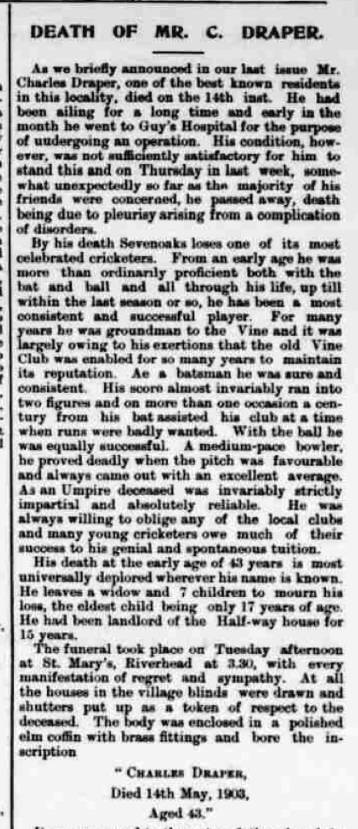
Charles Draper was born in Penshurst in 1860 and had been landlord of the Halfway House for fifteen years when he died on 14 May 1903 at Guy’s Hospital in London. For a pub landlord, Charles received a fulsome obituary in the Sevenoaks Chronicle, a testament perhaps not only to his prowess as a cricketer but also to his personality and he appears to have been much mourned.

The Sevenoaks Chronicle reported that

By his death Sevenoaks loses one of its most celebrated cricketers. From an early age he was more than ordinarily proficient both with the bat and ball and all through his life, up to the last season or so, he has been a most consistent and successful player. For many years he was groundsman to the Vine and it was largely owing to his exertions that the old Vine club was enabled for so many years to maintain its reputation.

Cricket clearly ran in the family as Charles’s father, William (1823-1901), had been a cricket ball maker, while his brother, William (1848-1919) had played first class cricket for Kent from 1874-1880. Another brother, Henry (1847-1896), was a test match umpire. William’s son, Herbert, also served during the war with the Royal Engineers only to die during the Spanish Flu pandemic in November 1919.

Charles’s obituary noted that he left a widow and seven children, the eldest being seventeen.

Charles Draper obituaryThe Sevenoaks Chronicle carried an obituary of Charles Draper

The Chronicle later recorded that the pub licence had been transferred to Bertha but by 1911 she was living at 14, Holyoake Terrace with Charlie, aged twenty three and recorded as a traction engine driver, and five of her other children, including Frank, aged fifteen, a butcher’s assistant . A daughter, Bertha, was residing at 118 High Street at Whyntie & Co. the subject of my last blog post on Cyril John Whyntie.

Charlie survived the war, leaving the army in 1920 and living until 1959 when it appears that he died, aged seventy one, in the St Albans area

Charlie’s younger brother, Frank Draper, enlisted shortly after the outbreak of war,  at Tonbridge in September 1914, was posted abroad in June 1915, and by 1916 had been promoted to Corporal, serving with 6th Battalion of the Royal West Kents. Unlike his brother, Frank did not survive the war and was killed in action in May 1917; the date of his death assumed to be 3rd. Frank is remembered at the Arras Memorial and on the Sevenoaks War Memorial.

What of the the of recipient of the postcard, Miss West, who was perhaps living or visiting at Charlie’s home at Morants Cottages when the postcard was sent? At the moment there is no way of identifying her with any degree of certainty. None of Charlie’s sisters appears to have married a Mr West. The one family of that surname who lived nearby to the Draper family, on Moor Road, did have one daughter of the right age in the 1911 census but she had died by the likely posting of the card in early 1917.

Despite the Draper family being large and well known, I have not been able to trace any descendants of the family, and there are no available photos. I would be very pleased to her from anyone who can shed further light on this story, from more detail of where 334 Road Construction Company was during the war, to any members of the Draper family who may be interested in this snapshot of their family history, all inspired by the detail on one postcard, sent home by a local man with the simple request, Remember Me.