
How we respond to a refugee crisis is one of the biggest questions of our own time and so I have been curious as to how Sevenoaks responded the last time the country saw a significant influx of refugees – how did the town cope, what did the refugees do, how was life altered?
The presence of significant numbers of Belgian refugees from 1914 onwards is a lesser known fact of the war in the public consciousness but there is plenty of evidence available to help answer these questions.
In 1914, the Sevenoaks Chronicle reported, in its Friday 16 October edition that
Since the fall on Antwerp, the Belgian refugee has really begun to make himself felt as part and parcel of London’s population; we may fairly add, of Sevenoaks population too.
Over the next few weeks and months, the paper highlighted how local people were engaged in raising money and collecting clothes for the refugees already in their midst. On 23 October, the Chronicle reported a whist drive being held in the Weald for the destitute Belgians Fund, while Mr Frank Robinson let it be known that the cinema was admitting Belgian refugees and soldiers in to the mid-week and Saturday matinee for free, to see such films as A Sporting Chance and the patriotic Your County Needs You.
The same edition of the paper carried names of some of the first refugees to arrive as well as those Sevenoaks residents who had opened up their homes to receive them. Madame de Chauvaux-Marlier, together with her four children and two other adults were staying at Bulimba, the grand residence of the Hemmant family, Mdme Chainage-Rooms of Liege was staying at Ashgrove with her children, and Mrs Hawkes, an English refugee from Insterburg, was staying at 10, Eardley Road, her husband being interned at Spandau fortress.

List of refugees published 23 October 1914
J S Richardson, Secretary of the Working Committee of the Sevenoaks War Relief Fund (who was later to be killed on active service and is remembered on the town war memorial) wrote to the paper asking for those hosting or otherwise responsible for any refugees in the town, to register them by completing a form to aid in the compilation of a national register.
A letter also appeared in the paper from Mr Swanzy, Chairman of the Urban District Council.He appealed for more means to deal with the “present and future needs of the Belgian Refugees in Sevenoaks”. Swanzy noted that
Were it not for the brave resistance of the countrymen of these exiles France would probably now be completely over-run by the common enemy and the prospects of the Allies very different to what they are to-day. Try to imagine what we would feel, if, like these people, we were fugitives with no means of livelihood for the future. In most cases they have the terrible certainty that their homes are wrecked and they stand stripped of practically everything.
We cannot exploit the sorrows of our guests. They are here in our midst, representative of every class, members of the aristocracy, tradesmen, artisans and country people. All alike in having lost everything.
The paper also recorded the number of wounded Belgian servicemen who had arrived in Sevenoaks and the surrounding district, noting that “some of them are really in an awful state of depression, through the loss of the greater part of their families and homes”.
Belgian soldiers were accommodated at the local VAD hospitals, including Cornwall Hall and St John’s and the names of many were listed.Thanks to the Cornwall Hall archive, we know what some of these men looked like, however, although a handful were named in the albums, no surname was given.
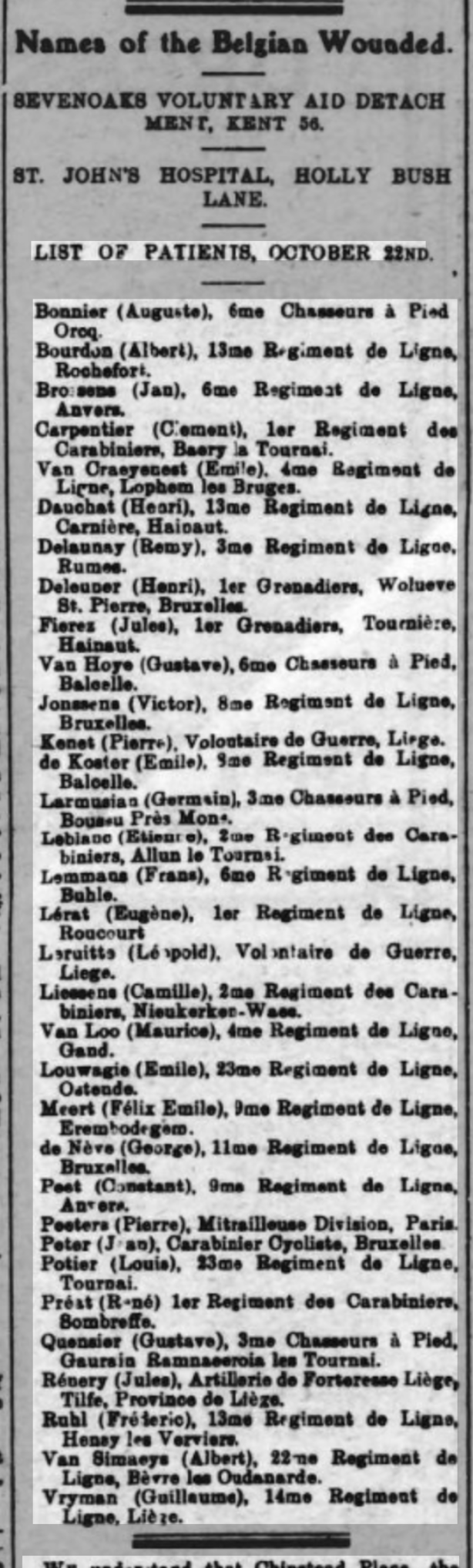
List of wounded Belgian soldiers in St John’s VAD hospital, published 23 October 1914
According to the Chronicle
At the Cornwall Hall, one soldier was of a regiment which went out 1,400 strong and got cut up by the Germans, only 300 managing to get back to the Belgian lines. He was one of the 300, and he tells how he went over the German trenches in which it was estimated there lay between nine and ten thousand dead Germans. Another tells of how he fell into German hands but managed to escape. He had a terrible wound in his hip and a broken arm.


Photos from the Cornwall Hall archive
At St John’s Hall, there were 33 Belgian patients under the Commandant, Miss Lambarde
The Chronicle again
The patients at this excellent hospital are all Belgians and, in spite of their great troubles, they can be heard happily singing to the tune of a gramophone. Some of them are playing cards, while others eagerly scan the contents of a French journal. The nurses…are doing excellent work, and are very grateful for all the gifts that have been sent, but we understand that all types of dried grocery and perhaps meat would be most acceptable. At this hospital it has been necessary for three operations to be performed, but the patients are progressing favourably.
The paper also carried the story of how one young Belgian soldier had not seen his brother since the start of the war and had thought him missing or injured, but discovered that he was also in Sevenoaks and was able to be reunited with him.
The generosity of the people of Sevenoaks even came from abroad. Bessie Styles, a young woman, formerly of Seal near Sevenoaks, who had emigrated to America, wrote to the vicar of St Mary, Kippington, asking for him to publicise the fact that together with her sister, Florence, she had collected £9 10s 4d from American donors, including one German who undertook to aid her collection. She asked that the generosity of her donors be publicised locally to reassure them that funds raised had reached the intended recipients and so the Rev Thompson had her letter published in the Chronicle in December 1914.
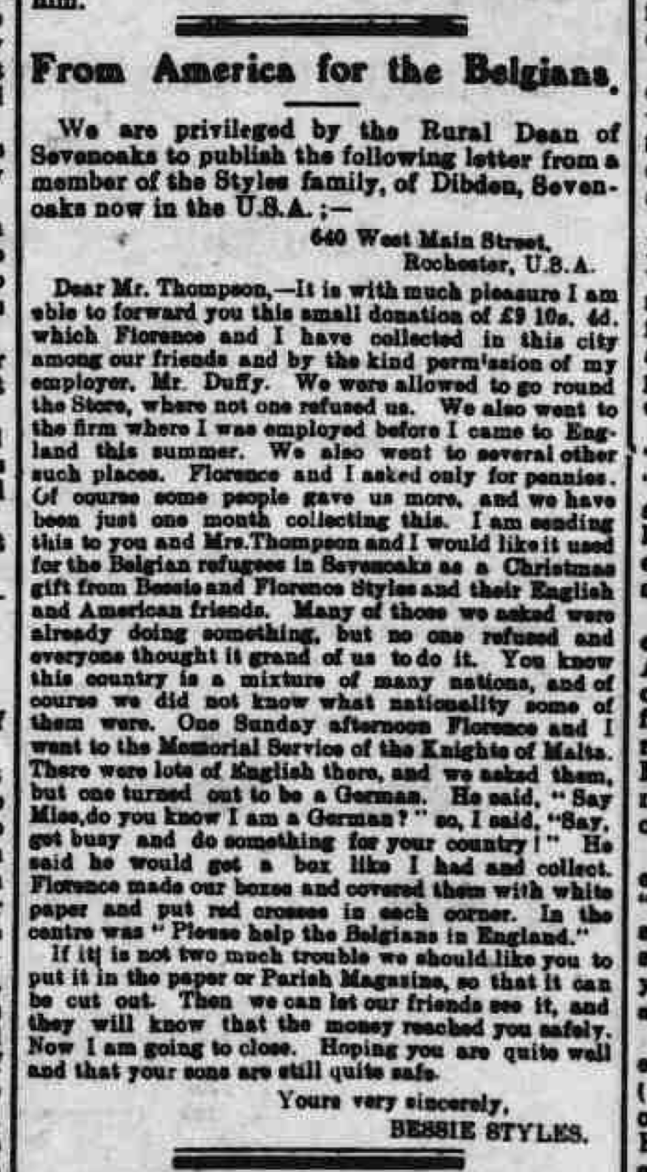
Bessie Styles wrote home about the fundraising for Belgian refugees amongst her American friends
A few weeks earlier the Chronicle sent an undercover reporter to chat informally to some of the wounded soldiers and refugees, who, he noted had begun to have “picked up quite a serviceable smattering of English and are now able to make themselves understood”.
Taking into account the many fundraising events, appeals for food and clothing, all of which were well responded to by local people, the paper concluded
Neither in the hospitals nor in the circles of private families throughout the land do we believe that the brave Belgians are being better treated than here in our own town.
This certainly seemed to echo the sentiments of many of the new Belgian residents. On Christmas Day 1914 at the Cornwall Hall hospital, Dr Mansfield was presented with a framed drawing by the Belgian soldiers, which had been drawn by one of the patients, George Dubois. Mrs Mansfield received a small silver stamp box and Mr Fred Keisen addressed the assembled, first in French, then English
For the first time in our lives and in consequence of the grave events which are taking place at the present moment in our beloved country, we are on this holy day which commemorates the birth of our Saviour, far from our homes and families. Although this festival has not in Belgium the significance which characterises it in England, it is for us a day of great joy, for we are always at this season of the year in the bosom of our family. Our grief is great but great is your kindness, for it is in these cruel moments that you have done for us all that was humanly possible to soften our exile, and we thank you very sincerely.
Belgian refugees remained in the town for the duration of the war. They were found homes, supported with food and clothing, helped, where possible, into employment and the people of Sevenoaks maintained the generosity of spirit and fundraising that had welcomed the very first arrivals.
In July 1916 the Sevenoaks Belgian Refugees’ Fund (which had been set up to coordinate relief) published its regular report. The report stated that since its foundation the Fund had “entirely supported or partially assisted over 80 persons” – and individuals had been assisted in a variety of ways, including one disabled soldier, crippled with rheumatism for whom electrical baths had been prescribed. The man had been sent, together with his young family, to Tunbridge Wells to receive this treatment for two months, in the hope that he would be able to work as a chauffeur.
There were some discordant notes. The same report noted King Albert’s request that his countrymen should be found employment rather than forced onto charity and the Fund recorded that
…we have attempted to comply with His Majesty’s request. In this, to our great regret, we have found ourselves hampered by the refusal of several Sevenoaks workmen to permit a Belgian among them.
Though in general, the evidence points to the respect and welcome that Belgian refugees received in Sevenoaks. As ever, news was anxiously awaited of local men serving with the forces and one report from a local soldier highlighted the reciprocal nature of care between the two nations. The Chronicle reported that Percy Ellman, nephew of local resident, Alfred Ellman, had written home to say
My battery was gassed and we lost temporarily a 47 gun. I got lost after the ‘scrap’ for two days but I found a real good Belgian Samaritan, who gave me rest and food and told me he was only returning the kindness shown to Belgian refugees in England.
Support for the refugees in the town continued unabated until the Armistice. The Chronicle reported that many Belgians joined with townspeople in services at the Catholic church to mark the end of the warThere is little evidence to suggest how and when the refugees and wounded servicemen left the town after the end of hostilities. Possibly some kept in touch with their host families and friends they had made. The arrival of so many refugees in the town in the early days of the war was perhaps a stark reminder of the reality of war and how communities are easily displaced, forced to flee with what they could carry. The people of Sevenoaks rose to the occasion, welcoming those who had fled their country and supporting them throughout their stay.


 Sevenoaks WW1