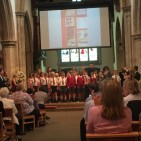
Wartime Christmases in Sevenoaks

Mention Christmas and the First World War to most people and they’ll imagine some variation of Christmas truces, football between the warring sides and the seemingly general notion that ‘it will all be over by Christmas’. Certainly Cedric Gordon of the North Staffordshire Regiment wrote this to his mother from France in September 1914. But there would be a further three Christmas Days before the Armistice was signed and I want to look at what that entailed for the people of Sevenoaks, those at war and at home.

In 1914, the popular firm of S.Young and Co. used its regular advertisement in the Kent Messenger to promote its Grand Bazaar, setting the tone by asking the question: Christmas as usual? Why not?

There are thousands of soldiers and sailors to whom Christmas will mean more this year than ever before. There are thousands of children for whom Christmas would be as indeed if the old customs were not kept up.

image

With so many local men away and large numbers of Belgian refugees in the town, as well as wounded servicemen at the newly established hospitals, fundraising was the order of the day.
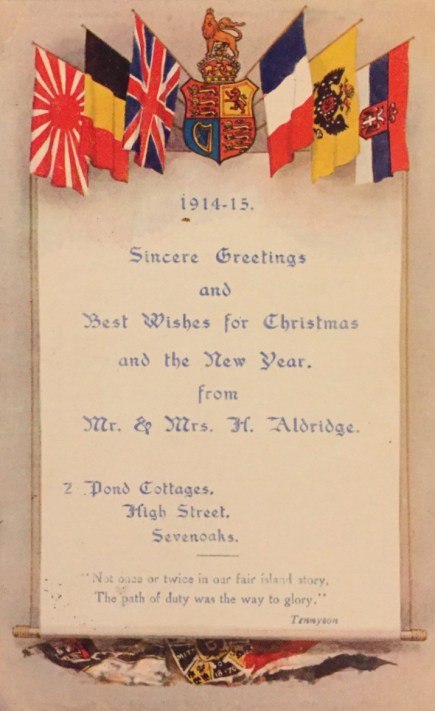
Christmas Card

Patriotic Christmas cards like this were sent in 1914

Lord and Lady Sackville hosted a concert at Knole in aid of the St John’s hospital where their daughter, Vita, was Commandant. Held on the afternoon of 15th December, the concert featured some well known artistes, including Miss Phyllis Dare and Miss Constance Collier. Children of the estate workers were also invited to a Christmas tea on a Wednesday afternoon.

The troops billeted in the town were not forgotten and the Territorials Christmas fund raised £167 17s 5. which was distributed between 4th and 5th Loyal North Lancashires, 4th and 5th King’s Own, the Army Service Corps, and the Army Medical Corps and Divisonal Headquarters division. The remainder being given to the Soldiers’ and Sailors Families Association.

Letters sent home were regularly forwarded to the Sevenoaks Chronicle to be reproduced for popular consumption. In 1914 Private F G Saxby of G Company 4th Battalion Royal West Kent Regiment wrote to local recruiting officer Captain H W Knocker

I am pleased to say that I am quite enjoying myself in my new life. The fellows here are a very sociable lot. The food we have is very good indeed and I have no doubt Major Laurie looks after G Company as well as any.

Our 1st Lieutenant is the Reverend Percy Thompson’s son, and our Second Lieutenant is Archdeacon Dunkerley’s son of St John’s.

I expect to get home for Christmas and I hope I shall as I have always spent it at home up till now. We have some very nice route marches of sixteen to eighteen miles and come home very tired, but full of fun. We have a football XI and are going to play for a cup and shield among the Companies. After all, army life is not all bad.

In January 1915, the Sevenoaks Chronicle printed an article by Thornton Shaw on How Our Troops Fared at Christmas. The article was in fact more of a guide to the men of the north and what was perceived as their strange habits.

“You have got to know the average Northerner before you can hope to understand him. He is, by nature, hardy and brusque, he often omits to lift his cap (which he wears in great preference to a bowler hat) to his lady friends and when he is not on military duty he has an inherent objection in saying “sir” to anybody on earth. But he possesses a heart as big as the wide world itself…”

He continued

“And if some of them seem just a little bit uncouth you must forgive them. And they have done Sevenoaks heaps of good in the matter of trade. Ask any tradesman you like…”
Shaw noted that the residents of Sevenoaks had raised £710 to ensure that the soldiers present in the town during Christmas enjoyed the festivities, with lavish amounts of food and entertainment; one contingent of 25 men “polished off an entire pig between them…as my informant (an officer) laughingly remarked ‘only a collier could have done it’”.

All of the men, wrote Shaw, were grateful but also wistful for the lives they had left at home, one corporal remarking, as he posted home a box of chocolates to his wife
“Ah’d reyther ‘uv bin up at whoam, if ah’d had nowt but kippers”.

News sometimes arrived home from Sevenoaks men being held as prisoner of war. One such man was twenty year old Albert Hayward, the son of William, an old soldier and his wife Jane, who resided at 13, Buckhurst Avenue, Sevenoaks. Albert was working as an apprentice printer before the war and enlisted in London in November 1914. He fought at Ypres With 2nd Battalion The Buffs, where he was taken prisoner in April 1915.

The Chronicle carried a report in January 1916 under the title A Sevenoaks Soldier in Germany, Xmas in an Internment Camp, which featured a postcard that Albert had written to his parents:

Just a hurried line to thank you for the two parcels which I received in quite good condition. I think I told you that the pudding was quite good, and that the cigars were quite nice and mild. I enjoyed my ‘Xmas quite well under the circumstances. My chum and I had a tin of mutton chops, ‘Xmas pudding, beef and vegetables, for dinner. Of course we managed to forget nuts, oranges, apples etc. the ‘boss’ gave us a bag containing 50 cigarettes, buns and lbs of apples; we also had a ‘Xmas tree decorated up, and we were allowed one bottle of lager beer, which was half the dinner. I hope you all had a very enjoyable ‘Xmas and New Year, and good weather, for we have had some heavy falls of snow lately, but it has changed to rain now. Please tender my thanks to the Rev J Rooker for the card he sent me of the Parish Church. I hope you are all as well at home as this letter leaves me – in the best of health.”

Albert saw one more Christmas before he died as a result of his diabetes in Otcober 1917. He is buried in the Niederzwehren Cemetery in Hessen, Germany and both brothers are remembered on the family grave at St Nicholas’ Church, Sevenoaks.

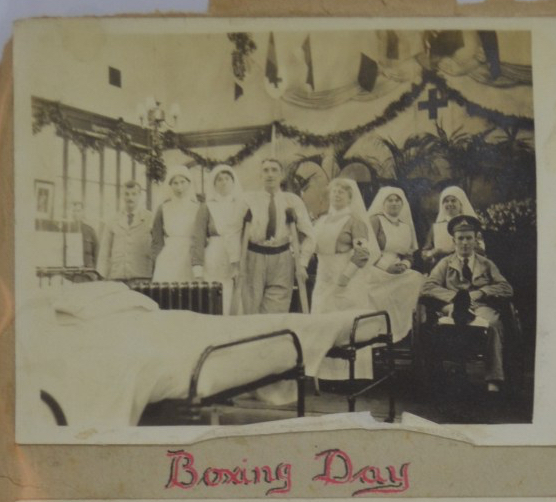
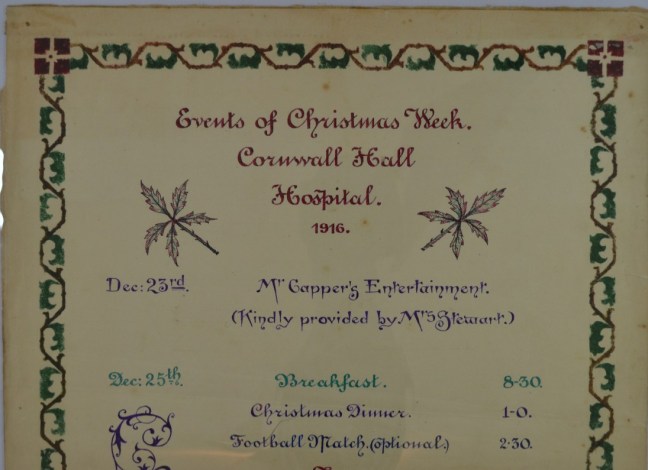
Throughout the war years, the Chronicle reported how Christmas was spent in the local VAD hospitals, where staff and patients celebrated the festive season together. In 1916, the large ward at Cornwall Hall was decorated with holly and laurel. Another ward featuring ‘a model of a gigantic Zeppelin, with excellent models of aeroplanes in close proximity to it’.

image

The paper printed a letter from A PATIENT, who outlined what he and his fellow patients had enjoyed

On Christmas Day, after many of the nurses and patients had attended Divine Service at the Parish Church, there was an incessant round of festivities, commencing with a splendid dinner, served in the large ward (cooked at the Royal Crown Hotel, through the kind thoughtfulness of Mr Marshall). Crackers and flowers made the tables look inviting, but when the board was covered with turkeys, mince pies, plum puddings and dessert, the effect was greatly increased.
image

image

At St John’s Hall hospital,

The festivities began in the early morning with the good old custom of Santa Claus, each man waking up to find  bulging sock in his bed; a surprise provided by the staff and much appreciated by the patients.

In the afternoon, after a typical Christmas tea, there was the stripping of a fine Christmas tree laden with gifts of all kinds, both or the staff and patients. A first-rate football from the nurses to the patients caused much applause as being a happy omen of future victories.

image

In its 1918 Christmas editorial, the Chronicle noted that despite the still somewhat dimly lighted streets, Sevenoaks has been wearing during the past week or so, a cheerier aspect. The Christmas of 1918 promises to carry with it some of the old-time gaiety. Peace on earth has a greater meaning than, perhaps, it ever had before.


Fifty years on – veterans remember

Half a century ago, the fiftieth anniversary of the First World War prompted many veterans to remember their wartime service or to recall life at home during the conflict. Fortunately, some of these memories have been preserved as the Sevenoaks Chronicle reported the thoughts of these veterans as they either returned to Sevenoaks where they had once been garrisoned, or looked back to their boyhoods to a time when thousands of soldiers were stationed in the town, along with many wounded at the local VAD hospitals, as well as refugees from Belgium.

Fifty years after he had been stationed in Sevenoaks as a Private with 5th Battalion King’s Own Royal Lancashire Regiment, between November 1914 and February 1914, Harry Burrow returned to Sevenoaks. Harry was interviewed by the Chronicle during his visit and said

Sevenoaks was utterly familiar. I booked into the famous Royal Oak Hotel and it had many of it 1914 qualities. Sevenoaks was still full of riches and Granville Road was no exception. At the junction with Eardley Road, recognisable to me at once, were the two detached houses commandeered for our battalion HQ and Quarter-Master stores. Down at Tubs Hill, to my delight, I found the Elite. This was the local flea pit, a small music hall.

On Thursday nights the local talent tried out its stuff. Entrance was 2d for men in uniform. The stage was still there but the laughing legion of the 5th King’s Own had long since dissolved. On the other side of Tubs Hill station I found Holyoake Terrace and to reach it I drove over the main bridge where we had assembled on the bleak, historic, wet and cold St Valentine’s Day 1915 to embark for France. At Knole Park, all I could do was peer in the gates and see again in flashback our battalion in trench digging practice. Little did I know that within a few months this was to become a stern reality.

In 1914 the main shopping street was full of dignified horse and carriage trade and urbanity. Now much of that personality was lost. The Shambles area retained its antiquity and I was delighted to find the pavilion band stand on the Vine had not changed. I was swept back to a Sunday afternoon where we sat expectantly in the gardens, a great concourse of khaki figures, when a lady mounted the platform. She wore a flimsy hat and, to our delight, Lancastrian red roses on her bosom. In a moment she slipped into the rousing, emotionally, recruiting song that was sweeping the country. A thousand cheers, a thousand pair of clapping hands, a thousand hearts wishing she would do the kissing now. And then her encore, ‘you made me love you, I didn’t want to do it’. She was Mrs Reubens, someone said, the wife of Paul Reubens, the composer.

John Edward Smith was featured in the Sevenoaks Chronicle in 1966 in his workshop at the foot of Wickenden Road. A local resident and a gunmaker during the war, he was also best man at the wedding of the parents of future Prime Minister, Edward Heath.

image

John Smith with son, Leslie, in his workshop

Smith worked at Woolwich Arsenal during the war, where he was in charge of a giant steam hammer, which could be adjusted so closely that it would come down on a watch placed on the anvil without breaking the glass. “I used to do it regularly. When the hammer fell, you couldn’t pull the watch out, but the glass was still intact”.

Smith bored 100ft long gun barrels for naval vessels. When the Zeppelin raids came he would climb into a barrel and wait until the bombing as over. “There was never a safer air raid shelter”. He recalled seeing Zeppelins brought down at Potters Bar, Cuffley and Billericay and was closeby when the Silvertown ammunition dump blew up.

Frederick Charles Zealey returned to Sevenoaks from further afield, having emigrated to Australia in 1920. Zealey was born in 1904 at the Limes, St John’s where his father was a well known builder. He attended Cobden Road School before graduating to the school at nearby Bayham Road. Although too young to enlist himself, his brother, Arthur William Zealey (1894 – 1960) served as a corporal with the West Kent Yeomanry and was stationed in India.

imageArthur Zealey stationed in India
Frederick recalled his memories of wartime Sevenoaks, writing for the Sevenoaks Chronicle that

I can remember when the firm of Quinnells, the removalists and contractors had a traction engine which pulled vans and wagons through the town, in 1911 – the Coronation year.

This engine and three open wagons, all covered in bunting took all the school children up through the town to Knole Castle (sic) where we had a picnic on the green in front of the castle.

I also remember Mr H Hill, the baker at St John’s, with his bread cart and blind white pony – also Mr Kipps, the butcher, with his butcher’s carts and his piebald pony Tetratch It used to pull a governess cart or trap around the town, and in it would be Mr and Mrs Kipps, their daughter, and son George, who was killed in World War One.

Intriguingly, Zealey continued

I have a photo of the men of the Royal West Kent Regiment on the Tubs Hill Station, waiting for the train to France on about August 4, 1914. Sevenoaks in those days became a garrison town for troops, and many were in billets and empty houses. Regiments such as the Loyal North Lancashires, Yorkshires, and King’s Own were stationed in Sevenoaks. I attended the unveiling of the war memorial at the Vine after the war.


image

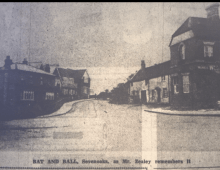
Bat & Ball from Zealey’s own photographs

The old cinema was opened before World War One and the prices listed in the Sevenoaks Courier were listed as twopence a seat for children and nice plush seats for 6d and 9d and 1s for the gallery. There used to be a pianist to play and sometimes a violinist. You could hear us roar the house down at Charlie Chaplin, Steve Hart, Broncho Bill, John Bunny, and Flo Finch, and other old time film actors.

We used to play in the old Oast House or hop kiln opposite the cinema, long since pulled down.

I’d be very pleased to hear from anyone related to these men, especially if any photographs from the time are still in their possession.


Echoes across the century – a memorial for William Goss Hicks

An exhibition at the Guildhall Art Gallery in the City of London is telling the story of local man, William Goss Hicks, who died as a result of his wounds on 3rd July 1917. The exhibition has been curated by artist Jane Churchill, a Great Great Niece of Hicks, and Alison Truphet. Based on Hicks’ life and drawing on family documents and his romance with fiancée, Jessie Ellman, Jane has worked with City livery companies and local school children to produce a moving chronicle of her uncle’s life, including many creative responses to the story from the children. The exhibition features over 600 objects through which real and imagined tales are told through heritage artefacts and reactive ‘response’ artworks.

img_5984

img_5985

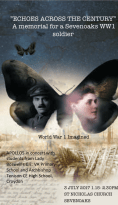
This Monday, 3rd July, on the anniversary of his death, family and local residents remembered Second Lieutenant William Goss Hicks at St Nicholas, the church where, with his fine singing voice, he was a member of the choir and helped run the Sunday School. Children from Lady Boswell’s School and scouts from the 1st Sevenoaks (Hicks Own)  took part to remember their former headmaster.

William Goss Hicks was born in 1882 in Fulham, the son of William, a footman and then butler at Eton College and his wife, Mary.

img_5988

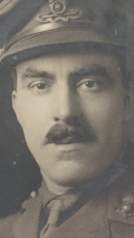
Second Lieutenant William Goss Hicks

260th Siege Battery, Royal Garrison Artillery

In 1881, the family were living on Chipstead Lane, with William senior now working as a butler at Knole. The 1901 census, shows William Goss Hicks  living with his mother and sisters at 1, Surrey Villas, Sevenoaks and working as a teacher. This arrangement continued to 1911 with the family now living at 8, High Street.

William had joined the staff of the Lady Boswell’s School in 1898 as an assistant teacher and by the outbreak of war had risen to become its Headmaster. He is credited with having brought the new scouting movement to Sevenoaks and would have been well known to many of the other men who are remembered on the Sevenoaks war memorial, such as Ernest Chatfield, Arnold Jarvis and George Marshall, as their former teacher or scout master.

Hicks was a popular figure; on his last leave home, he was spotted by his former scouts and pupils and carried shoulder high through the town.

img_5990

Hicks, on right of group

He was an active member of the congregation at St Nicholas, and a long standing member of it’s choir. After his death, the Sevenoaks Chronicle carried an appreciation of him by Reverend J Rooker, Rector of St Nicholas

He was amazingly brave and smiling quite up to the last”, wrote the chaplain in a letter to the parents, the words brought up to one’s mind the picture of Mr Hicks as he always was. bright, alert and cheery, with a breezy swinging carriage, he moved about his boys and friends as one who rejoiced in life, and wanted others to share his joy…When the war broke out he was in some doubt as to his duty. It was at my request he waited, for I put it to him that while many could fight, few could teach. But as the war went on he felt he must go and it was plainly his duty. He joined the R.F.A and had rough times but was always cheery. When he came home there were no complaints, but he was full of fun about his adventures. Then he applied for a commission and was gazetted a Lieutenant in the R.G.A. It was not long after that he went out to France. His letters were still buoyant and hopeful – even when he got up to the line…

Lieutenant Hicks was in charge of the Battery on Monday 2nd July. A German shell came over and struck him. He was removed to the clearing station but the loss of blood was great. Transfusion was tried and it is a witness to his popularity that many men offered to give their blood to him. The operation was tried and he seemed to rally. It was only temporary, however, and about mid-day on the Tuesday he began to collapse and died about half past four. He knew he was dying but was quite happy. He left messages for those he loved and thanked all who had been kind to him, and passed away smiling”.

William Hicks was buried in the Barlin Communal Cemetery Extension, France.

image

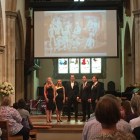
Voces8 perform at the memorial

image

Local schoolchildren performed wartime songs

image

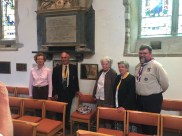
A wreath to remember William beneath his memorial plaque

image

Local Scout leaders and former members of Hicks Own

image

William’s niece, Jean, remembers her uncle