Sevenoaks men at the Somme: stories from the first day

Five men from Sevenoaks died on the first day of the Battle of the Somme – 1st July 1916. Although the anniversary of the battle is still a few weeks away, July will be a month filled with similar stories and I thought that it would be nice to write about each man in the days leading up to the centenary.

Three officers were killed on that day – Second Lieutenant Geoffrey Harrison of the Machine Gun Corps, Captain George Henry Heslop of the Middlesex Regiment, and Lieutenant Edouard H A Goss. The two ordinary soldiers who died were near neighbours from the St John’s area of the town.

Private Leonard Bowles, G/2217, 7th Battalion, The Queen’s Own Royal West Kent Regiment

Leonard Bowles was born in 1888,  the son of William, recorded as a gardener in the 1891 census and his wife, Alice. The Bowles family had lived variously at 6, Cobden Road, on Hartsland Road and at 11, Bethel Road, where, like his late father, he was recorded as a gardener in the 1911 census. Leonard had returned to the Front from leave a fortnight before his death.
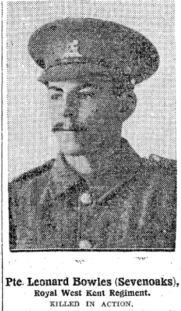
IMG_1221

Three of his other brothers,Lawrence, Clifford and Reginald, were also serving in the 7th Battalion of the West Kents, as was their one-time neighbour Jack Lewis. Lawrence Bowles was killed two weeks after his brother on 13th July.

Private Jack Lewis,  G/3418, 7th Battalion, The Queen’s Own Royal West Kent Regiment

Jack Lewis was born in 1895, the son of Jack, a plumber and his wife, Maria, and grew up at 5, Cobden Road. By 1911, Jack was working as a plumber’s assistant, most likely with his father. Jack enlisted in September 1914 and served with the Royal West Kents, being sent to France in August 1915.
IMG_0777
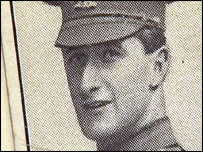
Private Jack Lewis

Fred Gilks his friend and neighbour from Sevenoaks, also from Cobden Road (who was killed only two weeks later on 13th July), wrote home describing what had happened

‘Jack and I both got over safely on the day of the attack. Next day, which was Sunday July 2nd, the Germans shelled the trenches we had captured. Poor old Jack was standing near me when a piece of shell hit him. He turned to me and said: ‘I am done, Fred’ and then dropped. I am thankful to say that he did not suffer at all, but passed away quietly…he was a chap to make a lot of friends as he was always so lively and good natured’.

Second Lieutenant Arthur Hogg wrote to his parents

‘As his platoon commander I can say that he was always cheerful and good natured and very popular with all the platoon. He is a great loss to us and we are all sorry he is gone. He lost his life in a battle which is probably the greatest in our country’s history and he did his duty’.

Despite Fred Gilks’s account, all official records give Jack Lewis’s death as 1st rather than 2nd July. Both Leonard Bowles and Jack Lewis are remembered on the Thiepval Memorial.

A further eleven Sevenoaks men died that July, including, Fred Gilks among them,  another four from Cobden Road.
Jack Marshall – saved by his pocket watch

Earlier this year, I was pleased to hear from Tim Marshall. Tim is a Great Nephew of George Marshall, one of the fallen of Sevenoaks of the First World War and one of several of the men who had lived on Buckhurst Avenue in the centre of the town. George Marshall had emigrated to Australia in 1912 with his friend Arnold Jarvis. Both had previously been pupils at the Lady Boswell’s school and sailed for a new life together on board the Ionie. Another Sevenoaks ANZAC, Kenrid Davey, was also on board and I wonder if they were known to each other. George Marshall died from wounds sustained, according to a report in the Sevenoaks Chronicle of 27 July 1917 by

…the accidental bursting of a bomb. Deceased, who left Sevenoaks for Australia about five years ago, joined the Imperial Force last year. In April last, he was married at Kensington and afterwards spent some days in Sevenoaks. Private Marshall is a brother-in-law of Mrs Marshall, whose husband is with the colours in Mesopotamia. Another brother of Private Marshall’s is serving in France whilst Mrs Marshall has seven brothers in the army, the eldest of whom has been a prisoner of war in Germany since the battle of Mons, in which he was wounded.

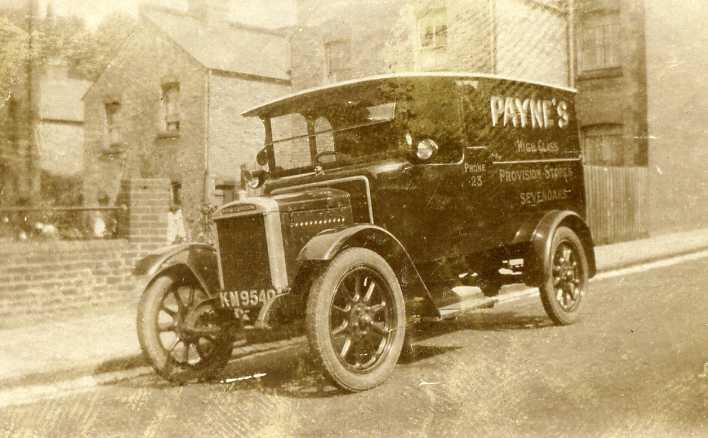
Tim Marshall’s grandfather, Harry, was one of the brothers mentioned, serving with the Army Service Corps in Mesopotamia. Harry, who before the war had worked for E.J. Payne, a grocer (now the site of the Sun Do restaurant), was himself mentioned in the Chronicle when he was hospitalised as a result of an accident, later making a full recovery. Harry served as a Verger at St Nicholas church and died in 1937 aged 58.

imageHarry’s delivery van, parked in Buckhurst Avenue

The other brother mentioned in George’s obituary, John, known as Jack, was 29 and working as a gardener at the Royal Crown Hotel in Sevenoaks, when he enlisted in December 1915. He served with the Royal West Kents

Jack was wounded in early 1918 and invalided home to England to recover before returning to action. Later in the August, the Sevenoaks Chronicle carried a news report detailing how Jack had again been wounded. As the paper noted,

This is the second time that he has been wounded and but for a remarkable circumstance his wound on this occasion would undoubtedly have been fatal. It appears that in returning to France, after recovering from his previous wound, he purchased a watch at Folkestone, which he was wearing when struck for a second time.The bullet passed clean through the watch, which broke its force, before it entered his body, and so saved his life. It is also a notable coincidence that the second wound was exactly on the same spot as the first.

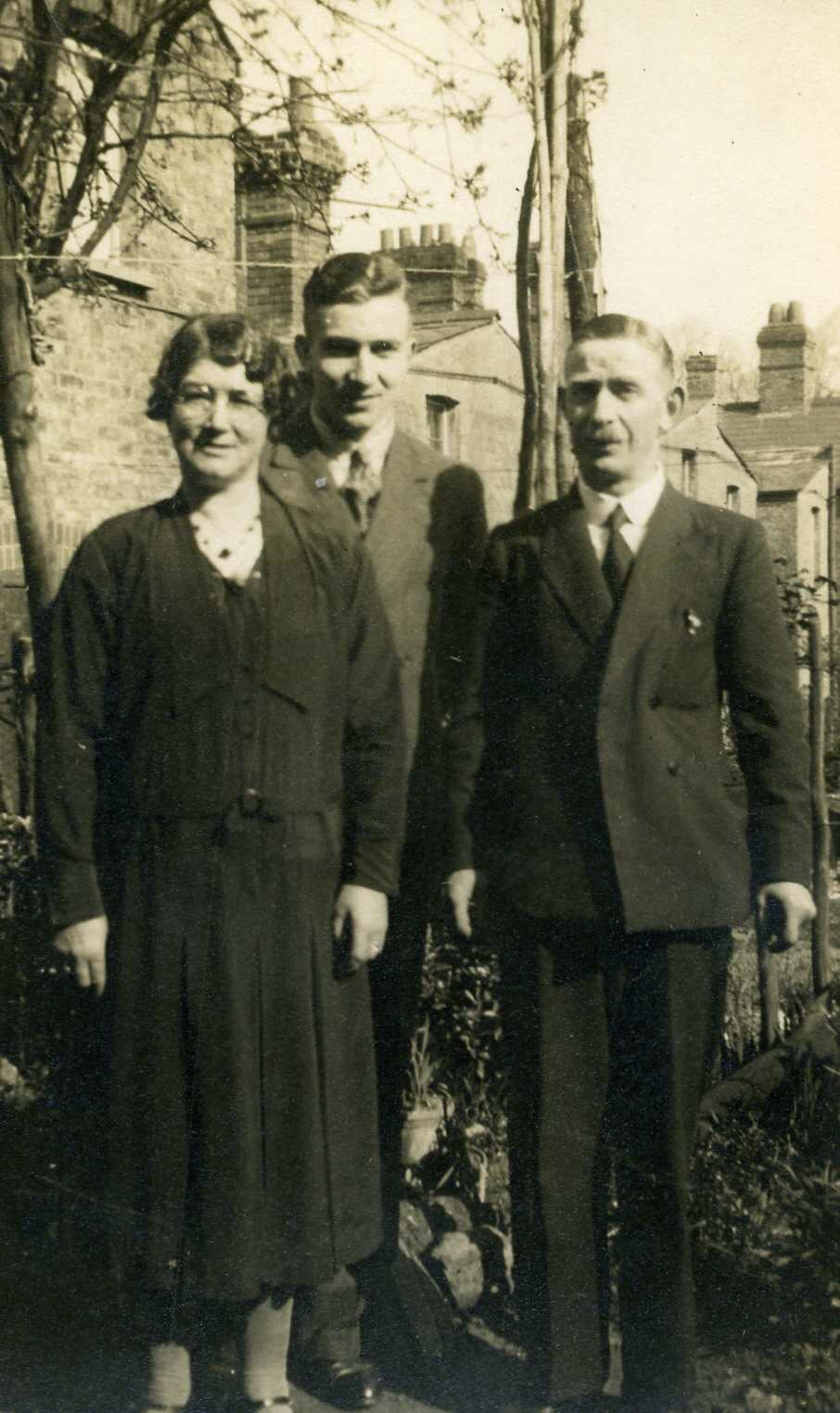
imageHarry in later life with his wife, Jane and son, Edward, who served in World War II

Both Harry and Jack survived the war but, as in so many families, it seems as if their war service and the story of Jack’s life being saved by his pocket watch, was not mentioned in subsequent years, only being rediscovered in recent research. The Marshall brothers grew up on Buckhurst Avenue, as did many other local men who fought in the war, including the Hayward and Hodgson families, who I’ll be writing about in my next post.