Wartime Christmases in Sevenoaks

Mention Christmas and the First World War to most people and they’ll imagine some variation of Christmas truces, football between the warring sides and the seemingly general notion that ‘it will all be over by Christmas’. Certainly Cedric Gordon of the North Staffordshire Regiment wrote this to his mother from France in September 1914. But there would be a further three Christmas Days before the Armistice was signed and I want to look at what that entailed for the people of Sevenoaks, those at war and at home.

In 1914, the popular firm of S.Young and Co. used its regular advertisement in the Kent Messenger to promote its Grand Bazaar, setting the tone by asking the question: Christmas as usual? Why not?

There are thousands of soldiers and sailors to whom Christmas will mean more this year than ever before. There are thousands of children for whom Christmas would be as indeed if the old customs were not kept up.

image

With so many local men away and large numbers of Belgian refugees in the town, as well as wounded servicemen at the newly established hospitals, fundraising was the order of the day.
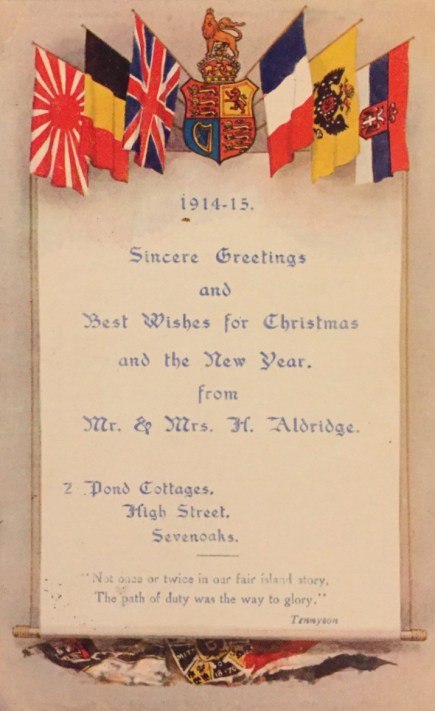
Christmas Card

Patriotic Christmas cards like this were sent in 1914

Lord and Lady Sackville hosted a concert at Knole in aid of the St John’s hospital where their daughter, Vita, was Commandant. Held on the afternoon of 15th December, the concert featured some well known artistes, including Miss Phyllis Dare and Miss Constance Collier. Children of the estate workers were also invited to a Christmas tea on a Wednesday afternoon.

The troops billeted in the town were not forgotten and the Territorials Christmas fund raised £167 17s 5. which was distributed between 4th and 5th Loyal North Lancashires, 4th and 5th King’s Own, the Army Service Corps, and the Army Medical Corps and Divisonal Headquarters division. The remainder being given to the Soldiers’ and Sailors Families Association.

Letters sent home were regularly forwarded to the Sevenoaks Chronicle to be reproduced for popular consumption. In 1914 Private F G Saxby of G Company 4th Battalion Royal West Kent Regiment wrote to local recruiting officer Captain H W Knocker

I am pleased to say that I am quite enjoying myself in my new life. The fellows here are a very sociable lot. The food we have is very good indeed and I have no doubt Major Laurie looks after G Company as well as any.

Our 1st Lieutenant is the Reverend Percy Thompson’s son, and our Second Lieutenant is Archdeacon Dunkerley’s son of St John’s.

I expect to get home for Christmas and I hope I shall as I have always spent it at home up till now. We have some very nice route marches of sixteen to eighteen miles and come home very tired, but full of fun. We have a football XI and are going to play for a cup and shield among the Companies. After all, army life is not all bad.

In January 1915, the Sevenoaks Chronicle printed an article by Thornton Shaw on How Our Troops Fared at Christmas. The article was in fact more of a guide to the men of the north and what was perceived as their strange habits.

“You have got to know the average Northerner before you can hope to understand him. He is, by nature, hardy and brusque, he often omits to lift his cap (which he wears in great preference to a bowler hat) to his lady friends and when he is not on military duty he has an inherent objection in saying “sir” to anybody on earth. But he possesses a heart as big as the wide world itself…”

He continued

“And if some of them seem just a little bit uncouth you must forgive them. And they have done Sevenoaks heaps of good in the matter of trade. Ask any tradesman you like…”
Shaw noted that the residents of Sevenoaks had raised £710 to ensure that the soldiers present in the town during Christmas enjoyed the festivities, with lavish amounts of food and entertainment; one contingent of 25 men “polished off an entire pig between them…as my informant (an officer) laughingly remarked ‘only a collier could have done it’”.

All of the men, wrote Shaw, were grateful but also wistful for the lives they had left at home, one corporal remarking, as he posted home a box of chocolates to his wife
“Ah’d reyther ‘uv bin up at whoam, if ah’d had nowt but kippers”.

News sometimes arrived home from Sevenoaks men being held as prisoner of war. One such man was twenty year old Albert Hayward, the son of William, an old soldier and his wife Jane, who resided at 13, Buckhurst Avenue, Sevenoaks. Albert was working as an apprentice printer before the war and enlisted in London in November 1914. He fought at Ypres With 2nd Battalion The Buffs, where he was taken prisoner in April 1915.

The Chronicle carried a report in January 1916 under the title A Sevenoaks Soldier in Germany, Xmas in an Internment Camp, which featured a postcard that Albert had written to his parents:

Just a hurried line to thank you for the two parcels which I received in quite good condition. I think I told you that the pudding was quite good, and that the cigars were quite nice and mild. I enjoyed my ‘Xmas quite well under the circumstances. My chum and I had a tin of mutton chops, ‘Xmas pudding, beef and vegetables, for dinner. Of course we managed to forget nuts, oranges, apples etc. the ‘boss’ gave us a bag containing 50 cigarettes, buns and lbs of apples; we also had a ‘Xmas tree decorated up, and we were allowed one bottle of lager beer, which was half the dinner. I hope you all had a very enjoyable ‘Xmas and New Year, and good weather, for we have had some heavy falls of snow lately, but it has changed to rain now. Please tender my thanks to the Rev J Rooker for the card he sent me of the Parish Church. I hope you are all as well at home as this letter leaves me – in the best of health.”

Albert saw one more Christmas before he died as a result of his diabetes in Otcober 1917. He is buried in the Niederzwehren Cemetery in Hessen, Germany and both brothers are remembered on the family grave at St Nicholas’ Church, Sevenoaks.

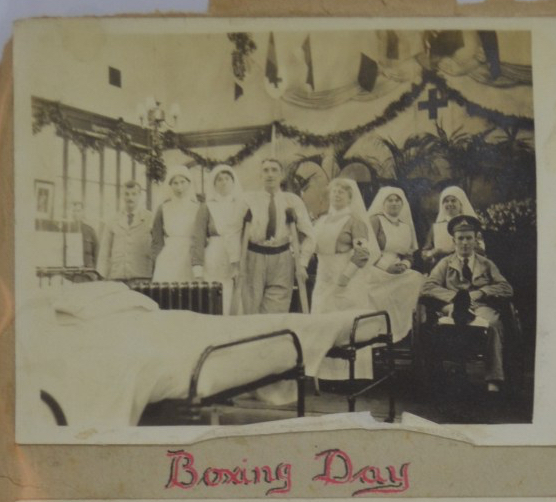
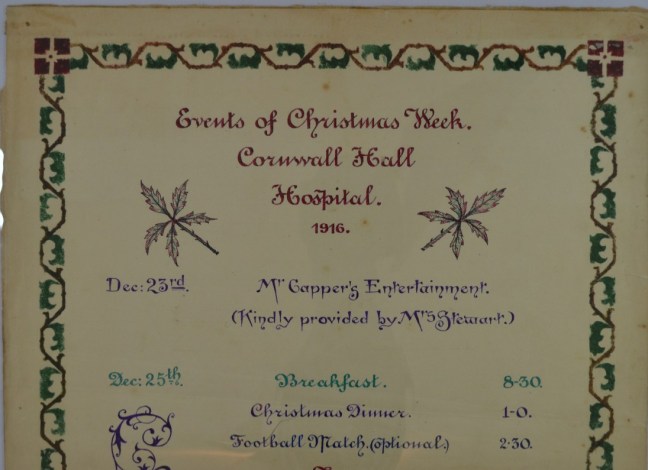
Throughout the war years, the Chronicle reported how Christmas was spent in the local VAD hospitals, where staff and patients celebrated the festive season together. In 1916, the large ward at Cornwall Hall was decorated with holly and laurel. Another ward featuring ‘a model of a gigantic Zeppelin, with excellent models of aeroplanes in close proximity to it’.

image

The paper printed a letter from A PATIENT, who outlined what he and his fellow patients had enjoyed

On Christmas Day, after many of the nurses and patients had attended Divine Service at the Parish Church, there was an incessant round of festivities, commencing with a splendid dinner, served in the large ward (cooked at the Royal Crown Hotel, through the kind thoughtfulness of Mr Marshall). Crackers and flowers made the tables look inviting, but when the board was covered with turkeys, mince pies, plum puddings and dessert, the effect was greatly increased.
image

image

At St John’s Hall hospital,

The festivities began in the early morning with the good old custom of Santa Claus, each man waking up to find  bulging sock in his bed; a surprise provided by the staff and much appreciated by the patients.

In the afternoon, after a typical Christmas tea, there was the stripping of a fine Christmas tree laden with gifts of all kinds, both or the staff and patients. A first-rate football from the nurses to the patients caused much applause as being a happy omen of future victories.

image

In its 1918 Christmas editorial, the Chronicle noted that despite the still somewhat dimly lighted streets, Sevenoaks has been wearing during the past week or so, a cheerier aspect. The Christmas of 1918 promises to carry with it some of the old-time gaiety. Peace on earth has a greater meaning than, perhaps, it ever had before.


Fifty years on – veterans remember

Half a century ago, the fiftieth anniversary of the First World War prompted many veterans to remember their wartime service or to recall life at home during the conflict. Fortunately, some of these memories have been preserved as the Sevenoaks Chronicle reported the thoughts of these veterans as they either returned to Sevenoaks where they had once been garrisoned, or looked back to their boyhoods to a time when thousands of soldiers were stationed in the town, along with many wounded at the local VAD hospitals, as well as refugees from Belgium.

Fifty years after he had been stationed in Sevenoaks as a Private with 5th Battalion King’s Own Royal Lancashire Regiment, between November 1914 and February 1914, Harry Burrow returned to Sevenoaks. Harry was interviewed by the Chronicle during his visit and said

Sevenoaks was utterly familiar. I booked into the famous Royal Oak Hotel and it had many of it 1914 qualities. Sevenoaks was still full of riches and Granville Road was no exception. At the junction with Eardley Road, recognisable to me at once, were the two detached houses commandeered for our battalion HQ and Quarter-Master stores. Down at Tubs Hill, to my delight, I found the Elite. This was the local flea pit, a small music hall.

On Thursday nights the local talent tried out its stuff. Entrance was 2d for men in uniform. The stage was still there but the laughing legion of the 5th King’s Own had long since dissolved. On the other side of Tubs Hill station I found Holyoake Terrace and to reach it I drove over the main bridge where we had assembled on the bleak, historic, wet and cold St Valentine’s Day 1915 to embark for France. At Knole Park, all I could do was peer in the gates and see again in flashback our battalion in trench digging practice. Little did I know that within a few months this was to become a stern reality.

In 1914 the main shopping street was full of dignified horse and carriage trade and urbanity. Now much of that personality was lost. The Shambles area retained its antiquity and I was delighted to find the pavilion band stand on the Vine had not changed. I was swept back to a Sunday afternoon where we sat expectantly in the gardens, a great concourse of khaki figures, when a lady mounted the platform. She wore a flimsy hat and, to our delight, Lancastrian red roses on her bosom. In a moment she slipped into the rousing, emotionally, recruiting song that was sweeping the country. A thousand cheers, a thousand pair of clapping hands, a thousand hearts wishing she would do the kissing now. And then her encore, ‘you made me love you, I didn’t want to do it’. She was Mrs Reubens, someone said, the wife of Paul Reubens, the composer.

John Edward Smith was featured in the Sevenoaks Chronicle in 1966 in his workshop at the foot of Wickenden Road. A local resident and a gunmaker during the war, he was also best man at the wedding of the parents of future Prime Minister, Edward Heath.

image

John Smith with son, Leslie, in his workshop

Smith worked at Woolwich Arsenal during the war, where he was in charge of a giant steam hammer, which could be adjusted so closely that it would come down on a watch placed on the anvil without breaking the glass. “I used to do it regularly. When the hammer fell, you couldn’t pull the watch out, but the glass was still intact”.

Smith bored 100ft long gun barrels for naval vessels. When the Zeppelin raids came he would climb into a barrel and wait until the bombing as over. “There was never a safer air raid shelter”. He recalled seeing Zeppelins brought down at Potters Bar, Cuffley and Billericay and was closeby when the Silvertown ammunition dump blew up.

Frederick Charles Zealey returned to Sevenoaks from further afield, having emigrated to Australia in 1920. Zealey was born in 1904 at the Limes, St John’s where his father was a well known builder. He attended Cobden Road School before graduating to the school at nearby Bayham Road. Although too young to enlist himself, his brother, Arthur William Zealey (1894 – 1960) served as a corporal with the West Kent Yeomanry and was stationed in India.

imageArthur Zealey stationed in India

Frederick recalled his memories of wartime Sevenoaks, writing for the Sevenoaks Chronicle that

I can remember when the firm of Quinnells, the removalists and contractors had a traction engine which pulled vans and wagons through the town, in 1911 – the Coronation year.

This engine and three open wagons, all covered in bunting took all the school children up through the town to Knole Castle (sic) where we had a picnic on the green in front of the castle.

I also remember Mr H Hill, the baker at St John’s, with his bread cart and blind white pony – also Mr Kipps, the butcher, with his butcher’s carts and his piebald pony Tetratch It used to pull a governess cart or trap around the town, and in it would be Mr and Mrs Kipps, their daughter, and son George, who was killed in World War One.

Intriguingly, Zealey continued

I have a photo of the men of the Royal West Kent Regiment on the Tubs Hill Station, waiting for the train to France on about August 4, 1914. Sevenoaks in those days became a garrison town for troops, and many were in billets and empty houses. Regiments such as the Loyal North Lancashires, Yorkshires, and King’s Own were stationed in Sevenoaks. I attended the unveiling of the war memorial at the Vine after the war.


image

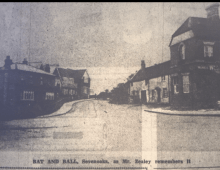
Bat & Ball from Zealey’s own photographs

The old cinema was opened before World War One and the prices listed in the Sevenoaks Courier were listed as twopence a seat for children and nice plush seats for 6d and 9d and 1s for the gallery. There used to be a pianist to play and sometimes a violinist. You could hear us roar the house down at Charlie Chaplin, Steve Hart, Broncho Bill, John Bunny, and Flo Finch, and other old time film actors.

We used to play in the old Oast House or hop kiln opposite the cinema, long since pulled down.

I’d be very pleased to hear from anyone related to these men, especially if any photographs from the time are still in their possession.


‘The gallant sons of Sevenoaks’ – the story of our war memorial

The Sevenoaks War Memorial was unveiled on an autumn day in October 1920 when thousands of local people assembled on The Vine to pay their public tribute to the memory of two hundred and twenty five sons of Sevenoaks, who lost their lives during the conflict. The Sevenoaks Chronicle subsequently noted in its report of the event how every class was represented and had suffered loss, all had been bound together in one great act of sacrifice.

The Memorial was funded by public subscription, including from house-to-house collections, with individual donations of up to £500. The total raised being £5,663. On the afternoon of the unveiling the memorial was covered with the Union Jack, with the town’s coat of arms. Lord Sackville and the Bishop of Rochester led proceedings and were joined by many other official representatives of the town. The relatives of the men stood in their own enclosure and a boy scout stood at each corner of the mound. Representatives of the VAD also attended as did many of the local churches and other organisations, all gathered to honour their fellow townsmen.

image

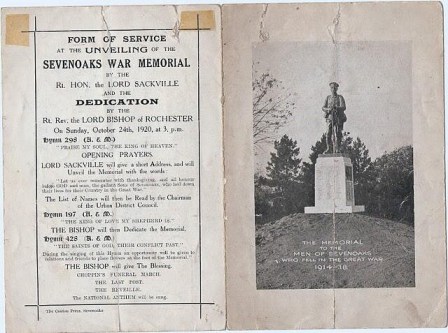
Order of Service for the unveiling ceremony

The choirs of St Nicholas, St Mary, Kippington, and St John’s led the singing and the ex servicemen marched to their places from nearby St John’s Congregational Church.

After hymns had been sung and prayers said, Lord Sackville, who had served throughout the war himself, spoke movingly

“I suppose there can be no occasion which calls for greater unity of feeling than an occasion like the present, when we meet here together for the purpose of unveiling and dedicating a Memorial to our fellow towns-men who fought and died in the Great War. It was inevitable that there should be divergence of opinion as to the particular form that any Memorial should take; it is inevitable that there should be criticism of the site chosen and of a dozen other matters: but I think that I may safely say that this gathering, as fully representative of all the various interests in this town of Sevenoaks, is united here today with one common thought, to pay tribute to the memory of those whose names you will find inscribed on this Memorial”.

“Many of these men were known to many of us: some of them met their end in my own regiment with me, and they went forth from Sevenoaks, hoping no doubt, that they might be safely spared to return in all safety, knowing full well the dangers they were going to encounter and yet facing those dangers with that cheerful uncomplaining acquiescence for the call of duty which has won for them a place in our esteem which no Memorial can ever adequately fill… I am glad to know that there are many in the assembly today of the men who were the comrades in arms of those whose memory we are honouring today”.

He concluded by speaking of the relatives gathered before him

May I, on behalf of the whole community, offer to them our heartfelt sympathy, our reverent gratitude for the sacrifices which they were called upon to make, and may I tell them that in erecting this monument, we are not unmindful of their sorrows but that we are erecting it as a sign to this generation and to future generations with the high honour and esteem with which we regard those so dear to them, who gave all, who lost all and yet who gained all”.

He then unveiled the memorial with the words “Let us ever remember with thanksgiving and all honour before God and man the gallant sons of Sevenoaks who laid down their lives for their country in the Great War”.

image

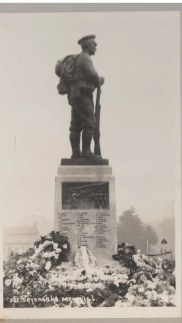
Postcard of the war memorial with flowers laid by relatives, October 1920

Mr Frank Robinson, Chairman of the Urban District Council, then read the list of the 225 names, which included those of his son, Frank, and nephew, Herbert Lethebe. He noted that it was unknown how many men from Sevenoaks had gone to war but 225 were remembered on the memorial and 1,265 had returned. He remarked, perhaps with his own loss at the front of his mind, that Sevenoaks had paid rather heavily.

The Bishop of Rochester then spoke saying , according to the newspaper report, that

The monument stands on a great highway along which hundreds of thousands of people would pass through from the great Metropolis to the seaboard. It would stand when all present that day had followed those men beyond the grave into the great Hereafter. It would stand to inspire those that came after us to be worthy of the heroisms of those men…He wanted the monument to uplift them and make them stand as the man on the monument stood, sentry-like, prepared not only to fight for their country but to fight against all that was evil, all that was of discord and all that prevented the country from rising in the time of peace to the high position it attained during the years of war. It was only Christ who would enable them to do so”

After the Bishop’s address wreaths and flowers were placed at the foot of the memorial by the relatives, helped by the Boy Scouts. Then came the Blessing, Chopin’s Funeral March and then the Last Post, sounded by two buglers of the Royal West Kent Regiment. After the silence came Reveille and the end of the service.

image

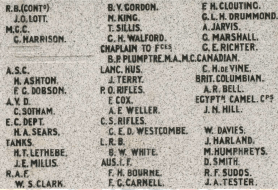
List of names from the Order of Service, 1920

The Memorial was designed by sculptor and painter, Arthur George Walker, who designed several others, including those of Dartford and Ironbridge which bear the same figure. The inscription on the Memorial reads ‘To keep in mind those from this place who gave their lives in the Great War 1914-1918’.

Private Bartholomew

There were  225 names listed on the memorial when it was unveiled. Two more were later added and one was removed, that of Adrian Maurice Bartholomew of the Royal Army Medical Corps.

Adrian’s service records survive and show that he enlisted in 1914 and was sent for instruction at the Royal Army Medical Corps School in Chatham before being posted.

He survived the war and lived to see his own name commemorated. His name is listed in the order of service for the unveiling of the memorial in 1920 (above) and is visible on a postcard of the memorial taken shortly after its unveiling.

image

Side view of memorial, October 1920

image

Panel showing where Private Bartholomew’s name had been

Adrian was born in 1895, one of seven children born to Frank Bartholomew, a house painter and his wife, Annie. The 1911 census shows that Adrian was working as a grocer’s boy and the family living at 3, Bradbourne Road Cottages.

His inclusion on the memorial is curious as there were plenty of family members living locally, none of whom would have requested his name to be included. His brother-in-law, John Tester, had been killed in 1915 and was remembered on the memorial, although not under his regiment, the Royal West Kents but with five other unassigned names. Adrian’s two nephews, John’s sons, Eric and Leslie Tester, were later included on the memorial as both died in the Far East at the end of the Second World War. However, their names were only added after their mother’s death in 1979 as she could not bear to see them named on the memorial while she lived.

image

Adrian’s obituary in the Sevenoaks Chronicle

Adrian Bartholomew died in Sevenoaks in 1966, aged seventy.

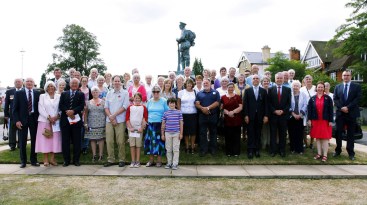
In August 1914, our memorial project gathered descendants of the men from across the country to remember them in a special service and family members lay crosses at the foot of the memorial as the names of the men were read out once more in remembrance.

IMG_1891

Descendants of those remembered gather at the memorial, August 2014