For King and Country – a memorial to the sons of Henry Forster MP

By 1914, Henry William Forster had been the MP for Sevenoaks for twenty two years, holding the seat from 1892. A Deputy Lieutenant of Kent he went on to serve as Financial Secretary to the War Office from 1915. Forster had married his wife, Rachel, daughter of the 1st Lord Montagu of Beaulieu, in 1890 and the couple had four children, John, Alfred Henry, Rachel and Emily.

Henry Forster later became MP for Bromley in 1918 and was ennobled in 1920 becoming 1st Baron Forster of Lepe in Southampton. From 1920 until 1925 he  served as Governor General of Australia before returning home to live at Exbury House until his death in 1936 aged sixty nine.

Forster’s eldest son, John, was born on 13th May 1893 and was gazetted as a Second Lieutenant in the King’s Royal Rifles on 3rd September 1913.

In the early days of the war the fact that the son of the local Member of Parliament was already at the front was mentioned several times at public recruitment meetings in Sevenoaks, to demonstrate that the sons of the politicians and the gentry were already ‘doing their bit’.
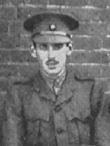
Forster

Second Lieutenant John Forster

John Forster was killed in the early hours of 14th September 1914 during the First Battle of the Aisne. His battalion had been ordered to advance to the plateau of Troyon and dig in.  They went forward in bad weather and when they reached the crest, were unable to continue further and found themselves pinned down by enemy fire coming from the occupied sugar factory at the crossroads above Troyon.

John’s death was reported in the Sevenoaks Chronicle, along with a letter that had been written to his parents

“I ought to have written before about your dear brave Jack, but I was shot through the head the same day and it has been impossible. He died like the gallant English gentleman that he was, leading his men at a critical time when men wanted leading. He was shot right through the head and never recovered. He was my best and brightest officer under all the most trying circumstances and his men all adored him – as of course we all did”.

“The circumstances were as follows:

Our Battalion was ordered out in advance of the Division to occupy some high ground and hold it while the Division passed. We were just getting up to the top at 4 a.m., when, at a point where the space between us and the top was almost perpendicular, we suddenly found ourselves being fired at in the dark by hundreds of Germans, who were firing right down on us as if we were in a rat-pit, so to speak. We had to force our way up to the top of the hill, and when we arrived there we found ourselves confronted by a strong force of Germans, entrenched with machine guns in position, and only 200 yards off. We remained there all day under a heavy shell and rifle fire”.

 “It was a terrible day for our Battalion. By mid-day there were only six Company officers left. We lost 15 officers out of 24 and 283 men. These heavy losses were mostly caused by those dirty Germans holding up their hands in token of surrender and then opening fire on us when we got within 20 yards of their trenches. I am so very sorry about your son, He was a first-class officer and a great favourite with his brother officers as well as his N.C.O’s and men”

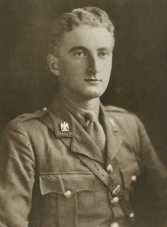
John’s brother, Alfred Henry was born on 7th February, 1898 and educated at Winchester College before attending the Royal Military College, Sandhurst. He was commissioned in the 2nd Dragoons Guards (Royal Scots Greys) in July 1916.
image

Lieutenant Alfred Henry Forster

Alfred was sent to France the following February and was promoted to Lieutenant on 19th January, 1918. On 17th October 1918 he was seriously wounded near Le Cateau and transferred to the Gerstley-Hoare Hospital for Officers at 53 Cadogan Square, Belgravia, London, where he spent five months before dying of his wounds on 10th March 1919.

While at the hospital, Alfred became friends with fellow patient, the sculptor Cecil Thomas (1885-1976). After Alfred’s death, Lord and Lady Forster commissioned Thomas to design the remarkable memorial to John and his brother, which is in the church of St Katherine at Exbury in the New Forest. The bronze figure was exhibited at the Royal Academy in 1924 and a model is held by the Victoria and Albert Museum.

image

image

image

Memorial to the Forster brothers at St Katherine’s, Exbury

All images ©Come Step Back in Time

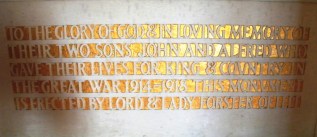
The memorial, which displays a recumbent figure of Alfred, is inscribed

To the glory of god and in loving memory of their two sons John and Alfred who gave their lives for king and country in the Great War 1914 -1918 this monument is erected by Lord and Lady Forster of Lepe.

There is a similar memorial in the church of All Hallows-by-the-Tower, London. It was Lord Forster’s wish that this would not be a personal memorial but one to all those who had died. There are similar memorials at the church of St John, Southend and in Newcastle Cathedral, Australia.

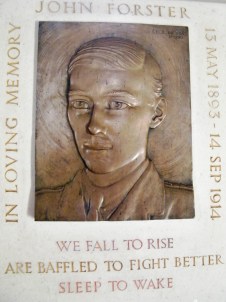
There is also a memorial plaque to John Forster at the church in Exbury.
image

Memorial plaque to John Forster

All images ©Come Step Back in Time

The Forster family had previously lived at Southend Hall in Lewisham (now demolished) and Lord Forster donated the land for Forster Memorial Park near Catford in memory of his sons and the park was opened by his daughter, Dorothy, in 1922.

The brothers are also remembered at their schools and in the parliamentary books of remembrance at Westminster.


All images of the Forster memorial are reproduced with kind permission by ©Come Step Back in Time
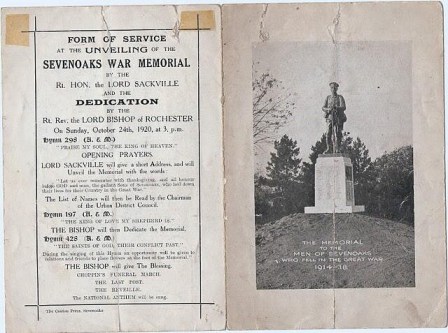


‘The gallant sons of Sevenoaks’ – the story of our war memorial

The Sevenoaks War Memorial was unveiled on an autumn day in October 1920 when thousands of local people assembled on The Vine to pay their public tribute to the memory of two hundred and twenty five sons of Sevenoaks, who lost their lives during the conflict. The Sevenoaks Chronicle subsequently noted in its report of the event how every class was represented and had suffered loss, all had been bound together in one great act of sacrifice.

The Memorial was funded by public subscription, including from house-to-house collections, with individual donations of up to £500. The total raised being £5,663. On the afternoon of the unveiling the memorial was covered with the Union Jack, with the town’s coat of arms. Lord Sackville and the Bishop of Rochester led proceedings and were joined by many other official representatives of the town. The relatives of the men stood in their own enclosure and a boy scout stood at each corner of the mound. Representatives of the VAD also attended as did many of the local churches and other organisations, all gathered to honour their fellow townsmen.

image

Order of Service for the unveiling ceremony

The choirs of St Nicholas, St Mary, Kippington, and St John’s led the singing and the ex servicemen marched to their places from nearby St John’s Congregational Church.

After hymns had been sung and prayers said, Lord Sackville, who had served throughout the war himself, spoke movingly

“I suppose there can be no occasion which calls for greater unity of feeling than an occasion like the present, when we meet here together for the purpose of unveiling and dedicating a Memorial to our fellow towns-men who fought and died in the Great War. It was inevitable that there should be divergence of opinion as to the particular form that any Memorial should take; it is inevitable that there should be criticism of the site chosen and of a dozen other matters: but I think that I may safely say that this gathering, as fully representative of all the various interests in this town of Sevenoaks, is united here today with one common thought, to pay tribute to the memory of those whose names you will find inscribed on this Memorial”.

“Many of these men were known to many of us: some of them met their end in my own regiment with me, and they went forth from Sevenoaks, hoping no doubt, that they might be safely spared to return in all safety, knowing full well the dangers they were going to encounter and yet facing those dangers with that cheerful uncomplaining acquiescence for the call of duty which has won for them a place in our esteem which no Memorial can ever adequately fill… I am glad to know that there are many in the assembly today of the men who were the comrades in arms of those whose memory we are honouring today”.

He concluded by speaking of the relatives gathered before him

May I, on behalf of the whole community, offer to them our heartfelt sympathy, our reverent gratitude for the sacrifices which they were called upon to make, and may I tell them that in erecting this monument, we are not unmindful of their sorrows but that we are erecting it as a sign to this generation and to future generations with the high honour and esteem with which we regard those so dear to them, who gave all, who lost all and yet who gained all”.

He then unveiled the memorial with the words “Let us ever remember with thanksgiving and all honour before God and man the gallant sons of Sevenoaks who laid down their lives for their country in the Great War”.

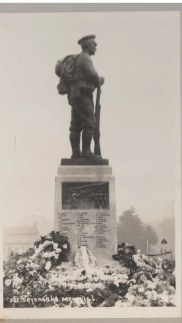
image

Postcard of the war memorial with flowers laid by relatives, October 1920

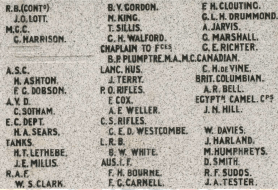
Mr Frank Robinson, Chairman of the Urban District Council, then read the list of the 225 names, which included those of his son, Frank, and nephew, Herbert Lethebe. He noted that it was unknown how many men from Sevenoaks had gone to war but 225 were remembered on the memorial and 1,265 had returned. He remarked, perhaps with his own loss at the front of his mind, that Sevenoaks had paid rather heavily.

The Bishop of Rochester then spoke saying , according to the newspaper report, that

The monument stands on a great highway along which hundreds of thousands of people would pass through from the great Metropolis to the seaboard. It would stand when all present that day had followed those men beyond the grave into the great Hereafter. It would stand to inspire those that came after us to be worthy of the heroisms of those men…He wanted the monument to uplift them and make them stand as the man on the monument stood, sentry-like, prepared not only to fight for their country but to fight against all that was evil, all that was of discord and all that prevented the country from rising in the time of peace to the high position it attained during the years of war. It was only Christ who would enable them to do so”

After the Bishop’s address wreaths and flowers were placed at the foot of the memorial by the relatives, helped by the Boy Scouts. Then came the Blessing, Chopin’s Funeral March and then the Last Post, sounded by two buglers of the Royal West Kent Regiment. After the silence came Reveille and the end of the service.

image

List of names from the Order of Service, 1920

The Memorial was designed by sculptor and painter, Arthur George Walker, who designed several others, including those of Dartford and Ironbridge which bear the same figure. The inscription on the Memorial reads ‘To keep in mind those from this place who gave their lives in the Great War 1914-1918’.

Private Bartholomew

There were  225 names listed on the memorial when it was unveiled. Two more were later added and one was removed, that of Adrian Maurice Bartholomew of the Royal Army Medical Corps.

Adrian’s service records survive and show that he enlisted in 1914 and was sent for instruction at the Royal Army Medical Corps School in Chatham before being posted.

He survived the war and lived to see his own name commemorated. His name is listed in the order of service for the unveiling of the memorial in 1920 (above) and is visible on a postcard of the memorial taken shortly after its unveiling.

image

Side view of memorial, October 1920

image

Panel showing where Private Bartholomew’s name had been

Adrian was born in 1895, one of seven children born to Frank Bartholomew, a house painter and his wife, Annie. The 1911 census shows that Adrian was working as a grocer’s boy and the family living at 3, Bradbourne Road Cottages.

His inclusion on the memorial is curious as there were plenty of family members living locally, none of whom would have requested his name to be included. His brother-in-law, John Tester, had been killed in 1915 and was remembered on the memorial, although not under his regiment, the Royal West Kents but with five other unassigned names. Adrian’s two nephews, John’s sons, Eric and Leslie Tester, were later included on the memorial as both died in the Far East at the end of the Second World War. However, their names were only added after their mother’s death in 1979 as she could not bear to see them named on the memorial while she lived.

image

Adrian’s obituary in the Sevenoaks Chronicle

Adrian Bartholomew died in Sevenoaks in 1966, aged seventy.

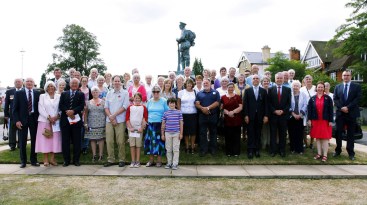
In August 1914, our memorial project gathered descendants of the men from across the country to remember them in a special service and family members lay crosses at the foot of the memorial as the names of the men were read out once more in remembrance.

IMG_1891

Descendants of those remembered gather at the memorial, August 2014


“No one knows how I miss him” – a wartime love story

Today, 9th June, sees the centenary of the death of a Belgian soldier who, for a brief time, had lived in Sevenoaks during the war.

In the churchyard at St Nicholas in the heart of Sevenoaks, there is a family grave, which bears witness to this remarkable love story between a Sevenoaks woman and a Belgian soldier.

img_2937

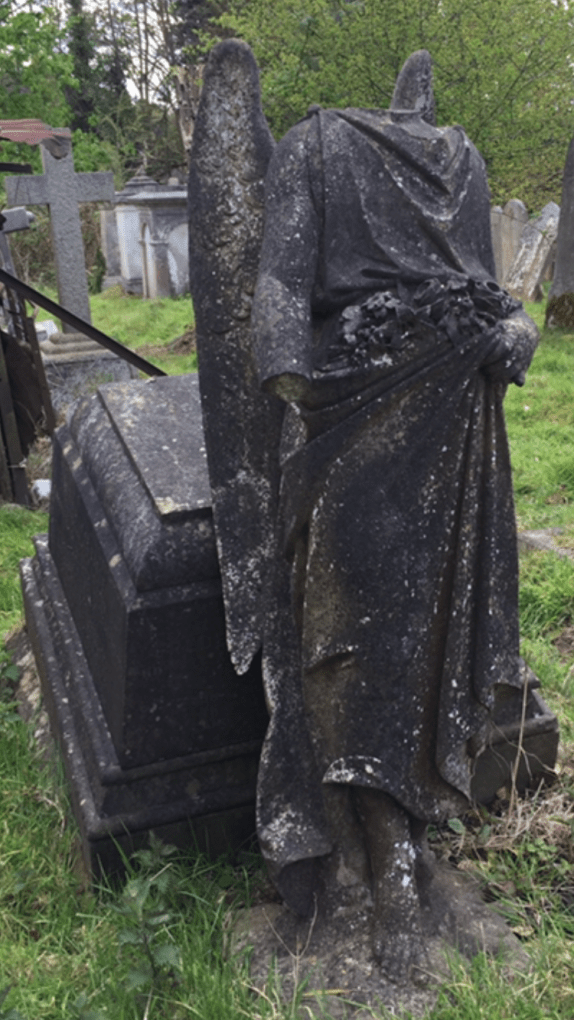
The family grave at St. Nicholas church

The memorial to the Caplen family has now fallen into disrepair but it is still just possible to read the inscriptions to Frederick and Rosina Caplen and their two children, Frederick and Rosina. However, one side of the memorial includes the following inscription

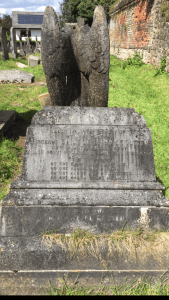
img_2939

Also in loving memory of my dear husband, Sergeant Emile Leonard de Coster, 22nd Infantry Belgium Army, killed about 9th June 1919, somewhere in Germany aged 35 years

No one knows how I miss him

No one knows how he died

No one knows how he suffered

No one knows where he lies

Having previously written about the arrival of Belgian soldiers and refugees in Sevenoaks, I researched this story further. What emerges is a love story and a tale of one woman’s passion and determination to find out what happened to her husband.

Frederick Caplen was born in Worthing, Sussex, in 1856 and married Rosina Jane Gunn (1858-1926) in 1880. Frederick and Rosina had two children, Frederick Nathaniel (1887-1920) and Rosina Jane (born 1884) and the 1911 census shows the family now living in Sevenoaks High Street, with Frederick senior working as a confectioner and his two children were running their own hairdressing business.

Emil is first mentioned in a list of wounded Belgian soldiers in the 23 October 1914 edition of the Sevenoaks Chronicle. Named as de Koster, he is a patient at St John’s Hall VAD Hospital, with fellow Belsele townsman, Gustave van Hoye.

Emil was born on 25th January 1886 in Belsele, St Niklaas, to Charles Louis August de Coster, a farmer/agricultural worker, and his wife Francoise. It is possible that Emil had two brothers, Gabriel, born 1887, and Leo Frans, born 1889, and the family, at least around 1919, were living at Groenstraat 6, Belsele.

A list of wounded Belgian soldiers, including Emil, in the Sevenoaks Chronicle

Although Rosina does not appear to have worked as a VAD nurse, she was a popular and industrious woman who sang and performed throughout her life. Perhaps she first met Emil at St John’s Hall whilst visiting or fundraising, or at one of the many entertainments provided for refugees in the town.

Emil, sat bottom right with fellow soldiers, and on crutches outside St John’s Hall VAD Hospital, Hollybush Lane, Sevenoaks

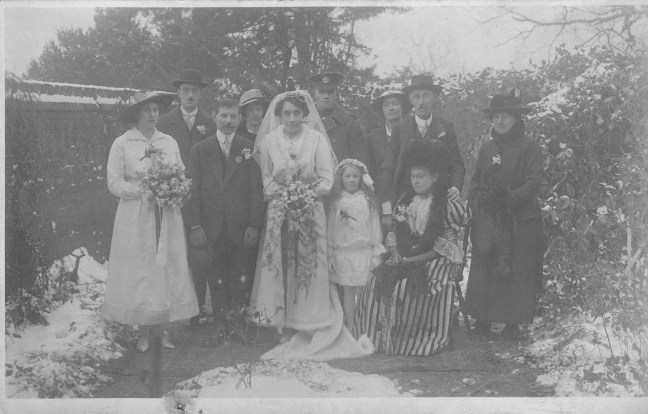
Emil and Rosina’s marriage with Rosina’s mother likely seated in striped dress, and Frederick Caplen standing behind her.

However they met, we know that Emil married Rosina Caplen on 31st January 1917 at St Mary, Kippington. He is not mentioned again until a brief report of his death by drowning in 1919. A full account of the story does not appear until three years later in an article in the Sevenoaks Chronicle on 15th September 1922.

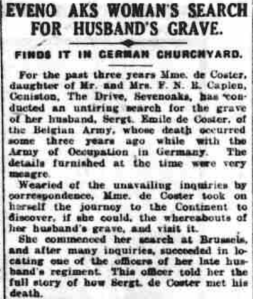
Entitled Sevenoaks Woman’s Search for Her Husband’s Grave, the article describes how Rosina, now Madame de Coster, had searched for three years for the grave of her husband, who had died while he was serving with the Army of Occupation in Germany.

img_2940

How the Chronicle reported Rosina’s search

According to the paper, after years of ‘unavailing inquiries’ as to the circumstances of her husband Emil’s death and burial place, Rosina travelled to Brussels to make inquiries in person. At Brussels she was able to trace and meet one of the officers of her late husband’s regiment who told her the full story of his death. He told her that

“Just after dinner, Sergeant de Coster went with others to the soldiers’ bathing pond. He had not been long in the water when he was seized with cramp. His comrades rescued him from the water and a doctor was called, but life was extinct. They buried him with full military honours in a pretty little churchyard at Rheinberg”.

Having learnt this, the intrepid Rosina set off for Rheinberg, some 400 miles across the frontier, she reached Cologne, where her impression was that “the British soldier rules”. In her words “The Germans are afraid of them“.  According to the paper

Everything she found to be fearfully expensive to the Germans, and the effect of the downfall of the Mark (it was 8000 to the £ during her visit) is illustrated by the fact that the journey from Brussels to Cologne, 2nd class, was only 2s in English money. “There were plenty of English people in Germany but it is difficult to bring anything out owing to the Customs”.

Following a further 12 hours train journey, Rosina arrived at Rheinberg and was able to visit her husband’s grave and met a German woman who had witnessed the funeral and was able to give more detail on his death and burial.

The paper concluded that Rosina’s one desire was to have her husband’s body returned to Sevenoaks for reburial and she was making an appeal to the Belgian War Office for this. Failing that, she wished her husband’s body to be returned for burial in his home town.

Rosina’s efforts were ultimately successful as Emil’s body was exhumed on 1st June 1923 and removed to Belsele for reburial.

Emil’s grave in Belsele

Some years later in January 1931, the  Chronicle reported that Madame de Coster was presented to Baron and Baroness Moschier the Belgian Ambassador and his wife, at a party given by the Society des Invalides at the Earl Haig Memorial Hall, Fulham, in memory of the Belgian soldiers who fell during the Great War. Later that year, in the November,  as the only known widow of a Belgian serviceman in England, Rosina de Coster laid a wreath at the cenotaph on behalf of the Belgian Federation.

Rosina continued to live in Sevenoaks and, as a singer and performer took part in many local productions and events. She lived on at her home ‘Coniston’ on The Drive, Sevenoaks,  until 1948, when she was buried in the family grave at St Nicholas.For many years, Rosina posted an In Memoriam notice in the Sevenoaks Chronicle in remembrance of her husband.

De Coster obituary

Rosina’s obituary in the Sevenoaks Chronicle

Rosina and Emil’s story was recently bought to life in a play by Lisa Whitbread, premiered at the Stag theatre in Sevenoaks in November 2018. He is also remembered on his home town by Ann Pieters, a historian of the Great War in Belsele.