The Headmaster’s son: Captain George Heslop at the Somme

George Henry Heslop

Captain, Duke of Cambridge’s Own (Middlesex Regiment)

George Henry Heslop is the fourth of the five Sevenoaks men who died on (or whose death was officially recorded as having occurred) on the first day of the Battle of the Somme.

He was the son of the Headmaster of Sevenoaks School, also George and his wife, Gertrude. Born in Sandbach, Cheshire in April 1895, the 1901 census shows the family living at the School, with George living with his three sisters, Margaret, Evelyn and Faith.

George had prepatory lessons at his father’s school until he was sent to Lancing College, where he was in Olds House from September 1910 to July 1914. He was a member of the Officer Training Corps where he achieved Certificate A. He was in the Cricket XI from 1911 to 1914 being Captain in 1913 and 1914.

He topped the batting average in all his summer terms, scoring 981 runs in his time at Lancing, finishing the 1914 season with an average of 89.

He also bowled, taking nine wickets for fourteen runs against Eastbourne College in 1913 and finishing the years 1913 and 1914 as the school’s highest wicket taker also being second in the bowling averages for both years. Consequently, he was described by Wisden as being “the most promising young all rounder who had yet to appear in a first class match”.

He was also a member of the Football XI from 1911 to 1914 and was Captain from 1912 to 1914. He was appointed as a Prefect in 1913, won his sports colours in 1912, 1913 and 1914 and was Victor Ludorum in 1914.

He won a place at Trinity College Cambridge in 1914 but did not take it, due to the outbreak of war, choosing to join the army instead. On the 11th of September 1914 he enlisted at 24 St James Street, London as Private 433 in the Public Schools Battalion of the Middlesex Regiment.

He was commissioned as a 2nd Lieutenant in the 16th Battalion on the 29th of September 1914, was promoted to Lieutenant on the 25th of January 1915 and to Captain on the 17th of May 1915.He attended Staff College for a month and qualified as a first class instructor of musketry.
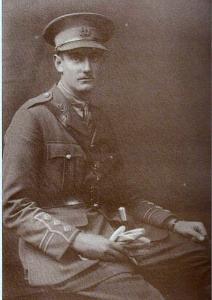
IMG_0892Captain George Henry Heslop

By November 1915 he was at the front where he saw action at the Hohenzollern Redoubt.

On the 26th of January 1916 the Germans attacked across the old Loos battlefield and the 16th Middlesex were called upon to re-enter the front line (they had been resting) to support a battalion of the King’s Royal Rifle Corps. On the morning of the 28th of January the Company Commander of B Company, Major Way, was moving along the front line trench with Captain Sholto-Douglas and the company runner. Shortly behind them was George Heslop leading a group of men of roughly platoon strength. Suddenly a heavy barrage fell on the group killing the two officers and wounding Heslop and a number of others.

He returned to his unit shortly afterwards when he spent much time involved in the reorganisation of his battalion after the losses they had suffered during the fighting at Loos.

He was put forward for promotion to Major but this was turned down on the grounds of his age and of insufficient experience. He attended a number of courses in bombing and machine gun practice and was appointed to the staff at his Headquarters.

He took part in a number of raids in the three weeks before the opening of the British offensive on the Somme on the 1st of July 1916. His Chaplain wrote of his attendance at Holy Eucharist shortly before the attack.

In the early hours of the 1st of July 1916 the 16th Battalion Middlesex Regiment moved up from where they had been resting at Auchonvillers to assembly positions from where they would take their part in the opening attack. They were to join the rest of their Brigade in assaulting the German positions from the village of Beaumont Hamel to a position 100 yards to the west of the German trenches at the Hawthorn Redoubt. The Middlesex were to be in support of the 1st Battalion Lancashire Fusiliers and the attack would be immediately preceded by the explosion of a large mine under the Hawthorn Redoubt which would be the signal for the British advance to begin. D Company, led by Captain George Heslop, would be on the left of the battalion’s advance and would take a Stokes Mortar with them.

They reached their assembly positions by 3am and by 6.25am the British artillery had become intense as zero hour approached. At 7.20am the mine under the Hawthorn Ridge exploded and at 7.30am the British advance began. The Middlesex followed at 7.55am, D Company quickly formed up into ranks, described as “parade ground straight”, and moved forward.

As they crossed no man’s land their ranks were swept by intense machine gun fire and men began to fall immediately. German artillery also joined the retaliation and began falling on the front line and support trenches adding to the enormous casualties.
The attack quickly faded under the weight of fire with the few survivors going to ground to seek cover from the relentless fire. But most had died in the two hundred yards between the British front line and the edge of the Hawthorn crater, including George Heslop.

By the end of the day the battalion had suffered 3 officers killed, 10 wounded, 5 missing with 6 more officers missing believed killed. Among the other ranks 19 were killed, 306 were wounded, 37 were missing believed killed and a further 138 were missing.

One of his men wrote that he advanced that day “not minding the shells and bullets, but just leading us on as if nothing was happening“.

His Colonel wrote of the love felt for him in the regiment, of his rapid promotion and that of the 24 officer casualties on the 1st of July and that “no one’s death would be more deeply felt”.


In order to establish what had happened to George Heslop a number of statements were taken from members of his battalion who were present that day.

On the 25th of October 1916 a statement was taken from Sergeant 1217 H.G. Valentine while he was in No. 11 General Hospital at Etaples. Valentine had been with the battalion signalling section that day

“I started out with the Colonel, but got separated from him and found myself with Captain Heslop who was in charge of the Pioneers. By his order, we lay down by the wire and advanced about 100 yards. Then we saw him drop down. At first we thought he was giving the signal to halt, but as he lay still, we concluded that he was dead and continued on, leaving him there. Later we retired and reported to the Colonel. Search parties were sent out, but could find no trace of him”.

A statement from Sergeant 1443 A. Butler, D Company was taken while he was at 5 Southern General Hospital, Faucett Road, Portsmouth

“Informant states that on 1st July or July 2nd at Beaumont Hill Capt. Heslop was seen lying dead just outside our parapet by L/Cpl Sephin, who told informant that he had examined Capt Heslop and had found him to be dead. Informant was lying out wounded for three days in this part of the line and said that the Germans were picking up and taking in many of our wounded, but as he was told that Capt. Heslop was lying nearer to our parapet than that of the Germans he did not think it likely that they had taken him in”.

The date of death was accepted for official purposes as having occurred in action on the 1st of July 1916.

Heslop’s family received a telegram informing them of his death on 6th July. His devastated father wrote to a in a letter to a parent

“My boy was killed on 1st July in the first ten minutes of the great push. There is nothing to say. He had a duty and it was done”.

image

imageGeorge Heslop senior’s letter describing the loss of his only son

Later in the war, in November 1917, Heslop wrote to another parent

“The war is very cruel. By our post yesterday I heard of the deaths of two more old boys. We schoolmasters have suffered. For though our boys are not of our blood they become very dear to us and something more than friends”.

imageGeorge Heslop senior

Over three hundred Old Boys of Sevenoaks School fought during the war with around forty being killed.

George Heslop’s body  was  recovered, identified and buried in 1917 and in another letter his father wrote

“I have just had a letter from the Front giving me a full account of the finding and burial of my boy”.

Captain George Heslop is buried at Hawthorn Ridge Cemetery and commemorated on the war memorial in the chapel at Trinity College Cambridge and with a memorial plaque inside the church at St Nicholas, Sevenoaks.
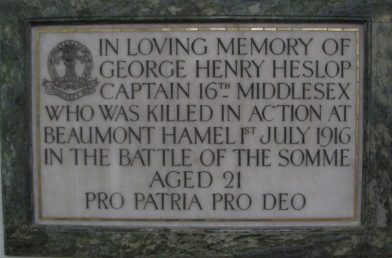
IMG_0345Memorial to George Henry Heslop at St Nicholas Church

The Sussex Daily News recorded another memorial to Captain Heslop on October 28th 1916

“In memory of Captain G.H. Heslop, Middlesex Regiment, who fell in action last July, and who was very prominent in athletics at Lancing College, an anonymous gift has been provided, by means of which a cricket bat will be presented annually for the best individual performance in the Brighton College match”.


My thanks to John Hamblin on behalf of Lancing College and Mrs Sally Robbins, archivist at Sevenoaks School, for their collaboration and permission to use some material published elsewhere.



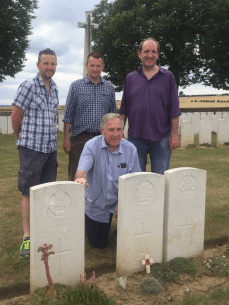
Remembering the Sevenoaks Anzacs; a visit to the war graves

I’ve written before about some of the Sevenoaks ANZACS. In particular,  George Marshall and his friend, Arnold Jarvis, who emigrated to Australia together in 1912, possibly with another friend, Kenrid Horace Davey. Tina and Robert Higgs are related to Arnold Jarvis and were the first relatives of a man named on the Sevenoaks War Memorial that I met on a glorious summer day in August 2014 when we held a special service at the memorial to remember the outbreak of war, one hundred years to the day. At the time, I hadn’t found any relatives of Arnold’s friend George Marshall and so, during the ceremony, Tina lay a cross to remember George as well as one for Arnold. Since then I’ve been very pleased to meet Tim Marshall, George’s Great Nephew and we’ve all exchanged emails. Tina and Robert have recently visited a number of family First World War graves and have written an account of their visit, including a trip to George’s grave.

Screen Shot 2016-05-10 at 17.33.14

It’s always special for family members to visit the graves of their relatives and I’m pleased to share Tina’s account of their trip in memory of both friends and the sacrifice they made:

My husband and I have recently returned from visiting the WW1 graves in France and Belgium of six of our great-uncles, plus the best friend of one. This was something we had been intending to do for several years and at last we were on our way.

We travelled from our home in Peterborough to France via Eurotunnel, and stayed for a week at a gîte just south of Lille. This was a fairly central location, with the furthest cemetery being 1 hr 10 mins away and the nearest 30 mins. We visited two memorials at Thiepval and Loos (Dud Corner) and five military cemeteries at Bulls Road, Dozinghem, Carnières, Calvaire (Essex) and Dernancourt. The smallest, with only 54 headstones, was in the picturesque village of Carnières and the largest, commemorating over 72,000 men, was Thiepval. The cemeteries were of similar appearance in their design, with a Great Cross, Stone of Remembrance, Grave Register and Visitors’ Book. The book and register were stored in an unlocked metal box in the wall, but there was never any sign of vandalism or graffiti. The cemeteries were all immaculately kept.

Two of the men are remembered on the Sevenoaks War Memorial – Arnold Jarvis and George Marshall. They were best friends who emigrated to Australia in 1912, no doubt full of excitement and optimism for their new lives. They enlisted in the Australian Infantry Force and ended up in France, where they died.

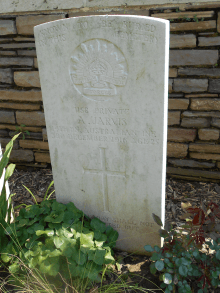
image

Headstone of Arnold Jarvis

image

Headstone of George Marshall

Another great-uncle, Harry Underwood, is remembered on the Knockholt Memorial. The family lived in Star Hill Road, Chevening, where his father was a gamekeeper.

At Dozinghem we met a young Belgian couple who told us that they often visit the cemetery and feel much love and respect for the men who lost their lives there. This was so heart-warming to hear.

At each grave we laid a small wooden cross and said a prayer. We left for home feeling reassured that our loved ones are at peace and not forgotten.

Since Tina’s visit, further research has led to the discovery of extracts from two letters that Arnold sent home during the war, to the Reverend Thompson at St Mary’s, Kippington, Sevenoaks, which were published in the parish magazine, the first in Spring 1915.

Ulysses. – here I am, really a soldier at last. This is a family large boat, and it is carrying (number censored) of us fellows: we all belong to the 4th Australian Infantry Brigade. None of us have the faintest idea as to our destination, whether it will be England or Egypt. We have just passed Aden and the voyage has been magnificent. we are getting 5s. a day, and 1s. a day deferred pay, and we all put in about ten weeks hard training before we came on board. I am sorry that I must not tell you much of our doings yet, but if we come to England and get a day or two off, of course I shall come up to the Vicarage to see you all. I have not been sea sick and I am quite happy. Do wrote to me often.

A later extract is introduced in the magazine with the news that after 12 weeks silence, a letter had arrived from Arnold, who had been wounded at the Dardanelles and had written from hospital in Egypt.

Heliopolis Hospital

June 8th

I received a slight wound in my leg, it is nothing in itself, but poison or something has got in so I cannot put my foot to the ground, however I hope soon to be out of this, although I am getting very good treatment. We had a very rough time of it for six weeks, with two days in the trenches and two days out all the time. Our Company lost nearly all its non-commissioned officers and several officers before we had been in the firing line an hour. It seemed awful at fist to see ones own friends being shot dead all round you, but afterwards everything seemed natural. I had several very marvellous escapes – in the first half hour a machine gun was turned on us and we had no trenches then, one bullet took a piece out of my trousers and another hit me in the jaw and took half a tooth out, another made a furrow in my leg and I had a piece of shrapnel in my back. I shall never forget it if I live another two centuries. There is a great fascination about it all and I am longing to be back, it is a nuisance to be lying here when there is so much to do, and I want to get back to my pals.

Update: July 2017

Tim Marshall and his three sons, Stuart, Doug and Gary, visited the grave of George Marshall on the centenary of his death on 13th July and later visited the grave of Arnold Jarvis, meaning that both families have now visited the graves of the two friends. A few weeks earlier, Stuart and joined me at the annual ANZAC service at Westminster Abbey to remember his uncle.

image

Tim Marshall with his sons at the grave of their Uncle George

Westminster-Abbey-ANZAC-Day-2017-018

Stuart Marshall and Matthew Ball on ANZAC Day


An officer of The Buffs -another story from the first day of the Somme

Edouard Herbert Allan Goss, 1877 – 1916

Temporary Lieutenant, 7th Battalion, The Buffs East Kent Regiment

In this second post on Sevenoaks men killed on the first day of the Battle of the Somme, I focus on one of the three officers from the town killed that day.

Edouard H A Goss was born in Burma on 13th June 1877, the son of Louis Allan Goss, Inspector of Schools in Burma and his wife, Marie Leonie Goss.

The 1891 census shows Edouard living at 4, Oak Field Grove, Bristol, with his mother, and siblings: Leo, Clement, Cecil and Marie. Aged four, Marie, is the only one not to have been born in Burma. Edouard’s mother was born on the French Colony of the Isle of Bourbon in the Indian Ocean, east of Madagascar, now known as Reunion Island

Edouard was educated at Clifton College 1889 to 1895 and lived in Bristol until around 1901, leaving for Burma in 1902 where he worked in the Burma Forest Service, and was a member of the Burma Bombay Trading Association. He returned to the UK in November 1905 and by 1911 was resident at 20 Brookside, Cambridge with his parents and sister, Marie, while working as an assistant in the timber business.

His application for a temporary commission, dated 17th November 1914, showed that he could ride and had served for approximately five years with the volunteer rifles. He applied to serve with any Kentish unit. The officer who interviewed him at Maidstone wrote that “He is 37 years of age but should make a very good officer” He gave his present address for correspondence as Fig Farm, Sevenoaks, which he had run for some time. On joining up he passsed responsibility to a manager and thereafter stationed himself at the Royal Oak Hotel in Sevenoaks when on leave.

He was gazetted Second Lieutenant in December 1914 and was stationed at Purfleet for some time before being posted to France in October 1915. He was later Mentioned in Despatches. He was last on leave in May 1916, returning to the Front on 16th May.

Edouard was killed on the first day of the Battle of the Somme. Some service records survive and show that he was killed instantly by a shell. His friend, Captain Kenchington, later recorded the incident.

“REPORT BY CAPTAIN A.G. KENCHINGTON “B COMPANY”
ON OPERATIONS OF 1st July 1916

1. TWO PLATOONS DETAILED TO TAKE CRATER AREA

Before “Y” day I had collected and stored in No 10 sap necessary bombs and apparatus. I had put notice-boards directing runners to this point at the end of all saps trenches in the crater area.

At Zero (07.30), the three sections of each platoon advanced as arranged round to flanks and the other two sections with snipers went over the craters which were very muddy.

The left hand party entered the enemy trenches with only one casualty, the platoon commander Lieut E.H.A.Goss who was killed instantly by a shell. This platoon found the rear portion of the crater area quite knocked out of recognition, and soon overcame two
bombing parties and three or four snipers who opposed them”.

In the book Historical Records of the Buffs 1914-1919 by RSH Moody, published in 1922 it says

The Carnoy mine craters took six hours to clear, and six hours very heavy fighting it was, carried out under 2nd Lt Tatam whose excellent work was rewarded by a M.C. C Company was soon called away to aid the East Surreys, as were later two platoons of A Company. In fact, these two platoons of A, together with one of C Company, under Lts Dyson and Budds respectively, reached the final objective and held that part of it allotted to the East Surrey Regiment until relieved by other troops. Again it became necessary about noon to send up half of D Company to make good part of the final objective of the 7th Queen’s. This was done successfully, but the company lost its commander Capt GT Neame, during the operation.

There is no doubt that during the whole operation, which was carried out more or less as planned, our troops encountered far more oppostion than was anticipated; particularly was this the case at the craters, to attack which only two platoons were originally assigned, a number of men quite inadequate. The whole position, indeed, proved to be a very strong one, consisting of four lines.

The batttalion lost the following casualties on this day:

Killed:

Capt G T Neame, Lts P G Norbury and E H A Goss and 2nd Lt J F Baddeley and 48 other ranks.

Edouard Goss was initially buried on the Carnoy Montauban Road but after the war his body was exhumed and reinterred in Danzig Alley British cemetery, Mametz, East of Albert, France.

In a brief obituary, the Sevenoaks Chronicle recorded that

He was very highly respected by all who knew him, embodying as he did, the finest qualities of a typical English gentleman.

He is remembered on the Bombay Burma Trading Corporation Memorial, in the cathedral of the Holy Trinity, Rangoon, Myanmar. He is also remembered on the Riverhead memorial as well as the nearby Sevenoaks War Memorial at The Vine.