‘For gallantry and leadership’ – the story of Jack Whyntie MC

Cyril John ‘Jack’ Whyntie was an early recruit to Kitchener’s Army and had a successful career throughout the war. Clearly earmarked as a promising recruit, his bravery was to win him the Military Cross in the last year of the war.

Cyril was born on 5th October 1894 in Kentish Town, London, to William Whyntie (1860-1948) a draper originally from Scotland, and his wife, Annie Frances (1867-1938).
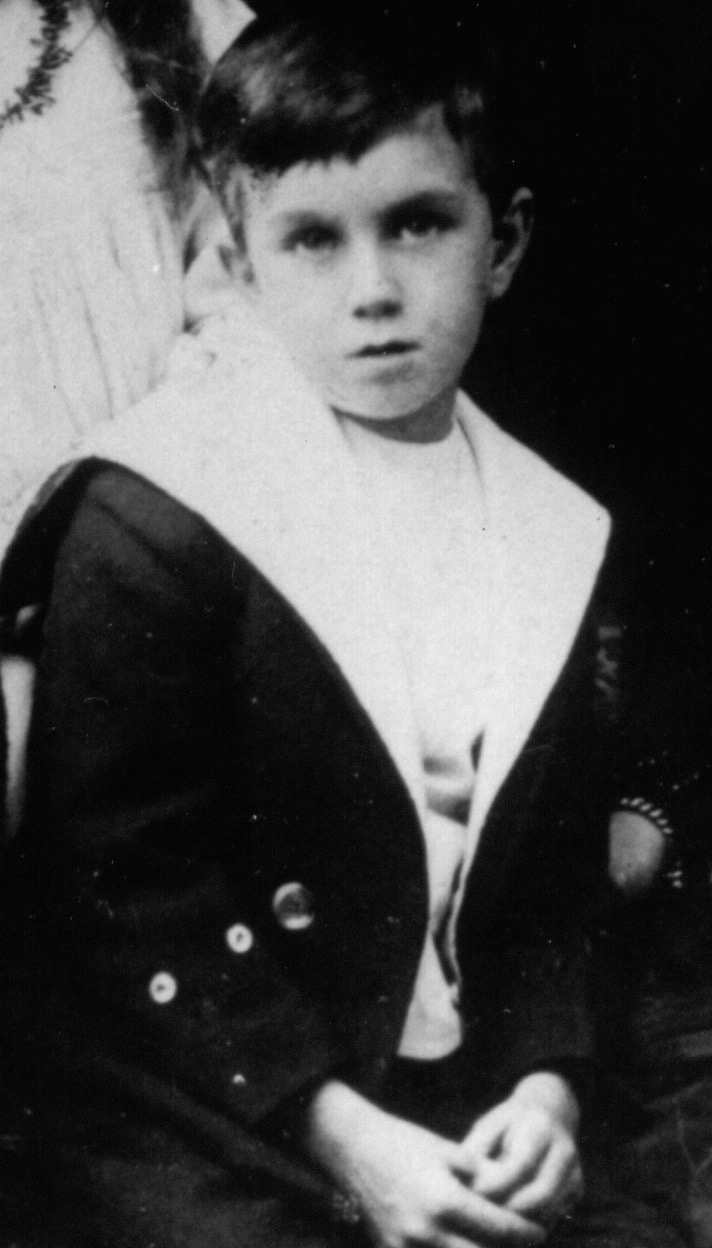
imageA young Cyril John ‘Jack’ Whyntie

By 1901 the family were living in Sevenoaks at 118, High Street. That year’s census shows William working as a draper’s manager and living with his wife, sons Jack and Fred, and daughter, Olive. Thirteen servants were also listed as residing at the premises.

By 1911, Jack was listed as an apprentice draper and the family now included two other daughters, Doris and Kathleen. Including servants and a companion to his wife, William Whyntie’s sizeable home of fourteen rooms housed fifteen people, including the appropriately named Bertha Draper, sister of Frank Draper who was killed in 1917 and is remembered on the Sevenoaks War Memorial.

image

imageViews of Whyntie & Co. in the High Street, Sevenoaks

The family were Wesleyans and William Whyntie often preached and involved himself in church business. Cyril had been educated at Avenue House School, Sevenoaks, followed by the Judd School in Tonbridge. After leaving he had been apprenticed as a draper to Frank East of Tonbridge. Like many Sevenoaks men, shortly after the outbreak of war he enlisted at Tunbridge Wells on 4th September 1914 where he was assigned to 7th Battalion The Queens Own Royal West Kent Regiment, one of the new regiments composed of recruits who answered Lord Kitchener’s appeal for volunteers. His papers show that he was 5 10 & 3/4 tall with grey eyes, brown hair and a fresh complexion.
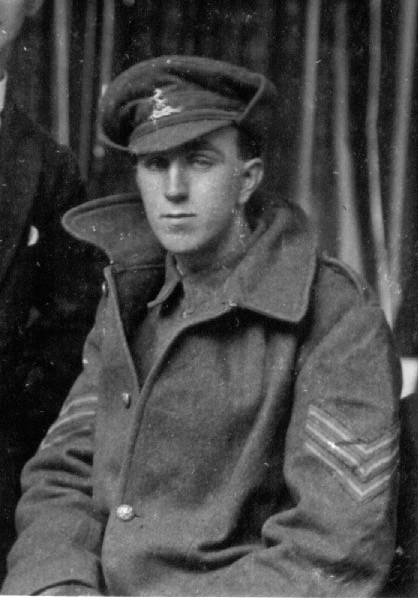
imageSergeant Jack Whyntie, Royal West Kents

By the time Jack was sent to France with his battalion in July 1915 he had been promoted from lance corporal to corporal,  lance sergeant and then sergeant. As a sergeant in 7th Royal West Kents, Jack saw action in the early days of the Somme and was present at the capture of  Trones Wood, where three other Sevenoaks men, Fred Gilks, Lawrence Bowles and James Pettitt, all in Jack’s battalion, lost their lives on 13th July 1916.

imageJack Whyntie, taken at the Essenhigh Corke Studio, Sevenoaks

Jack Whyntie’s records show that he remained at the front until February 1917 when he returned home for four months. Perhaps it was during this period of leave that he sat for local photographer, Charles Essenhigh Corke, whose firm was situated on the London Road. The Essenhigh Corke studio had offered free photographs to serving men, and many locals, as well as men who were stationed in the town, took advantage of the offer. In 2008, five hundred glass plate negatives were found in the former studio. These, including Jack’s portrait, were digitised and put on public display before being housed at the Kent County Archives in Maidstone.

In 1917 while still a serving sergeant in B Company of the 7th Royal West Kents, Jack applied for a temporary commission, which he received in the June, being gazetted as a temporary Second Lieutenant in 8th Battalion East Surrey Regiment.

A few months later in October 1917, the Sevenoaks Chronicle reported that Jack had been wounded

‘in the big advance, last Friday, October 12th. Going over the top – during which operation all his senior officers were hit – it fell to Lieut. Whyntie’s lot to lead his company on in the advance until he, too, was hit by shrapnel some distance on. Lt. Whyntie is now lying in a hospital at the Base, suffering from shrapnel wounds in the thigh’.

The incident was mentioned in the battalion war diary

The barrage started at Zero mins four minutes by Brigade time, and appeared fairly intense, but machine gun fire was immediately opened from guns posted close to our tape, which was not touched by the barrage at all. Second Lieutenant C Whyntie, the sole remaining Officer of ‘D’ Company, was wounded at once…

In its November 23rd edition the Chronicle was able to report that Jack had sufficiently recovered to be able to rejoin his regiment.

On 4th April 1918, Jack was again injured, this time at Villers-Bretonneux on the Somme. Once again the Sevenoaks Chronicle reported news of his injury, stating that on this occasion he had been wounded by a bullet in the arm. Jack was sent back to England where he was treated at the 5th Southern General Hospital before being transferred to a convalescent home for officers. By June 1918 a Medical Board concluded that he had regained perfect movement in his shoulder and was fit for general service.

image

Jack Whyntie’s Military Cross, still in family ownership

Later that year, by now serving as Acting Captain, he was awarded the Military Cross, according to the citation

For conspicuous gallantry and leadership near Ronssoy on the 18th September, 1918. He held his company well together in the dense mist and kept them straight on their objective. Owing to the failure of troops in front to take the Green Line the company soon found itself in the front line and met with heavy machine-gun fire. He at once extended his company and pushed on, thereby gaining two thousand yards of ground and reaching the Green Line.

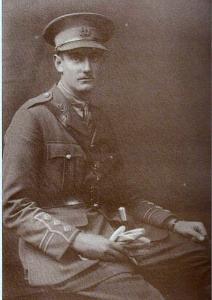
imageJack as a captain in the East Surrey Regiment

After the armistice, Jack continued to serve, for a time in the army of occupation, before he returned to the family business where he became a director and settled in Sevenoaks with his wife, Helen, and two children, Barbara (born 1923) and Brian (born 1925). A popular businessman, local resident and a keen follower of cricket, he was often seen watching a match at the Vine ground which overlooks the war memorial.
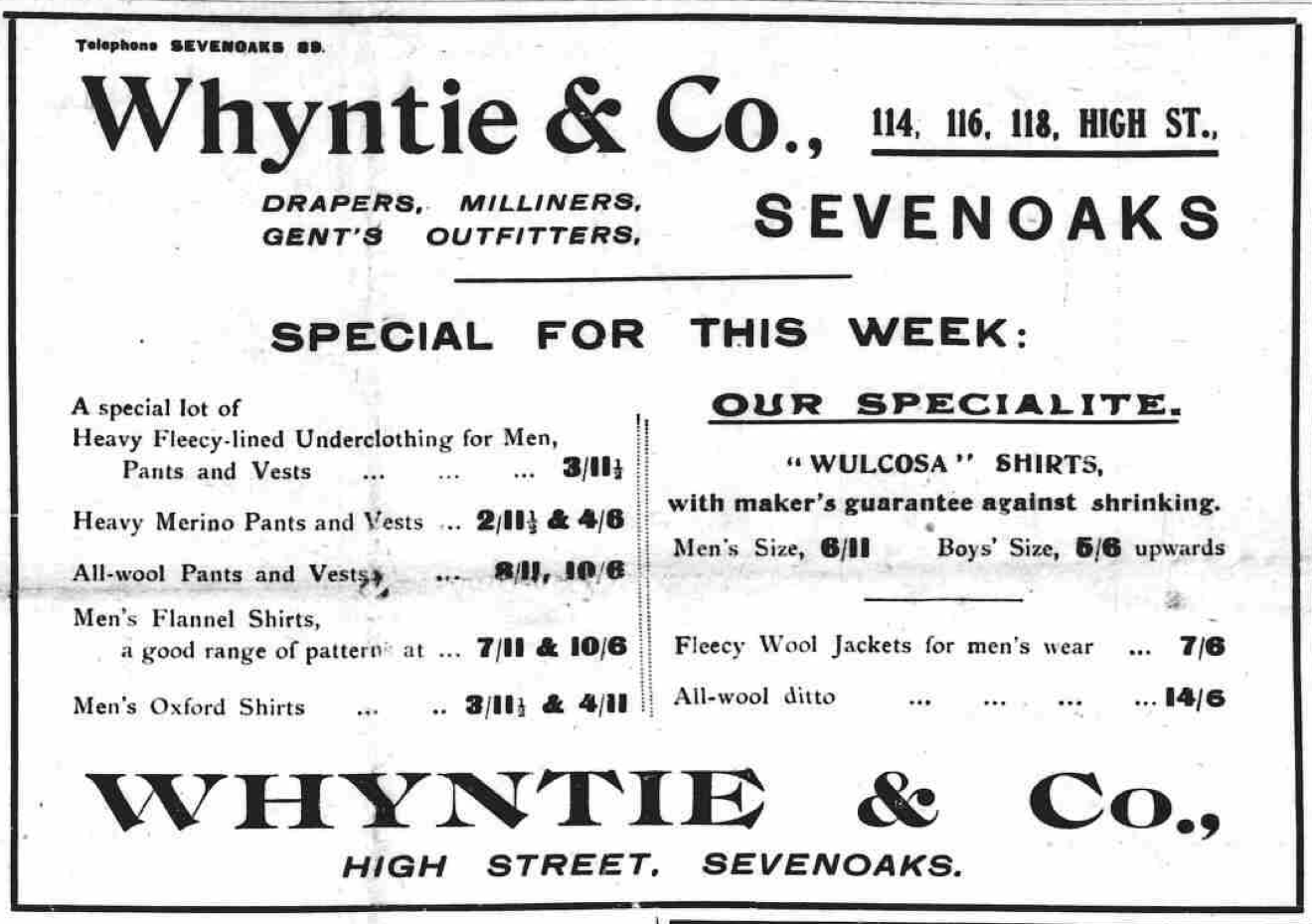
imageAn advert for Whyntie & Co, Sevenoaks Chronicle, 1922

Jack Whyntie was taken ill suddenly when preparing to close the shop one Thursday evening in 1935 and died of meningitis on his forty first birthday on the following Saturday 5th October. He was buried in Greatness Cemetery. His brother Fred, who had served as an Air Mechanic during the war, survived him by only two years, dying in 1937, followed the year after by their mother, aged seventy one. William Whyntie, the patriarch of the family, lived on until 1948 when he died aged eighty eight and was survived by his daughters and grandchildren.
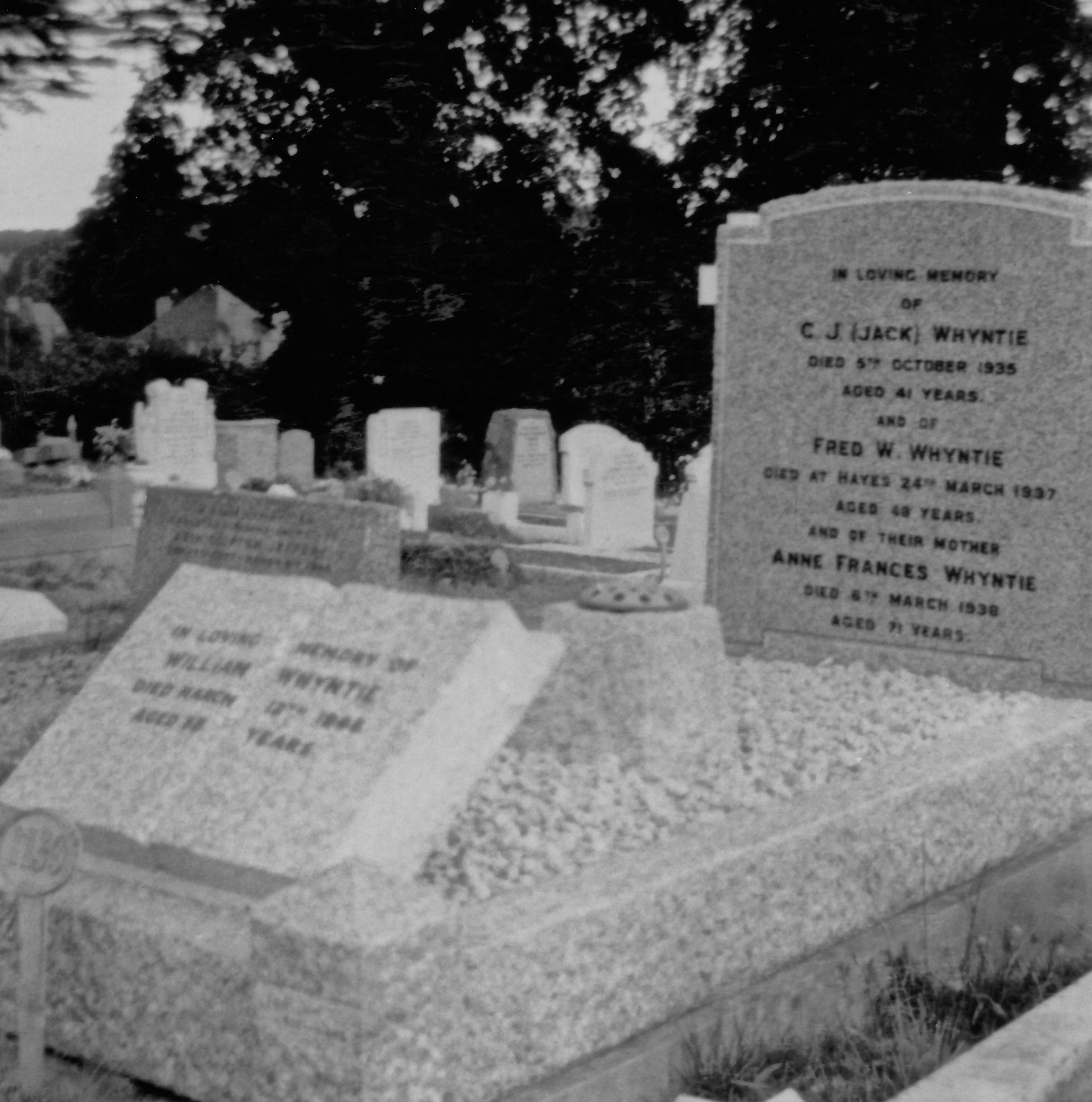
imageThe family grave at Greatness Cemetery

I am grateful to Jack Whyntie’s Great Nephew, Adrian, for sharing information and some splendid photos of his Great Uncle.

‘I can only say that his men loved him’: Geoffrey Harrison on the first day of the Somme

Second Lieutenant Geoffrey Harrison, Machine Gun Corps

Geoffrey Harrison is the fifth and last of the Sevenoaks men that were killed on the first day of the Battle of the Somme. His great nephew, Sir Michael Harrison, still lives in Sevenoaks and has written this account of the life of his great uncle, which is included in my book on the war memorial.

Geoffrey Harrison, my paternal great uncle, was born on 8th April 1896. His father was Bernard Bowles Harrison and his mother was Elizabeth Anne Harrison (nee Franks). In the 1901 Census, Bernard Bowles Harrison was described as a Master Printer. At the time of that Census, the family was living at ‘Hurstdale’ in Granville Road, Sevenoaks, a house which was built sometime between 1890 and 1896 and which is still standing today. The family at that time included Geoffrey’s older brother Bernard Guy (my grandfather, who later became Sir Guy Harrison), who was fifteen at the time, and his two sisters Winifrid Madge, then aged thirteen, and Elsie, then aged twelve. Geoffrey was the youngest, aged four. Guy Harrison married Cicely Vicat, sister of Horatio John Vicat and Frederick Holland Vicat, who are also remembered on the Sevenoaks War Memorial.

Geoffrey was educated initially by Miss Webb in Granville Road, Sevenoaks. He then went to a prep school called Beechmont in Sevenoaks where he was captain of the school. After that, he went to Rugby School in 1910. He left Rugby School in 1914 to go to University College, Oxford but shortly thereafter, on the outbreak of war, he enlisted in the Public Schools Brigade. Documents at that time record that he was 6’ 2 inches tall and weighed 160 lbs. He was described as having a fair complexion, blue eyes and blond hair.

In December 1914, he obtained a Commission in the 12th Battalion of the Hampshire Regiment, transferring later to the 13th Battalion. On 21st December 1915, he was transferred to the Machine Gun Corps (Infantry), and in April 1916 he left for the Front.

Screen Shot 2016-06-28 at 11.08.54Second Lieutenant Geoffrey Harrison

He was killed only a few months later on 1st July 1916 on the first day of the battle of the Somme (there is a telegram from the Army Council to his father dated 9th July informing him that Geoffrey was killed on 2nd July but that was corrected in a later document dated stating that there had been confusion between officers of the same name and confirming that Geoffrey had been killed on 1st July 1916).

The circumstances of his death were that he was leading his Section in ‘No Man’s Land’ at Contalmaison when he received a wound in the thigh. He gave instructions to his NCO to push on, when a shell burst and killed him. He was aged twenty.

Eleven days later a brother officer, GB Martin Scutt, wrote to Geoffrey’s mother.

My dear Mrs. Harrison,

‘I have been out of action ever since the first day of the attack, and only had my first news of the Coy. late last night, and with it the terrible news about Geoff. As you know we have been chums ever since we joined the Corps. and for the last six months have done everything together. Since we have been in France, whenever the officers had to be paired off for billets, etc, or an occasional day free, we two were together. This is a fairly stiff test of friendship, yet I can honestly say that no man could ever want a better pal, and throughout that close relationship I have never known him to say or do anything unworthy of the true Gentleman he always was.

Off parade and in Mess his classical allusions and quaint phrases kept us in constant good humour up to the last. He was everybody’s pal. On parade I can only say that his men loved him.

We said Good-bye to each other on the evening before the attack commenced at about 6.30 when he was in the best of spirits. As our sections were on opposite flanks I had no chance of seeing him during the action, and before we’d been moving a quarter of an hour I had a bullet through both lungs. I shall do my best to learn more details from those who were with him up to the last, if I get the opportunity – but I know there is only one way in which he could have gone out, and that is as a gallant officer and gentleman.

As I am sure you know, my sympathies go out in full to you and Mr. Harrison, and I feel much more than I can express.

If I succeed in learning anything that I think would interest you at all, I will let you know, or, when I am well enough, may I come and see you?

Until then, I remain,

Yours very sincerely,

G. B Martin Scutt

Geoffrey is buried in Ovillers Military Cemetery in the locality of the Somme.

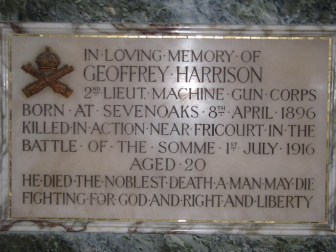
IMG_0346Memorial to Geoffrey Harrison in St Nicholas Church
There is a splendid plaque inside St. Nicholas’ Church, Sevenoaks, in memory of Geoffrey Harrison. It refers to him being killed in action near Fricourt in the Battle of the Somme on 1st July 1916, aged 20. ‘He died the noblest death a man may die Fighting for God and Right and Liberty’.

His name is also recorded on the Roll of Honour inside the church, as well as on the church War Memorial near the entrance to the churchyard. His name is also recorded on the Roll of Honour inside St. Mary’s Church, Kippington, Sevenoaks although not on the War Memorial outside.

The Headmaster’s son: Captain George Heslop at the Somme

George Henry Heslop

Captain, Duke of Cambridge’s Own (Middlesex Regiment)

George Henry Heslop is the fourth of the five Sevenoaks men who died on (or whose death was officially recorded as having occurred) on the first day of the Battle of the Somme.

He was the son of the Headmaster of Sevenoaks School, also George and his wife, Gertrude. Born in Sandbach, Cheshire in April 1895, the 1901 census shows the family living at the School, with George living with his three sisters, Margaret, Evelyn and Faith.

George had prepatory lessons at his father’s school until he was sent to Lancing College, where he was in Olds House from September 1910 to July 1914. He was a member of the Officer Training Corps where he achieved Certificate A. He was in the Cricket XI from 1911 to 1914 being Captain in 1913 and 1914.

He topped the batting average in all his summer terms, scoring 981 runs in his time at Lancing, finishing the 1914 season with an average of 89.

He also bowled, taking nine wickets for fourteen runs against Eastbourne College in 1913 and finishing the years 1913 and 1914 as the school’s highest wicket taker also being second in the bowling averages for both years. Consequently, he was described by Wisden as being “the most promising young all rounder who had yet to appear in a first class match”.

He was also a member of the Football XI from 1911 to 1914 and was Captain from 1912 to 1914. He was appointed as a Prefect in 1913, won his sports colours in 1912, 1913 and 1914 and was Victor Ludorum in 1914.

He won a place at Trinity College Cambridge in 1914 but did not take it, due to the outbreak of war, choosing to join the army instead. On the 11th of September 1914 he enlisted at 24 St James Street, London as Private 433 in the Public Schools Battalion of the Middlesex Regiment.

He was commissioned as a 2nd Lieutenant in the 16th Battalion on the 29th of September 1914, was promoted to Lieutenant on the 25th of January 1915 and to Captain on the 17th of May 1915.He attended Staff College for a month and qualified as a first class instructor of musketry.

IMG_0892Captain George Henry Heslop

By November 1915 he was at the front where he saw action at the Hohenzollern Redoubt.

On the 26th of January 1916 the Germans attacked across the old Loos battlefield and the 16th Middlesex were called upon to re-enter the front line (they had been resting) to support a battalion of the King’s Royal Rifle Corps. On the morning of the 28th of January the Company Commander of B Company, Major Way, was moving along the front line trench with Captain Sholto-Douglas and the company runner. Shortly behind them was George Heslop leading a group of men of roughly platoon strength. Suddenly a heavy barrage fell on the group killing the two officers and wounding Heslop and a number of others.

He returned to his unit shortly afterwards when he spent much time involved in the reorganisation of his battalion after the losses they had suffered during the fighting at Loos.

He was put forward for promotion to Major but this was turned down on the grounds of his age and of insufficient experience. He attended a number of courses in bombing and machine gun practice and was appointed to the staff at his Headquarters.

He took part in a number of raids in the three weeks before the opening of the British offensive on the Somme on the 1st of July 1916. His Chaplain wrote of his attendance at Holy Eucharist shortly before the attack.

In the early hours of the 1st of July 1916 the 16th Battalion Middlesex Regiment moved up from where they had been resting at Auchonvillers to assembly positions from where they would take their part in the opening attack. They were to join the rest of their Brigade in assaulting the German positions from the village of Beaumont Hamel to a position 100 yards to the west of the German trenches at the Hawthorn Redoubt. The Middlesex were to be in support of the 1st Battalion Lancashire Fusiliers and the attack would be immediately preceded by the explosion of a large mine under the Hawthorn Redoubt which would be the signal for the British advance to begin. D Company, led by Captain George Heslop, would be on the left of the battalion’s advance and would take a Stokes Mortar with them.

They reached their assembly positions by 3am and by 6.25am the British artillery had become intense as zero hour approached. At 7.20am the mine under the Hawthorn Ridge exploded and at 7.30am the British advance began. The Middlesex followed at 7.55am, D Company quickly formed up into ranks, described as “parade ground straight”, and moved forward.

As they crossed no man’s land their ranks were swept by intense machine gun fire and men began to fall immediately. German artillery also joined the retaliation and began falling on the front line and support trenches adding to the enormous casualties.
The attack quickly faded under the weight of fire with the few survivors going to ground to seek cover from the relentless fire. But most had died in the two hundred yards between the British front line and the edge of the Hawthorn crater, including George Heslop.

By the end of the day the battalion had suffered 3 officers killed, 10 wounded, 5 missing with 6 more officers missing believed killed. Among the other ranks 19 were killed, 306 were wounded, 37 were missing believed killed and a further 138 were missing.

One of his men wrote that he advanced that day “not minding the shells and bullets, but just leading us on as if nothing was happening“.

His Colonel wrote of the love felt for him in the regiment, of his rapid promotion and that of the 24 officer casualties on the 1st of July and that “no one’s death would be more deeply felt”.


In order to establish what had happened to George Heslop a number of statements were taken from members of his battalion who were present that day.

On the 25th of October 1916 a statement was taken from Sergeant 1217 H.G. Valentine while he was in No. 11 General Hospital at Etaples. Valentine had been with the battalion signalling section that day

“I started out with the Colonel, but got separated from him and found myself with Captain Heslop who was in charge of the Pioneers. By his order, we lay down by the wire and advanced about 100 yards. Then we saw him drop down. At first we thought he was giving the signal to halt, but as he lay still, we concluded that he was dead and continued on, leaving him there. Later we retired and reported to the Colonel. Search parties were sent out, but could find no trace of him”.

A statement from Sergeant 1443 A. Butler, D Company was taken while he was at 5 Southern General Hospital, Faucett Road, Portsmouth

“Informant states that on 1st July or July 2nd at Beaumont Hill Capt. Heslop was seen lying dead just outside our parapet by L/Cpl Sephin, who told informant that he had examined Capt Heslop and had found him to be dead. Informant was lying out wounded for three days in this part of the line and said that the Germans were picking up and taking in many of our wounded, but as he was told that Capt. Heslop was lying nearer to our parapet than that of the Germans he did not think it likely that they had taken him in”.

The date of death was accepted for official purposes as having occurred in action on the 1st of July 1916.

Heslop’s family received a telegram informing them of his death on 6th July. His devastated father wrote to a in a letter to a parent

“My boy was killed on 1st July in the first ten minutes of the great push. There is nothing to say. He had a duty and it was done”.

image

imageGeorge Heslop senior’s letter describing the loss of his only son

Later in the war, in November 1917, Heslop wrote to another parent

“The war is very cruel. By our post yesterday I heard of the deaths of two more old boys. We schoolmasters have suffered. For though our boys are not of our blood they become very dear to us and something more than friends”.

imageGeorge Heslop senior

Over three hundred Old Boys of Sevenoaks School fought during the war with around forty being killed.

George Heslop’s body  was  recovered, identified and buried in 1917 and in another letter his father wrote

“I have just had a letter from the Front giving me a full account of the finding and burial of my boy”.

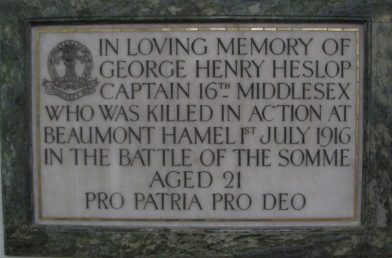
Captain George Heslop is buried at Hawthorn Ridge Cemetery and commemorated on the war memorial in the chapel at Trinity College Cambridge and with a memorial plaque inside the church at St Nicholas, Sevenoaks.

IMG_0345Memorial to George Henry Heslop at St Nicholas Church

The Sussex Daily News recorded another memorial to Captain Heslop on October 28th 1916

“In memory of Captain G.H. Heslop, Middlesex Regiment, who fell in action last July, and who was very prominent in athletics at Lancing College, an anonymous gift has been provided, by means of which a cricket bat will be presented annually for the best individual performance in the Brighton College match”.


My thanks to John Hamblin on behalf of Lancing College and Mrs Sally Robbins, archivist at Sevenoaks School, for their collaboration and permission to use some material published elsewhere.