After the introduction of the Military Service Act in 1916, many local men appeared before the local Military Tribunal to seek an exemption from service and could appeal decisions to the West Kent Tribunal in Maidstone. I’ve written about some of these stories in a previous post. Many of these men were seeking exemptions on health grounds, working in a reserved occupation work or family commitments.
In Sevenoaks, and across the country, some men refused to serve on religious grounds. As conscientious objectors they stated that they could not take another man’s life. The Act allowed for objectors to be absolutely exempted, to perform alternative civilian service, or to serve as a non-combatant according to the decision of the Tribunal.
Around 16,000 men were recorded as conscientious objectors: 4,500 objectors were sent to do ‘work of national importance’ such as farming, 7,000 were given non-combatant duties, and around 6,000 were forced into the army, and when they refused orders, they were sent to prison. However, cases regarding conscientious objectors formed only around 2% of Military Service Tribunals’ cases.
As most of the files for conscientious objectors were destroyed in the 1920’s, I have had to rely on newspaper reports for information. I would be very interested to hear from any relatives of who might have more information on these men and what happened to them and their families following their decision to take such a stand.
Stories from the Tribunal
In March 1916, Charles Edward Farrant, 26, of 42, Cobden Road, was a cowman employed by Mr Mond at Combe Bank, and applied for absolute exemption on religious grounds. His case was supported by his employer, who stated that he was looking after pure bred stock. His exemption was refused and he was recommended for non combatant service.
Harold John Mann was a 22 year old schoolmaster of Heatherleigh, Dartford Road, employed at the New Beacon School. Mann stated that the religious views he had been brought up with prevented him from taking life in any circumstances. He also had to support his mother. In his case a temporary exemption was granted for three months.
Leslie Frank Hoad was living a 2 Gilehurst Villas, Argyle Road and had been employed as a draper’s assistant, when he appeared before the Sevenoaks Tribunal in September 1916. The fact of his conscientious objection was accepted without argument and Hoad stated that he had given up his job to work on agriculture near Swanley to demonstrate that he was willing to do something of which the country had need.
 The Sevenoaks Chronicle reported Leslie’s appearance before the local Tribunal
However, the committee refused to grant an exemption. He subsequently appeared before the West Kent Tribunal in January 1917. This Tribunal granted him an exemption for three months, conditional upon him remaining in employment on the land. Leslie was working as a motor tractor driver when next reported as having been granted a further four month extension when he appeared before the county Tribunal again in July 1917.
Alfred Mannington Sayers appeared before the Tribunal in June 1916 and pleaded guilty to a charge of not reporting himself for military service. Detective Coley gave evidence against Sayers, stating that he declined to go because he was a conscientious objector. The defendant’s father, agreed that there was no doubt that his son was an absentee but argued that it was well understood that ‘the tribunals had not administered the Act’. The Chair denied this and highlighted the responsibility of the court to carry out the law; the defendant had been ordered to do something by a competent authority and had not done so. He went on to remark that
defendant might be a perfectly amiable young man and did not want to hurt anyone at all, not even his country’s enemies. The bench would accept that for him.
The court then imposed a fine of forty shillings and the defendant was handed over to a military escort.
De Barry Cox, aged 22, of 4, Barrack Corner, was another man arrested by Detective Coley for not reporting for military service on the grounds of conscientious objection. He was fined fifty shillings, which was to be deducted from his military pay, and handed over to the authorities.
 De Barry Cox served with the Non Combatant Corps
Jack Harbour a railway porter, of Greatness Terrace was similarly charged. Records for both Cox and Harbour survive, showing that each served subsequently served in the war with the Non Combatant Corps.
Herbert Sears was another conscientious objector who served with the non combatant corps. Sears had worked for the Rector of Sevenoaks, Revd. John Rooker, managing the rectory farm. He died in October 1918 of pneumonia and is buried in the churchyard at St Nicholas, together with his wife who died only days after her husband.
Harry Raven, 33, of Sunnyside, Clarendon Road, was the manager of a shirt making and hosiery business in Picadilly. Raven claimed to be
A true and consistent follower of the Lord Jesus Christ, whose commands he must obey. Thou shalt love thy God and thy neighbour as thy self
Raven was willing to do farm work, though he had no experience of it. The tribunal refused his case and recommended him for non-combatant service.
At the same hearing, James Samuel Bolton a married signwriter of Bradbourne Villas, Bradbourne Road stated ‘I hold it wrong to terminate human life unnaturally’.
Thousands, he added, were suffering innocently owing to the use of arms, which secured the victory to the stronger side, whether it was in the right or wrong. Bolton said that he was not a member of any religious body and pleaded that he was only able to keep himself, his wife, and family without being a burden to the community, and without being able to take part in philanthropic work. He remarked that he was not averse to agricultural, railway or police work. The tribunal refused the case and Bolton declared that he would exercise his right to appeal.
George Mullen appeared before the tribunal in June 1918. Mullen was the manager of a grocery business in St John’s for his employer, Mr Frank Rowley. Aged 44, he had been classified as grade 2 and his appeal had been supported by the Local Food Control Committee (by casting vote of the Chairman). A solicitor for Mr Rowley stated that he had had bad health for two years and had 700 registered customers for sugar. Mr Mullen had managed the business and been with him for 22 years. There were two other shops and the other manager was not fully qualified. It was revealed that Mullen was a member of the International Bible Students’ Association and conducted meetings at Tunbridge Wells. Mullen was questioned on the information that he had a son of eighteen serving in the navy, replying that he allowed his son to hold his own opinions.
Rowley’s solicitor argued that if Mullen were taken, the business would have to close down as he was not fit enough to run it on his own and he could get no one else capable to run it for him.The Tribunal dismissed the appeal but gave 56 days before call up in view of Mr Rowley’s condition.
Objectors at Greatness Farm
Many conscientious objectors worked on the farms in and around Sevenoaks. No doubt some of these men were local but others, such as thirty-six year old Walter Flexman, had been a manager and buyer in the books and stationary department at Hamleys store in London. Flexman had lived on Brondesbury Road, North London, but in 1916 was resident at 11, Bethel Road and working for Mr Wood of Greatness Farm.
Walter Flexman had been granted a conditional exemption from combat service only in August 1916 and was offered work on the farm from the September, at a rate of three shillings day. In that December he was required to apply for a renewal of his exemption, which was supported by his employer on the farm, Mr Wood, who stated that after three months, Flexman was a real help on the farm; to lose him would be to lose valuable experience and require time in training new workers.
 Walter Flexman’s employer supported his case for renewal of his exemption
Walter Flexman was granted a renewal. At around the same time, his employer, Mr Wood appeared before the local Tribunal in the case of a Mr Cheeseman, a worker on the farm. Cheeseman was described as a skilled farm labourer. Mr Wood stated that there were six conscientious objectors on the farm but they were not skilled farm hands and had taken the place of other men who had gone to fight.
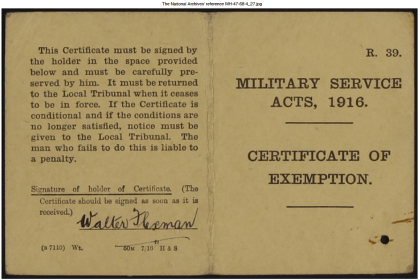 Walter’s certificate of exemption
A committee member asked how they men worked, to which Mr Wood’s reply was laughter and Mr Cheeseman was given a conditional exemption.
Local hostility
On the limited evidence available, the Sevenoaks Tribunal appears to have conducted its hearings in a business like way. Few men who appeared before it as conscientious objectors were granted complete exemptions. More often cases were dismissed and the applicant recommended for non combatant service. There is little evidence of local hostility toward conscientious objectors and their families but this must have existed. No doubt individuals and their families were ignored, given white feathers and viewed with suspicion by those whose friends and relatives were serving.
Public opinion generally viewed conscientious objectors with suspicion and disdain and the Sevenoaks Chronicle did occasionally carried criticism of conscientious objectors, from printing popular jokes to reporting the speech of the Earl of Denbigh when he visited Sevenoaks in January 1918.According to the Earl
We should spare no effort to make the women understand the things the Germans did. Let the women of Kent think about it, because probably they might be the first to feel it. If the British women knew and realised one quarter of the German ideas; they would see to it that no conscientious objector would dare to show his contemptible face in the public street.
Occasionally, the paper also printed criticism of objectors from serving soldiers. Rifleman H Woodfine from Hither Green, wrote a letter from Salonika in June 1916, which was printed in the Chronicle (the writer’s link to Sevenoaks is not noted). Woodfine wrote
The boys are making huge fun of the conscientious objector. In the times of Nelson and Wellington, such people would be shot. They ought to go and see places like Mons, Ypres, Louvain, Rhiems, and Alsace. I think this would alter their attitude.
After the Armistice, a concerned parent wrote to the paper, indignant at the thought that the rights of conscientious objectors would be put before those who had served.
Dear Sir
I saw in your last issue an appeal from one of the Territorials in India. I myself have a son serving there, who has been away for the past four years and a half, and who is anxious to return. The idea of releasing conscientious objectors before the man who has done his duty! I hope this will meet the eyes of those who shouted for the men to join! Are they still shouting to get them released?
Yours faithfully,
A DISGUSTED PARENT
Conscientious Objectors were still viewed with suspicion after the war and were not allowed to vote until 1926. However, many of the objectors from Sevenoaks appear to have carried on living and working in the community after the war. George Mullen took over his former employer’s shop when Frank Rowley died in 1922. During the Second World War, Alfred Sayers published a collection of poetry – Poems of 20 years, that the Chronicle featured prominently, which suggests that by then he was viewed as a respected member of the local community.
It would be interesting to hear from anyone with more information on any of these men who took the difficult and principled decision not to fight.




 Sevenoaks WW1